Arranging a Funeral in the First Week? The Order the Decisions Actually Have to Come In
A plain sequence for the first seven days after a death: what has a real deadline, what only feels urgent, and how to tell the difference while you are standing at the desk.
- Written by
- Roy Castellano
- Published
- Filed under
- Family
- Length
- 1,127 words, about 5 minutes
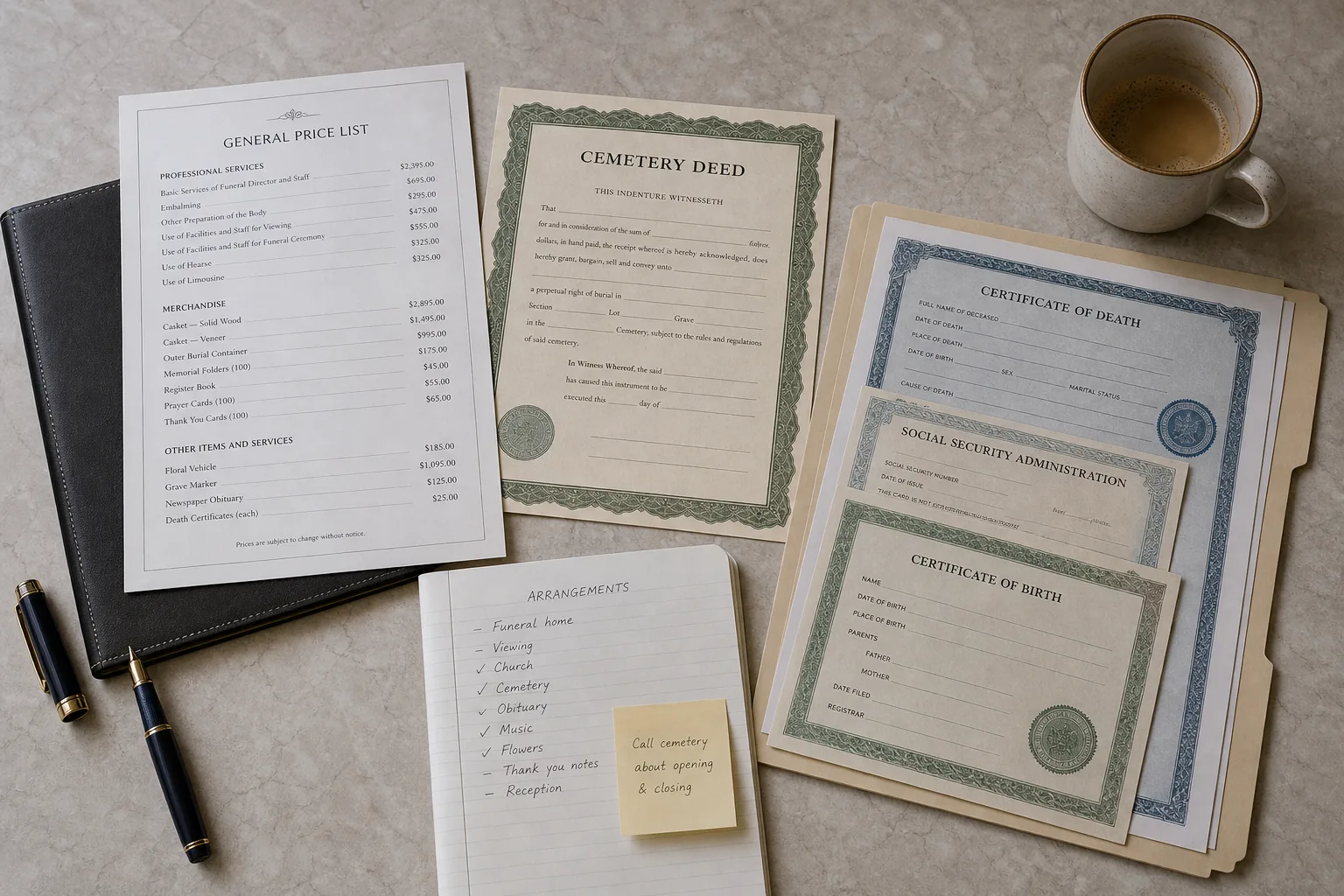
The first week after a death is arranged backwards from the reader's point of view. You arrive at a funeral home having made no decisions, and within ninety minutes you are being asked about twenty of them, in an order set by the paperwork rather than by what matters to you. Most of the regret families describe later comes from that mismatch. Not from being cheated. From answering questions in the order they were asked.
The fix is unglamorous. Learn which decisions carry a genuine deadline, which ones only sit next to a deadline, and which ones were never a first-week decision at all.
There is not one clock. There are four.
Families talk about the funeral as a single event with a single date. The arrangement desk is tracking four separate timetables, and they move at different speeds.
- Care of the body. This is the only true immediate decision. Someone with legal authority has to authorize transfer from the place of death. That is a phone call and a signature, not a plan.
- The death certificate. A physician or medical examiner must certify cause, the funeral director files it, and the state or county registrar issues certified copies. Everything financial downstream (banks, insurers, title transfers, pensions) waits on this.
- The disposition permit. Burial or cremation cannot legally proceed until the filing is complete. A delay here is usually a signature elsewhere in the system, not anything you did.
- The gathering. Service, visitation, reception. This is the clock everyone feels, and it is the only one of the four you fully control.
Keep them separate in your head and the week stops feeling like one giant deadline. It is one urgent thing, two administrative things that move at their own pace, and one thing you are allowed to schedule.
Why you are handed a price list before you are handed a catalog
When someone slides a printed itemized list across the desk in the first few minutes, that is not a sales technique. It is a federal requirement, and knowing where it came from tells you how to use it.
Through most of the twentieth century, funeral pricing was quoted as a single package built around the casket. You picked a casket; the casket price silently carried the staff, the vehicles, the embalming, the facility. You could not see what you were buying, so you could not decline any part of it. The Federal Trade Commission oversees funeral industry disclosure practices and established the rule that broke the package apart: providers must give you an itemized general price list, must quote prices over the phone, and must sell goods and services separately rather than only as a bundle.
What that history gives you, practically:
- You may decline any item you do not want, with narrow exceptions required by state law or by your chosen cemetery.
- Embalming is almost never legally required. It is often practically required if you want an open-casket viewing days later, which is a different question with a different answer.
- You can buy a casket or urn elsewhere, and the funeral home cannot charge a handling fee for accepting it.
- The nonrefundable basic services fee is the one line nearly everyone pays. Comparing homes means comparing that number alongside the rest, not instead of it.
Read the list once, slowly, in the order it is printed. The itemization exists so you can see the shape of the bill before the emotional part of the conversation starts.
The first seventy-two hours, in sequence
A workable order for the opening days, written from the family's side rather than the file's:
- Establish who has authority. State law sets a priority order: typically a named agent in an advance directive, then spouse, then adult children, then parents. If that order puts three siblings at the same level, settle it in the car, not at the desk.
- Authorize transfer and nothing else. You can stop there on day one. Transfer does not commit you to that provider for the full arrangement in most states, though you should ask directly.
- Hunt for prearrangements. A prepaid contract, a cemetery deed, a veteran's discharge paperwork, a burial insurance policy. Check the safe deposit box, the filing cabinet, the email archive. Finding a paid-for plot on day two changes the whole week.
- Decide burial or cremation. Everything after this branches. If the deceased left no instruction and the family is split, make this the one decision you take an extra day on.
- Order certified copies. More than you think. Each institution wants an original. A dozen is not excessive for someone with accounts, property, and benefits.
- Set the date last. Once you know the cemetery's available days and when out-of-state family can arrive, the date writes itself.
The decision the week will try to pull forward
Somewhere around day four, a catalog of granite appears. This is where the most money is spent with the least information, because it is the one purchase that has no deadline at all and feels like it does.
Nothing requires you to select a permanent headstone for grave in the first week, and several good reasons argue against it. A new grave settles, and many cemeteries will not set a monument on unsettled ground for several months anyway. Cemetery regulations, not the catalog, govern permitted size, material, color, and whether upright markers are allowed in that section at all. Inscriptions are frequently ordered in grief and regretted in daylight. A temporary marker costs little and holds the place.
What you can usefully do in week one is collect: the deed and section number, the cemetery's written monument rules, and the exact spelling of names and dates. Then close the folder until spring.
How to tell a good answer from a fast one
Judgement, in this context, is mostly one question asked repeatedly: what happens if we decide this on Friday instead of now?
A provider worth working with answers it specifically. The crematory has a slot Thursday. The registrar's office closes at noon. The cemetery's vault requirement applies regardless. Those are real constraints, and a good funeral director will name them without being pushed, then tell you plainly which of your remaining questions have no deadline attached.
Ask for the itemized statement before anything is ordered, not after. Ask which items are required by state law, which by the cemetery, and which by the home's own policy, because those are three different authorities and only the first two are fixed.
The families who come out of that week steady are rarely the ones who knew the most going in. They are the ones who sorted the list into things with a clock and things without, and refused to let the second group borrow urgency from the first.