Storing Stock Without a Warehouse? The Paperwork That Decides Who Pays When a Pallet Goes Missing
Self-storage, on-demand space, a full 3PL or marketplace fulfillment: the differences that matter show up in the contract, the certifications and the inventory record, not the rate card.
- Written by
- Nadine Buckley
- Published
- Filed under
- Corporate
- Length
- 1,248 words, about 5 minutes
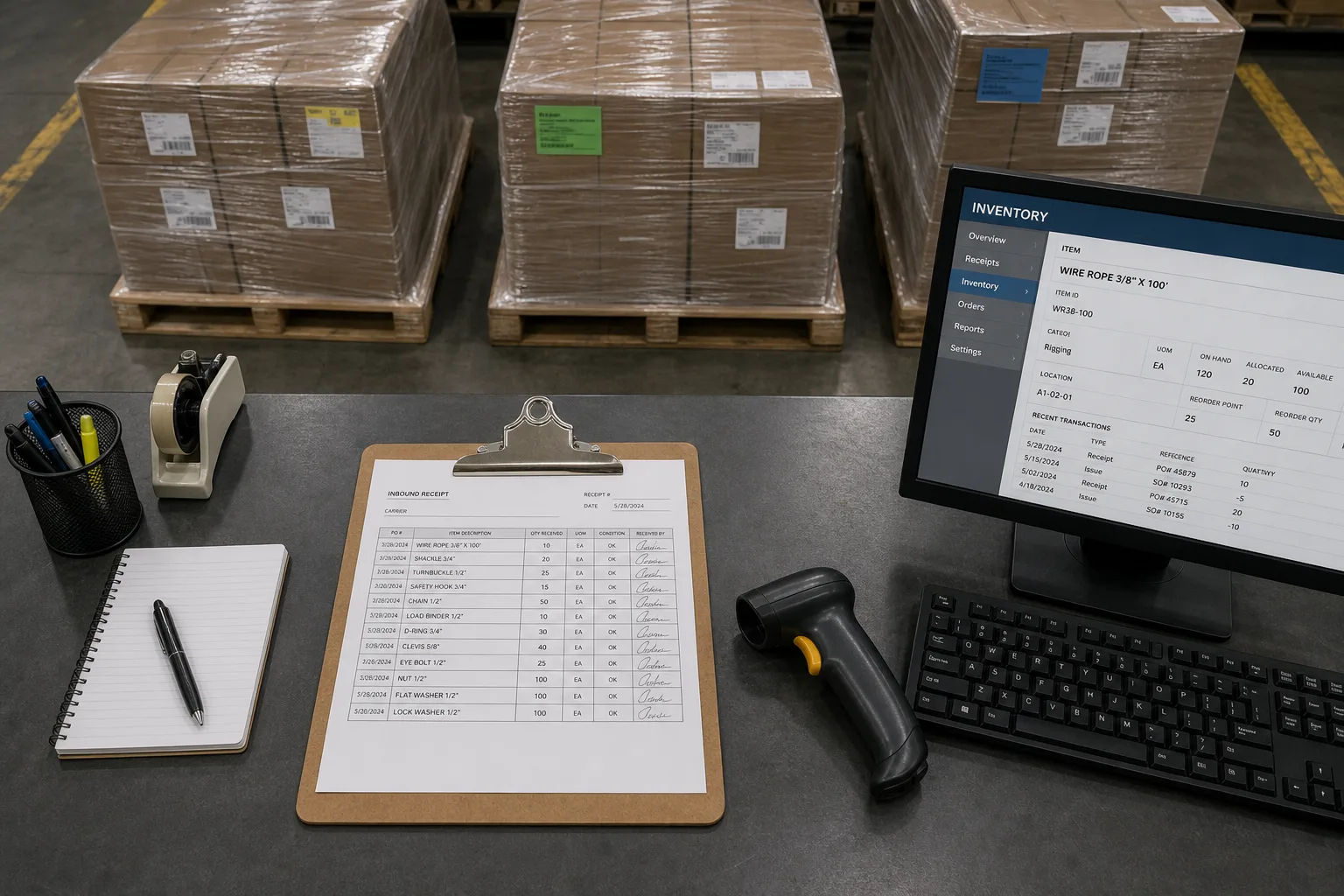
Every arrangement for holding someone else's goods comes with a document that says what happens when the goods are not there. Most buyers read the rate card closely and that document not at all. The rate card tells you what a pick costs this quarter. The other one tells you whether a lost pallet is worth its invoice value or fifty cents a pound.
If you are running inventory for an organization with more than one channel, more than one SKU family and a finance team that closes books monthly, the choice between storage options is mostly a choice between record-keeping regimes. Here is how the four common shapes compare, and what paperwork each one actually obliges you to keep.
Four shapes, and what each one really hands over
| Option | Who touches the goods | Governing document | Where it strains |
|---|---|---|---|
| Self-storage unit plus your own labor | You | Month-to-month rental agreement | No inventory system, no dock, no liability transfer. Fine for buffer stock, poor for order flow. |
| On-demand or shared warehousing | Provider, per transaction | Marketplace terms plus a per-site addendum | Capacity is real but not reserved. Terms can differ building to building. |
| Full-service 3PL | Provider, under contract | Master services agreement, SLA, rate card, warehouse terms | Negotiable, measurable, and the heaviest onboarding lift. |
| Marketplace fulfillment | Platform | Non-negotiable platform policy | Excellent throughput, thin recourse, limited visibility into lot and condition. |
A larger organization usually ends up running two or three of these at once: marketplace fulfillment for the fast-moving catalog, a contracted 3PL for wholesale and returns, on-demand space for a seasonal spike. That is a reasonable architecture. It only works if one inventory record is treated as authoritative and the others are reconciled to it.
What the certifications promise, and what they deliberately leave out
Providers lead with logos. Read each one for scope, because scope is the whole message.
- ISO 9001. Says the provider has a documented quality management system and audits itself against it. It does not say the system is demanding, and it does not set a pick accuracy number. It promises consistency with their own procedures, which is useful only once you have read those procedures.
- SQF, BRCGS and similar food safety schemes. Scope is site-specific and category-specific. A certificate covering ambient dry storage says nothing about the cold rooms in the same building. Ask for the certificate itself, not the badge, and check the scope statement and expiry date.
- Food facility registration. If you hold human or animal food, the Food and Drug Administration is responsible for facility registration and for the record-keeping expectations that follow. Registration is a filing, not a grade. It establishes that the agency knows the site exists and can inspect it. It is not an endorsement of how the site is run.
- C-TPAT. Supply chain security posture for cross-border freight. Relevant to clearance treatment. Silent on whether your cartons get picked correctly.
- Insurance certificates. A certificate of insurance proves a policy existed on the date it was issued. It does not make you a beneficiary. For that you want to be named as additional insured, or you want your own cargo and stock-throughput coverage.
None of this is a reason to discount certification. A provider that maintains current, in-scope certificates is a provider that survives audits, and audit-readiness correlates well with everything else you care about. Treat the logos as evidence of discipline, then verify the specific promises in the contract.
The document set that makes a third-party arrangement manageable
For anything beyond a storage unit, assemble these before the first inbound shipment. Most disputes trace back to one of them being missing.
- Master services agreement. Term, termination, notice period, exit assistance. The exit clause matters more than the entry pricing. Confirm who pays to pick, pack and load your goods out, and how many days the provider has to release them.
- Standard warehouse terms and conditions. This is where limitation of liability lives, usually expressed per pound or per package with a stated maximum. If your average pallet is high-value and low-weight, that limit is the single most important number in the file. It is routinely negotiable upward for a fee, and the fee is cheaper than the gap.
- Service level agreement with defined measurement. Not "99% accuracy" alone. Accuracy measured how, over what denominator, reported when, with what credit if missed. A metric with no reporting cadence is decoration.
- Rate card with accessorials listed. Receiving, putaway, storage by unit of measure, pick, pack, carton, special projects, returns processing, disposal, minimum monthly. Ask which charges apply to a returned unit that is restocked and which apply to one that is scrapped.
- Warehouse receipts or signed inbound documents. Every receipt should generate a record showing counted quantity, condition and any exception noted at the dock. An unnoted exception becomes your problem roughly one week later.
- Bills of lading and proof of delivery, retained. Carrier claims die on missing paperwork more often than on merit.
- A written SOP per SKU family. Packaging, dunnage, labeling, lot handling, inserts, serial capture. If it is not written, the provider will do it the way they do it for everyone else.
- A cycle count and reconciliation policy. Frequency, tolerance, who adjusts, who approves, how shrinkage is charged. Agree this during onboarding, because agreeing it after a variance is an argument rather than a process.
Systems: one authoritative record, everything else reconciled
The operational half of the same problem. A provider's warehouse management system holds their truth. Your ERP or inventory platform holds yours. They diverge daily, and the question is only how fast you detect it.
Decide early which system is authoritative for available-to-promise. Usually that is yours, with the provider feeding it. Then insist on the mechanics that keep the feed honest: advance shipping notices on inbound so receiving is a confirmation rather than a discovery, SKU codes that are identical in both systems with no helpful local renaming, real-time or near-real-time inventory adjustments rather than a nightly file, and lot or serial capture at pick for anything regulated or recall-prone.
Ask what happens when the integration fails at 2am. The answer you want involves queued messages and an alert to a named person, not a report that surfaces three days later.
Buying as a larger organization, and what a provider needs from you
At scale the relationship stops being a purchase and starts being a joint operation. Larger buyers get better outcomes because they bring structure to it, not because they are big.
That structure is unglamorous. A named account owner on each side. A monthly scorecard with the same handful of metrics every month: receiving turnaround, on-time pick, order accuracy, inventory record accuracy, damage rate, cost per order. A quarterly business review that looks at trend lines and forecast, not at last week's complaint. A forecast you actually share, because a provider staffing for your peak cannot do it on a week's notice.
Also worth knowing: delivery timing promises you make to customers are governed by federal rules on mail, internet and telephone orders, and the Federal Trade Commission oversees them. Your fulfillment contract should carry a ship-by commitment tight enough to support whatever your storefront says. That is a clause, not a hope.
Run two providers through the same comparison and the shortlist usually narrows itself. One will produce the certificates, the warehouse terms and a sample scorecard within a day. The other will send a rate card and ask when you can start. The first conversation is the one worth continuing.