Inspected in a Cold Snap? What Goes Untested, and How to Get It Checked
A home inspection is a one-day visual snapshot, and the calendar decides what can be seen. Here is what each season hides and how to recover it before closing.
- Written by
- Nadine Buckley
- Published
- Filed under
- Property
- Length
- 1,155 words, about 5 minutes
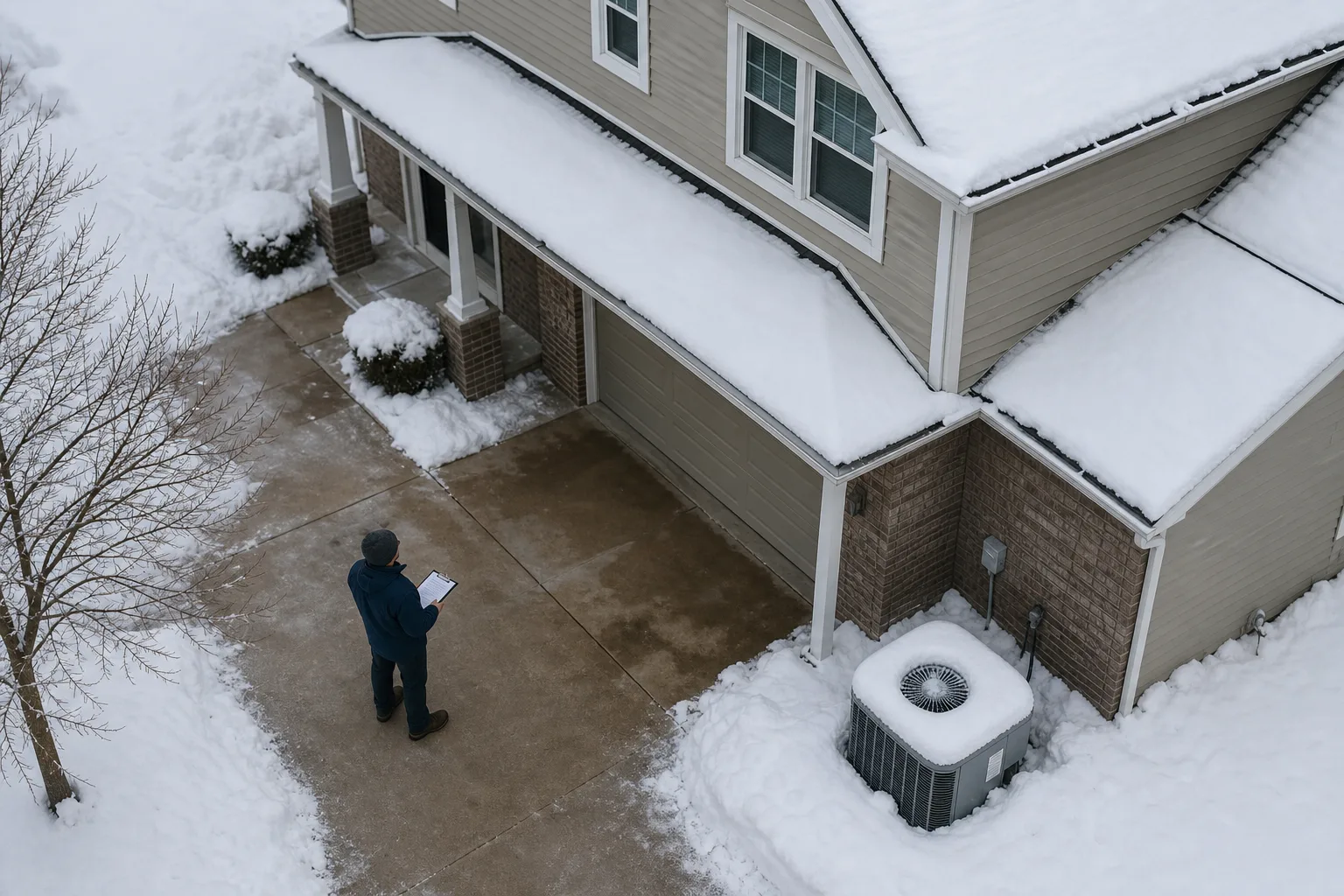
The report lands in your inbox on a Tuesday evening. Forty-eight pages, a hundred photographs, and somewhere around page thirty a line that reads: air conditioning not tested due to outdoor temperature. You have until Friday to respond to the seller. The furnace ran. The roof looked fine from the driveway, under four inches of snow.
That line is not a failure of the inspection. It is the standard working exactly as written. The useful question is not whether the inspector should have done more. It is what you now know, what you do not, and which of the gaps is worth money or time to close before you sign.
What the standard actually promises
A general home inspection in the United States is governed by a standard of practice, usually the one published by the inspector's trade association and, in many states, by a licensing statute that adopts something close to it. The standards differ in detail and agree on the shape.
What the inspection is:
- Visual. If it cannot be seen without taking something apart, it is out of scope.
- Non-invasive. No cutting drywall, no pulling up carpet, no lifting shingles.
- A snapshot of the day. Present condition, not a forecast and not a warranty.
- Limited to readily accessible areas. A crawlspace hatch behind a stack of boxes is not accessible.
- Operated under normal controls. The inspector uses the thermostat, not a bypass.
What it deliberately excludes, and this is the part people misread as an oversight:
- Code compliance. An inspection is not a code inspection, and the house is judged against safe and functional, not against current code.
- Anything inside a sealed system: the interior of a boiler, a sewer line past the cleanout, the inside of a wall.
- Estimating repair cost. Some inspectors add numbers as a courtesy. It is not part of the standard and it is not a contractor's estimate.
- Predicting remaining life. "Functional at time of inspection" means functional at time of inspection.
Read the scope section before you read the findings. It tells you which absences in the report are real information and which are just the boundary of the job.
What the calendar removes from the report
Season is the most predictable limiter on a general inspection, and the most fixable, because you know in advance which items will be missing.
Winter, roughly:
- Central air conditioning is not run below a threshold, commonly in the low sixties outdoors. Compressors can be damaged by starting cold. The inspector will not risk it and should not.
- Roof coverings under snow or ice get a limited or deferred note. Flashing details, granule loss and soft decking are all invisible.
- Exterior faucets and irrigation are typically shut off and drained.
- Grading and drainage cannot be judged while the ground is frozen. Standing water tells you nothing when it cannot soak in anyway.
- Landscaping is bare, which helps: you can actually see the roofline, the chimney, the soffits and the grade at the foundation.
Summer, roughly:
- The furnace or boiler gets a short cycle, not a real heating-season workout. A heat exchanger crack rarely announces itself in July.
- Ice dam history is invisible. The stains inside a bedroom closet ceiling may have dried out months ago.
- A dry spell hides a wet basement completely. Seven weeks without significant rain means the sump pump has nothing to tell you.
Spring and fall are the accommodating seasons, and even then the report follows the weather that week, not the month on the calendar. A warm January and a cold May both move the line.
The seasonal test the standard hands off entirely
Radon is not part of a general inspection. It is a separate test with its own protocol, and the protocol is seasonal in a way that matters to the result. Short-term testing is done under closed-house conditions, which are easier to achieve and more representative in colder months, when the house is shut up and the stack effect is pulling on the soil under the slab. The same house tested with the windows open in June can read lower and still have a problem in February.
The Environmental Protection Agency is responsible for national radon guidance and the action level that mitigation contractors work to. If your test was run in an open house in warm weather, or if the seller had the windows open during the measurement period, the number is not wrong so much as not answering the question you asked.
Sewer scopes, chimney inspections and pest inspections sit in the same category: separate scopes, separate professionals, mostly unaffected by season, and routinely skipped by buyers who assume the general inspection covered them.
Turning gaps into decisions in the days you actually have
The realistic timetable is short. Inspection Monday, report Tuesday night, response to the seller by Friday. You are not going to become an expert on heat exchangers in seventy-two hours. What you can do is sort the findings into three piles and act on the piles.
Sort it this way
- Priced and negotiated now. Anything visible, quantified and safety-related. Get one contractor's estimate if the item is large enough to justify the scramble. Take the number into the negotiation.
- Verified before closing by someone else. Untested systems where a specialist can substitute for the season. An HVAC technician can evaluate a condenser in February with gauges, capacitor readings, refrigerant charge and nameplate age even without running a cooling cycle. A roofer will walk a roof with snow on it if the pitch allows, or come back after it clears.
- Documented and diarized. Items nobody can settle in winter, like grading and drainage performance. You write them down, you budget for them, and you look at them the first heavy rain after you move in.
Evidence the seller already has
Before you pay for a specialist, ask for what exists. Service records for the AC, the last two heating tune-up invoices, a receipt for the sump pump, any roof or ice dam repair paperwork, the last radon test and any mitigation permit. Sellers who have maintained a house usually have the folder. That folder does more to close a seasonal gap than a second opinion often does.
If the season simply wins
Escrow holdbacks exist for this. An agreed sum stays with the title company until the AC can be started in April and confirmed working, with a named inspection date and a named person to do it. Your agent and the title company will know the local mechanics. It is ordinary, and it is far better than accepting an untested system because the weather was uncooperative.
The judgment you are building is not technical. It is procedural: knowing which absences in a report are the standard doing its job, which are the weather, and which of the two you can convert into a number, a specialist visit, or a line in the contract before Friday.