Pay It Yourself or File It? What Each Choice Leaves on Your Loss History
Five ways to handle a covered loss, what each one puts on your record, and why the folklore about asking questions is mostly out of date.
- Written by
- Roy Castellano
- Published
- Filed under
- Money
- Length
- 1,242 words, about 5 minutes
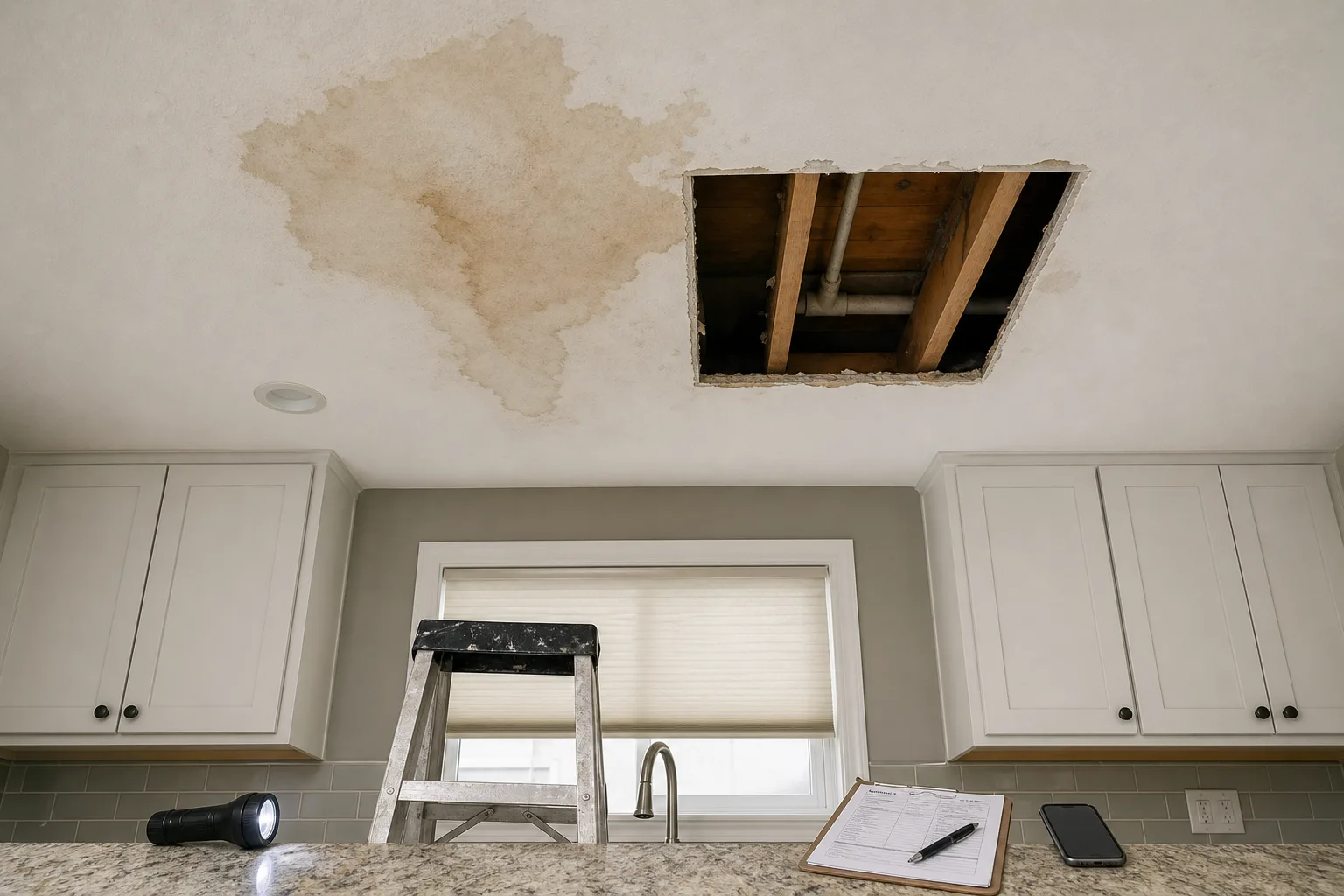
The advice gets passed around every time a pipe lets go: don't call, don't even ask, because the question alone will cost you at renewal. That belief was roughly accurate in a narrow window, in some states, decades ago. It has hardened into folklore since, and the folklore now costs people more money than the thing it was meant to protect them from.
Here is how the record actually works, and what each of the five realistic ways to handle a loss leaves behind.
Where the fear came from
Before the late 1980s, an insurer underwriting a new policy knew what the application said and what the local agent remembered. Verification was slow and mostly voluntary. Carriers solved that the way lenders had solved it: a shared database. Loss history reporting took hold, and an industry-wide record of property and auto losses became a standard underwriting input rather than a specialty tool.
In the early years, what fed that database varied by carrier. Some fed in anything that generated a file, including calls that never became claims. Agents noticed. The advice to never pick up the phone dates from exactly that period, and it was sound advice at the time.
Two things changed. State regulators pushed back on pricing off contacts that produced no loss, and loss history reports were pulled firmly into consumer reporting territory. They are consumer reports under federal law, which means you have the right to see yours, dispute what is wrong in it, and get a copy at no charge in the circumstances the statute allows. The Federal Trade Commission oversees the fair credit reporting framework that governs those rights. Once a record is disputable and visible, sloppy entries become expensive for the people making them, and the data got cleaner.
So the exception explains the rule. A generic question about coverage is not a loss. A reported loss is a loss, paid or not. The folklore collapsed those two and never uncollapsed them.
The five options, side by side
Every property loss, past the first hour of cleanup, resolves into one of five choices. They are not interchangeable and the differences are not subtle.
1. Pay it yourself, say nothing
Nothing reaches the file. Nothing reaches the loss history database. Your renewal sees a property with no reported losses.
The cost is real, though, and it is not only the repair bill. You have no documented date of loss, no adjuster's scope, and no paper proving that the damage was fixed properly. If the same wall fails in three years and that one is big enough to claim, you are arguing about whether it is new damage or the continuation of something you handled quietly. The second claim is the one that gets the scrutiny.
Best fit: small, fully contained, under or near the deductible, and the kind of failure that does not repeat.
2. An unnamed inquiry
You call an agent or a broker, describe the situation in general terms, and ask how the policy would respond. No address, no date of loss, no policy number tied to a claim file.
This generates no claim and nothing for the loss database to record. It is the single most underused option on the list, because the folklore says it is dangerous. For a straightforward coverage question, it is not.
Best fit: when the real question is whether this is even a covered peril, before you decide anything.
3. A record-only notice of loss
You report the loss and state explicitly that you are not seeking payment, you want the event documented. You get a claim number. A file opens. It will show on your loss history as a reported loss with zero paid.
People treat this as the worst of both worlds. It is not. It is the right answer in exactly two situations: when a third party may come back at you later (a guest fell, a tree you owned landed on a neighbor's fence), and when damage may prove larger than it currently looks. Liability exposure in particular does not respect your preference for keeping things quiet. A notice filed on the day beats a claim filed eleven months later when somebody's attorney writes.
Best fit: anything with another human being's injury or property involved, and anything where hidden damage is plausible.
4. File, then withdraw
You open a claim, the adjuster scopes it, the number comes in under your deductible or under what the work actually costs, and you close it without payment. The file stays. Zero paid.
Underwriters read a zero-paid claim as a reported loss. Some weigh it lightly. Some weigh it the same as a paid one, on the theory that the event happened regardless of who wrote the check. You generally cannot find out which kind of carrier you have until renewal.
What you get in exchange is a free professional estimate of the damage and a documented date of loss. That is not nothing. It is simply not free.
Best fit: when you genuinely did not know the size of the loss when you called, which is most of the time.
5. File and pursue payment
The full claim. Payment, depreciation holdback if your policy is replacement cost, recoverable on proof the work was done.
This is the option the policy exists for, and the one people talk themselves out of over amounts that are worth claiming.
What renewal actually reacts to
After enough of these, the pattern is clear and it is not the one people expect.
- Frequency beats severity. One large claim is an event. Three small ones in three years is a risk profile. Underwriting systems are far more sensitive to the count than to the dollar figure.
- Peril type matters more than amount. Water damage and liability losses carry weight that wind and hail usually do not, because one suggests a condition of the property and the other suggests a storm passed through. A claim shared across a whole zip code reads differently than one that is yours alone.
- The clean-record discount is the quiet expense. The rate increase after a claim is often smaller than the loss of a multi-year claims-free credit. Ask what the credit is worth in dollars before you decide anything. Your agent can pull that number.
- Nonrenewal is a separate decision from rating. A carrier can price a claim mildly and still decline to continue the policy after a second one. Those two outcomes come from different departments and different rules.
The order to run it in
- Stop the damage and photograph everything before you move it. This step is not optional and it is not a claims decision.
- Get your loss history report and read what is already on it. You are deciding what to add to a record you have presumably never looked at.
- Ask the agent, unnamed, what the peril is and what the claims-free credit is worth.
- Get one contractor's estimate before you decide. A real number changes the arithmetic more often than you would think.
- Then choose from the five. Not before.
The householders who come out ahead over twenty years are not the ones who never claim. They are the ones who never file a claim they could have predicted would close at zero, and never swallow a loss that belonged on the policy. That distinction is learnable in an afternoon, and it holds up far better than the advice to keep quiet.