Thirty-Three Percent of What? The Party Who Gets Paid Before You Do
A contingency percentage means nothing until you know the base it applies to, where case costs sit, and which lienholder has a claim on the same money.
- Written by
- Nadine Buckley
- Published
- Filed under
- Legal
- Length
- 1,003 words, about 4 minutes
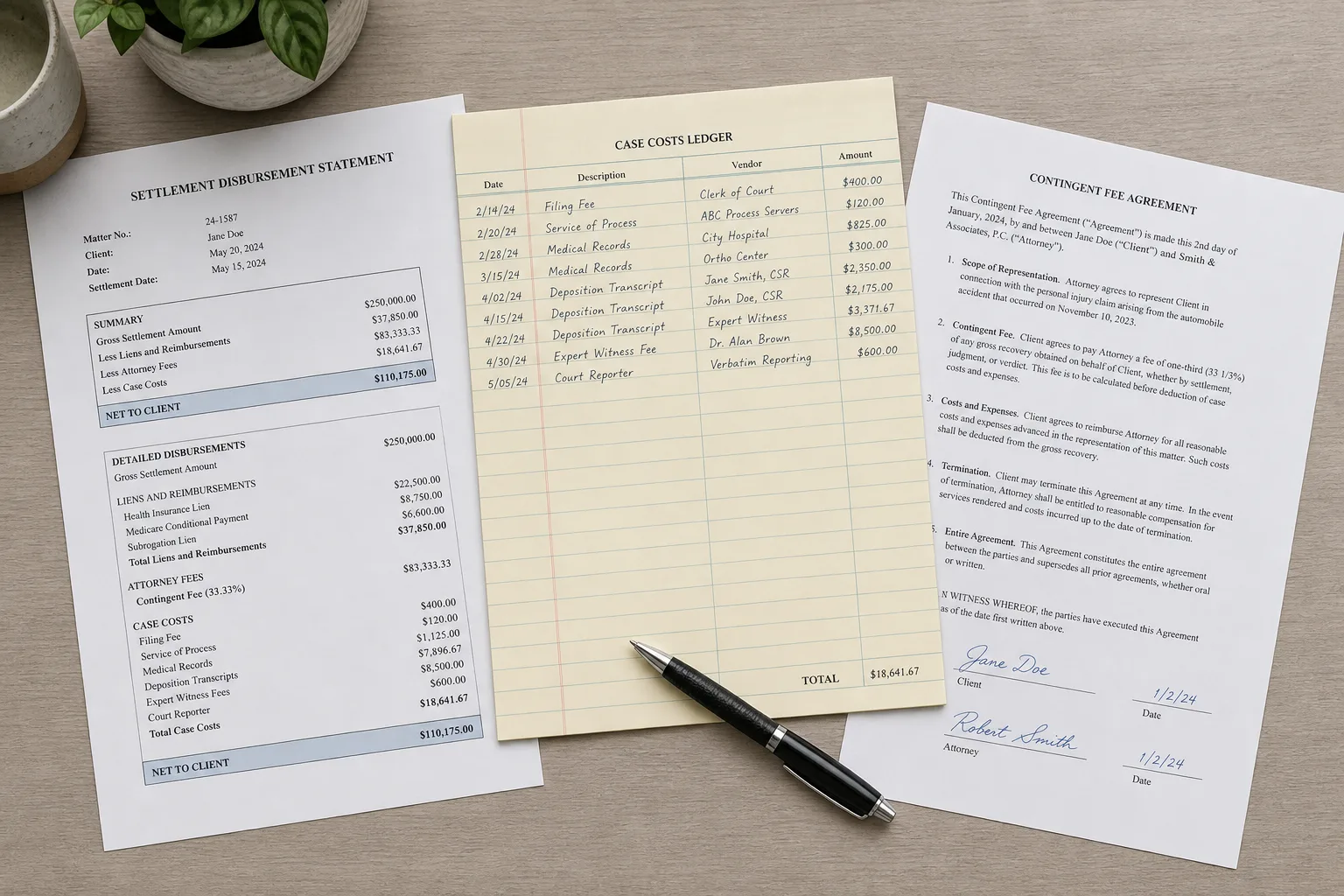
A contingency percentage is the number everyone remembers and the least useful one to compare firms on. The same stated rate can produce meaningfully different checks depending on what the percentage is multiplied by, when the rate steps up, and who else has a claim on the pot. The percentage is the rate. The base is the deal.
Gross or net: the two bases, and the gap between them
Every contingency agreement applies the fee to one of two numbers. Either the fee comes off the total recovery before case costs are repaid, or costs come off first and the fee applies to what is left.
Work a hypothetical to see the shape. Take a settlement of $300,000 with $40,000 in advanced case costs and a flat one-third fee.
| Order of operations | Fee | Costs repaid | To the client |
|---|---|---|---|
| Fee on gross, then costs | $100,000 | $40,000 | $160,000 |
| Costs first, then fee on net | $86,667 | $40,000 | $173,333 |
Same rate, same recovery, a five-figure difference. Neither method is improper, and fee-on-gross is common in firms that front heavy expert costs. But the agreement has to say which one applies, in a sentence you can read without a translator. If it does not, that is the first question, not the fifth.
Two more base questions worth settling in writing: does the fee apply to amounts recovered for costs or attorney fees awarded separately, and does it apply to the full face value of a structured settlement or to the present cash cost of funding it.
Flat rate versus sliding scale, and what triggers the step
A flat percentage is one line of math. A sliding scale is several, and the step-ups are tied to events, not to effort.
- Filing suit. Many agreements move the rate up the day a complaint is filed. Ask whether a demand letter answered favorably sits below or above that line.
- A date certain. Some use calendar triggers tied to trial settings. A continuance granted for the defense can move your rate.
- Appeal. Post-trial and appellate work frequently carries its own rate, sometimes under a separate signed agreement.
- Policy limits tender. A few agreements reduce the rate if an insurer pays limits early, which is worth asking about directly.
A lower opening rate with an aggressive step is not automatically worse than a higher flat rate. It depends on where your case realistically resolves. Ask the firm which tier most of their matters of this type actually land in.
The costs ledger, and who carries it if the case loses
Case costs are not the fee and are not overhead. They are money spent on your file: filing fees, deposition transcripts, record retrieval, investigators, expert retainers, mediation, trial exhibits. In serious civil cases they are the line item that moves the most.
Three things to pin down before signing:
- Advance or invoice. Does the firm front costs, or do you fund them as they arise? Firms that advance costs sometimes add interest or a finance charge. That has to be disclosed.
- Loss scenario. If there is no recovery, are you still liable for advanced costs? Many agreements waive repayment. Some do not. This single clause is the difference between a zero and a five-figure bill.
- Reporting cadence. Can you get an itemized costs ledger on request, quarterly, or only at settlement? Monthly is better. A ledger you have been reading all along is impossible to dispute at the end.
The lienholder nobody budgeted for
There is a third party at the settlement table who never signed your fee agreement and who is paid out of the same money you are. Your health insurer may have a contractual right of reimbursement for what it paid toward your treatment. A hospital may have filed a statutory lien. If any care was covered by Medicare or Medicaid, those programs have their own recovery rights, and the Centers for Medicare and Medicaid Services is responsible for the federal side of that process. State crime victims compensation funds that paid for counseling or an emergency exam often carry a repayment obligation too.
None of this is hidden, but it is routinely left out of the conversation about percentages, and it determines your actual take-home more often than the difference between 33 and 40 percent. In a civil claim arising from an assault, a sexual assault lawyer should be asking at the first meeting which of those payers has touched the file, because the answer changes both the net math and the negotiating strategy.
Good news on this front: liens are negotiable far more often than clients expect, and reductions are routine work. Ask whether lien resolution is included in the stated fee or billed separately. Both arrangements exist. You want to know which one you have.
The paperwork that makes it manageable
Four documents carry almost all of the weight.
- The engagement agreement. Read the base clause, the step clause, the costs clause, and the termination clause. Termination matters: if you change firms, the first firm usually holds a claim for time or costs.
- The costs ledger. Itemized, dated, with vendor names. Request it on a schedule rather than at the end.
- The lien schedule. A running list of every payer with a potential claim, the asserted amount, and its current status. Most firms keep one internally. Ask for a copy.
- The settlement disbursement statement. The one-page accounting of gross recovery, fee, costs, liens, and net to you. You sign it. Ask for a draft version, with real numbers, before you sign a release.
Client funds sit in a trust account until that statement is executed, which is exactly the point at which questions are still cheap to ask.
Before you choose between two firms, give each the same hypothetical: a recovery of a stated size, costs of a stated size, a known health insurer in the picture. Ask them to write out the disbursement. The firm that produces it quickly and in plain numbers has already told you how the rest of the case will be run.