Your Inspection Report Hedges on Everything. Which Lines Are Actually Telling You to Act
An inspection report is drafted to limit the inspector's exposure, and that drafting decides what you do next. Here is how to tell boilerplate from a real warning.
- Written by
- Roy Castellano
- Published
- Filed under
- Property
- Length
- 1,243 words, about 5 minutes
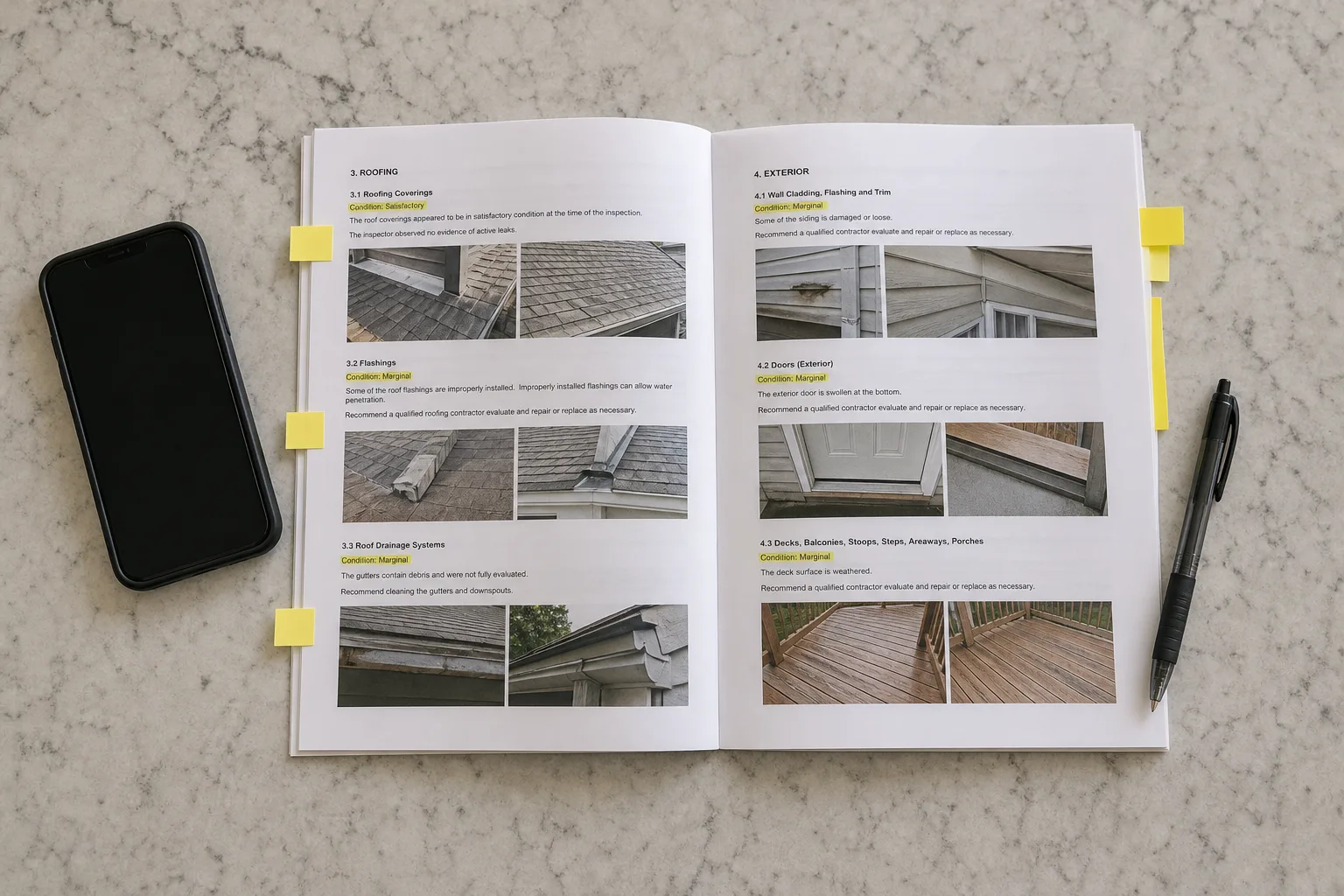
You get the report at 9 p.m., forty-one pages, and by page six every roof, furnace and outlet has been described in language that commits to nothing. Appeared serviceable at the time of inspection. Recommend further evaluation by a qualified licensed contractor. Monitor. You have ten days, sometimes seven, to turn that into a list of asks. The hedging is not evasion. It is the direct product of how this trade got regulated, and once you know the shape of it, you can sort the lines that are padding from the lines that are a person quietly pointing at something.
Why the sentences are built that way
Home inspection did not start as a licensed profession. It started as contractors and retired tradespeople walking houses for a fee, with no agreed scope and no agreed standard for what counted as a miss. When buyers sued, the first question in every case was the same: what were you hired to do?
The answer came from the trade associations, and later from state licensing boards that adopted their language more or less whole. The standards of practice they wrote define the job largely by exclusion. The inspection is visual. It is non-invasive. It covers readily accessible components on the day of the visit. It is not a code compliance check, not a warranty, not a prediction.
That definition then migrated into the contract you signed before the inspector arrived, usually with a clause limiting liability to the fee you paid. The report is written to sit inside that boundary. Every phrase you find vague is doing one of two jobs: keeping a statement true for one specific day, or routing a question to a trade with a license that covers it.
Knowing the reason explains the exception, too. When an inspector steps out of the hedged register and names a component, a condition and a consequence in plain words, that is not habit. That is someone deciding the risk of saying it is lower than the risk of not saying it.
Three documents that look like one
Most reports are three things bound together, and buyers read them as a single narrative. They are not interchangeable. In a negotiation, a reinspection, or a conversation with an attorney six months later, each one does a different job.
| Part | What it is for | What it will not do |
|---|---|---|
| The summary or priority page | A triage list, usually the inspector's judgment of what is urgent or expensive | It is not complete. Items in the body that never reach the summary are still findings. |
| The body, system by system | The record of what was observed, with photos and locations. This is the part that supports a repair request. | It rarely ranks anything. Three sentences about a cracked heat exchanger sit next to three about a loose handrail. |
| The scope and limitations section | Defines what was excluded, what was inaccessible, and on what basis | It is not filler. It tells you where the unknowns are, which is often the most useful page in the file. |
The practical consequence people rarely trace back: sellers and their agents negotiate off the summary page, because it is short. If something expensive is described only in the body, you have to lift it out yourself and put it in writing. Nobody does that for you.
Four phrases, compared by what they are asking of you
These four carry most of the traffic. They are not equivalent, and treating them as equally vague is how a real problem gets filed next to a loose handrail.
- "Appeared serviceable at the time of inspection." The weakest statement in the document. It means the thing ran when a switch was flipped. It makes no claim about age, remaining life, or whether it will run in March. Treat it as neutral, not as reassurance.
- "Monitor" or "recommend monitoring." Something was seen that is not currently a defect but could become one. The hidden cost here is time: monitoring is a job that transfers to you at closing, and most people forget it within a month. If you keep one list from the report, keep this one.
- "Recommend further evaluation by a qualified specialist." The inspector saw enough to be concerned and the diagnosis sits outside the licensed scope. This is a referral, not a disclaimer. It costs money and days to resolve, which is exactly why it gets skipped.
- "Beyond the scope of this inspection." Nothing was assessed. A crawlspace that was flooded, a panel cover that was painted shut, an attic with no access hatch. This is an open question, not a clean result, and it is the phrase most likely to become your problem later.
Comparing your options when a line says further evaluation
Say the report flags evidence of past moisture at the base of a foundation wall and recommends evaluation by a licensed contractor. You have four realistic moves, and they buy different things.
Do nothing and proceed
Costs nothing now. Buys nothing. If the issue surfaces after closing, the report showing a recommendation you declined to follow does not help you with the seller or your insurer.
Call the inspector back with questions
Usually free, usually by phone, and often the highest value per dollar in the whole process. Inspectors will say more out loud than they will write. Ask them directly: if this were your purchase, is this a five hundred dollar problem or a fifteen thousand dollar problem? Most will answer with a range.
Hire the trade specialist
A structural engineer, a licensed plumber, a roofer. Costs a few hundred dollars and two to four days you may not have inside the contingency period. What you get is a document with a number in it, which is the only kind of document that moves a seller.
Ask for a credit without the diagnosis
Fast, and it keeps the deal moving. The weakness is that you are negotiating against an unknown. Sellers counter low on undiagnosed items precisely because nobody has priced them.
The sequencing that works: call the inspector first, same evening if possible, and use that conversation to decide which one or two items justify paying a specialist. You cannot afford to specialist-check everything, and the report, read plainly, was never asking you to.
Where the report quietly reaches past its own limits
Certain items are hedged less, and that is worth noticing. Radon, lead-based paint and asbestos live under federal disclosure and testing rules that the Environmental Protection Agency is responsible for, so language around them tends to be specific and procedural rather than cautious. The same is true of anything an inspector photographed in detail. Photos take effort. Five pictures of one junction box is an inspector telling you something the sentence underneath would not let them say.
Read for those tells: a named component, a stated condition, a measurement, a cluster of images, or a safety word like hazard, active, or immediate. Those lines were written against the drafting conventions, not inside them.
Give yourself an hour with the report and a highlighter before you talk to anyone. Pull every item carrying a safety word or a referral into one short list, every monitoring item into a second list you keep after closing, and every inaccessible area into a third. Then make the phone call. The report will not rank your risks for you, but it contains everything you need to rank them yourself in a single evening.