Arranging a Funeral This Week? The Second Price List Nobody Warns You About
A funeral bill comes from at least two separate businesses, and the one families forget to ask about usually sends its numbers last.
- Written by
- Roy Castellano
- Published
- Filed under
- Family
- Length
- 951 words, about 4 minutes
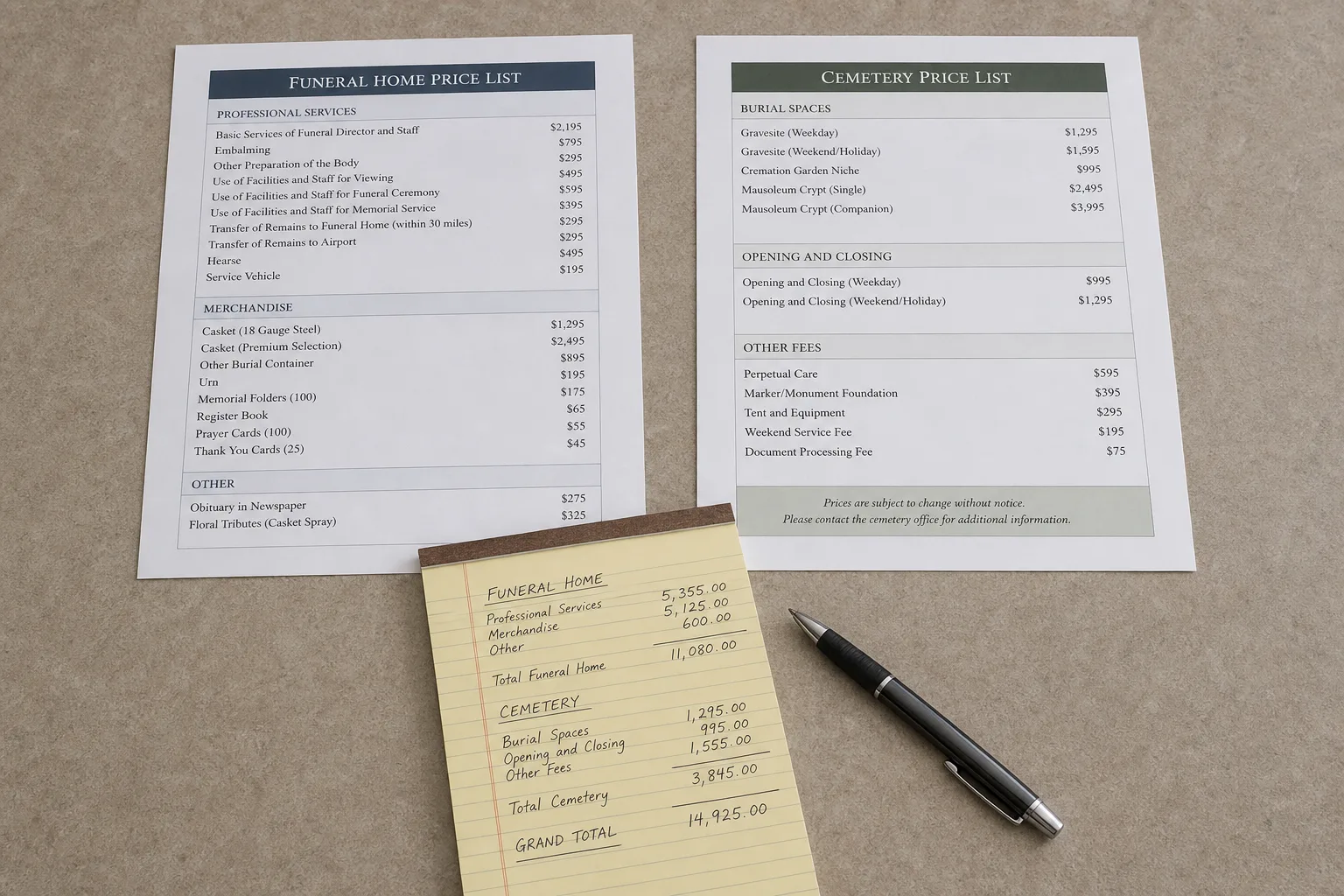
Most families arrive at the funeral home believing they are about to learn what the whole thing costs. They are about to learn what part of it costs. The other part is being decided somewhere else, by a business they have not called yet, and it frequently lands within a few hundred dollars of the first bill.
Why there is an itemized list at all
Before the mid-1980s, the standard practice was a package. You chose a casket, and the price of that casket carried the staff, the vehicles, the room, the paperwork and the professional fee inside it. Choosing a more expensive box did not just buy a better box. It silently bought a more expensive funeral. Families had no way to see what any single element cost, because no single element had a price.
The Federal Trade Commission oversees how funeral pricing is disclosed to consumers, and the rule it administers is why the folder in front of you now contains a written, itemized general price list. That document is the single most useful object in the room. It exists specifically so that the components can be priced apart from one another, which is also what makes most of them declinable.
That history explains the exception, too. One line on the list is not declinable: the basic services fee. It covers the funeral director's professional time, the initial conference, permits, filing the death certificate, coordination with the cemetery or crematory, and overhead. Every family pays it. It was carved out precisely because unbundling everything else would otherwise have left the firm with no way to charge for the work that has to happen regardless.
The four buckets on a funeral home bill
Read the list as four groups rather than twenty lines.
- Basic services. The non-declinable fee described above. Compare it between firms, because it varies widely and it is the floor under everything else.
- Care and transport of the body. Transfer from place of death, refrigeration or embalming, dressing and casketing, use of a hearse. Each is priced separately.
- Facilities and staff for events. Viewing hours, a chapel service, staff at a graveside, a reception room. Priced by event, sometimes by the hour.
- Merchandise. Casket or cremation container, urn, outer burial container, register book, prayer cards, flowers.
Then there is a fifth category that is not really the funeral home's charge at all: cash advances. These are items the firm buys on your behalf, such as newspaper notices, clergy honoraria, death certificate copies, and permits. They should appear as pass-throughs, and you are entitled to know whether the firm is adding a service charge on top.
The party most people overlook
The cemetery. Or the crematory, if it is independently operated, which it often is.
Cemeteries are separate businesses with their own price lists, their own rules, and their own sequence. They did not develop as part of the funeral trade. Many American cemeteries began as municipal ground, church ground, or nineteenth-century private associations, and they were selling one thing: the right to occupy a specific piece of land indefinitely. Everything else they charge for accreted around that. The disclosure obligations that reshaped funeral home pricing did not reshape theirs in the same way, which is why the cemetery's numbers usually arrive later, less itemized, and less negotiated.
What a cemetery typically charges for, separately from anything the funeral home quotes:
- Interment rights. The plot, niche or crypt itself. You are buying the right of burial, not the land.
- Opening and closing. Excavation, equipment, backfill, ground restoration. Frequently the second-largest single number in the entire arrangement.
- The outer burial container or grave liner. Not required by state law anywhere that I am aware of, but required by most cemeteries as a condition of burial, because settling ground is expensive to maintain. Ask whether a basic liner is acceptable, since the sealed vault is a different price entirely.
- Monument or marker, plus the foundation. Two charges. The stone is one purchase; pouring the base it sits on is a cemetery charge, and the cemetery may set specifications for size and material.
- Endowment or perpetual care. A percentage added to the plot price, held toward long-term grounds maintenance.
- Surcharges. Weekend interments, late arrivals, second interments in the same plot, recording fees for transferring the deed.
Call the cemetery before you finalize the funeral home selections. Their container requirement, their marker specifications and their scheduling windows all constrain choices you would otherwise make in the arrangement conference.
Which lines are genuinely optional
More than families expect. Embalming is not generally required by law for a burial or cremation happening on a normal timeline; it becomes a practical necessity for a public viewing with an open casket, and some firms require it for that reason. Refrigeration is usually the cheaper alternative if you decline the viewing.
Also optional, in the ordinary case:
- Viewing or visitation hours, and the facility fee attached to them
- A casket for cremation, in place of an unfinished alternative container
- Protective or sealed casket features
- Limousines and lead cars
- Register books, acknowledgment cards, printed programs
- Paid newspaper notices, which are priced by the line and can run high
- Graveside staff, if family members will handle the committal
You may also supply merchandise yourself. A casket or urn bought from a third party has to be accepted without a handling fee. That single provision is the practical reason the itemized list matters.
Ask both businesses for their written lists on the same day, put them side by side on one sheet of paper, and total the two columns before agreeing to anything. The families who do that are rarely surprised by what arrives in the mail three weeks later.