Got a Ticket and a Flat Fee Quote? What You Bring to the First Meeting Moves the Number
Traffic defense is priced as a flat fee for historical reasons, and the documents you bring to the first meeting decide which fee you land in.
- Written by
- Roy Castellano
- Published
- Filed under
- Legal
- Length
- 1,095 words, about 5 minutes
Call a traffic defense firm with a speeding citation and you will usually get a number before you get an attorney. Not a range, not an estimate, a number. That is unusual in legal work, and it is worth understanding why, because the same logic that produces the flat fee also produces the exceptions, and the exceptions are where people get surprised.
Why this corner of law prices by the matter instead of the hour
Hourly billing came out of commercial practice, where the work is open-ended and the client is a business that can absorb variance. Traffic court is the opposite. The calendar is published, the charge is on a short list, the evidence is a citation and sometimes a calibration log, and a firm that handles a few hundred of these a year knows almost exactly how many hours a given infraction consumes.
When a provider has that much repetition, hourly billing stops making sense for either side. The firm can price to its average and still make the economics work. The client gets a number they can compare against the fine and against the insurance consequence. Volume made the flat fee possible, and volume is also what makes a larger firm quote faster than a solo practitioner who handles traffic matters occasionally between other work.
Understand that and the exception rule follows: the flat fee holds as long as your matter looks like the average matter. Everything that makes it unusual is a line item.
What the intake step is actually doing
At a firm of any size, the first person who touches your file is usually not the attorney. It is an intake coordinator working through a script, and that script exists to sort your case into a pricing tier before anyone bills time on it. This is not a brush-off. It is the reason the quote can be firm.
The coordinator is trying to establish a small number of facts:
- Which court the citation is returnable to, and on what date
- The exact charge, including the statute or municipal code section printed on the ticket
- Whether you hold a commercial driver's license or drive for work
- What else is on your record in the last three to five years
- Whether you have already responded to the citation, paid it, or missed a deadline
- Whether anyone was hurt, or whether a crash report exists
If you can answer all six in the first two minutes, you get a real quote on the first call. If you cannot, you get a range, and the real number arrives after someone pulls your abstract. A firm with staff depth will pull that driving record for you, and most will do it before the paid consultation rather than during it, which is the difference between an hour spent on strategy and an hour spent on data entry.
The six things that move the fee
Across most providers, the drivers of price are the same, and they stack:
- The court. A municipal court twenty minutes away costs less to appear in than a district court two counties over. Travel time is real time, and firms with multiple attorneys absorb it better because somebody is already on that calendar.
- The charge class. An infraction is priced differently from a misdemeanor. Reckless driving, driving on a suspended license, and anything criminal move you into a different schedule entirely, because the exposure includes jail and the procedure includes arraignment.
- Your license type. Commercial drivers are a separate tier. The Federal Motor Carrier Safety Administration sets the standards that govern commercial licensing and disqualification, and those rules sharply limit what a prosecutor can offer a CDL holder. Less room to negotiate means more hours.
- Your record. A clean abstract gives the attorney an argument that works on volume. A second similar citation inside two years removes it.
- Whether it contests. Most matters resolve in a negotiation or a mitigation hearing. A contested hearing with the officer subpoenaed is a different product, and nearly every flat fee carves it out as an add-on quoted separately.
- Timing. Retain the firm two weeks before the response deadline and the work is routine. Retain after a default judgment or a license suspension notice and someone has to undo something first.
Ask which of these six applies to you before you sign anything. A straightforward traffic ticket attorney engagement should name the carve-outs in writing, in plain language, on the fee agreement itself.
What to bring so the paid hour buys advice
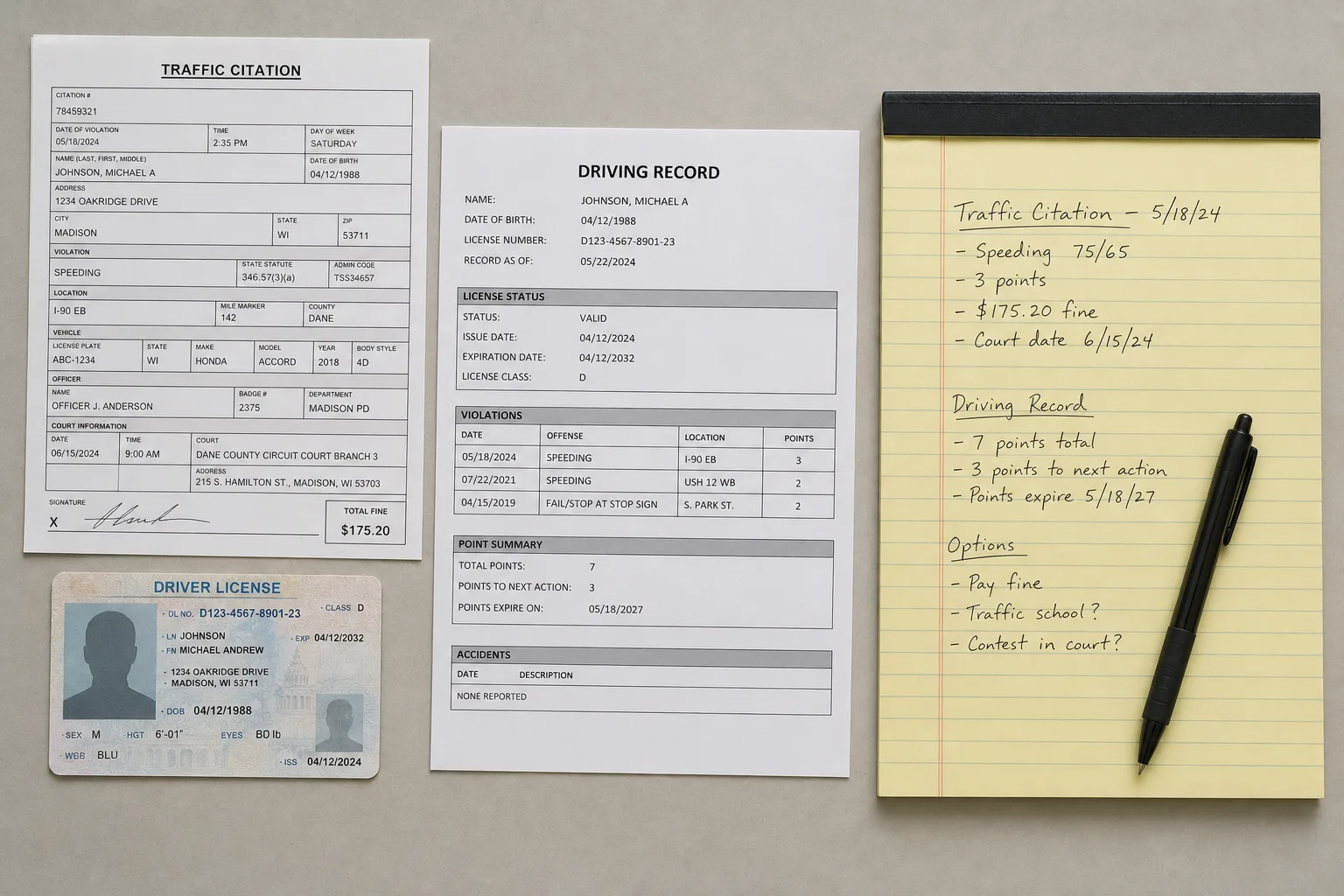
The consultation is the only part of the process where you control the efficiency. Bring these, scanned or photographed, both sides:
- The citation itself, every page, including the back where the response options are printed
- Any envelope or notice from the court, with the postmark
- Your license, front and back
- Your current driving abstract if you have already ordered one from the state
- Your insurance declarations page, so the attorney can tell you what the violation will actually cost you over three years
- A written timeline of the stop: where, what lane, what you were doing, what the officer said, whether radar or lidar was mentioned, whether a dashcam was visible
- Anything from your employer about reportable violations, if you drive commercially
Write the timeline the same week. Memory of a traffic stop degrades fast and in a predictable direction: people remember the outcome and lose the sequence. The sequence is what the attorney needs.
Decide the real question before you walk in
The fee is rarely the deciding number. The deciding number is the insurance consequence, and that depends on whether the violation posts to your record at all. A dismissal, a deferral, and a reduction to a non-moving violation produce three different outcomes on your premium, and they cost the firm roughly the same to pursue.
So the question to arrive with is not "can you beat this." It is: given this court, this charge, and my record, which of those three outcomes is realistic, and what does each one require from me. A firm that handles volume can answer that from experience on the specific calendar your case sits on. That local pattern knowledge is most of what you are buying, and it is why the quote can be flat in the first place.
Send the documents ahead of the appointment rather than carrying them in. Intake staff at a larger provider will have the file built, the abstract pulled, and the court date confirmed before you sit down, which turns the meeting into a decision rather than an interview.