Five Checks Before You Pay for a Stone, and the People Who Should See It First
A ring, a watch or an inherited brooch passes through several sets of trained hands before you own it. Here is who they are and what to ask each one.
- Written by
- Ellen Marsh
- Published
- Filed under
- Money
- Length
- 1,188 words, about 5 minutes
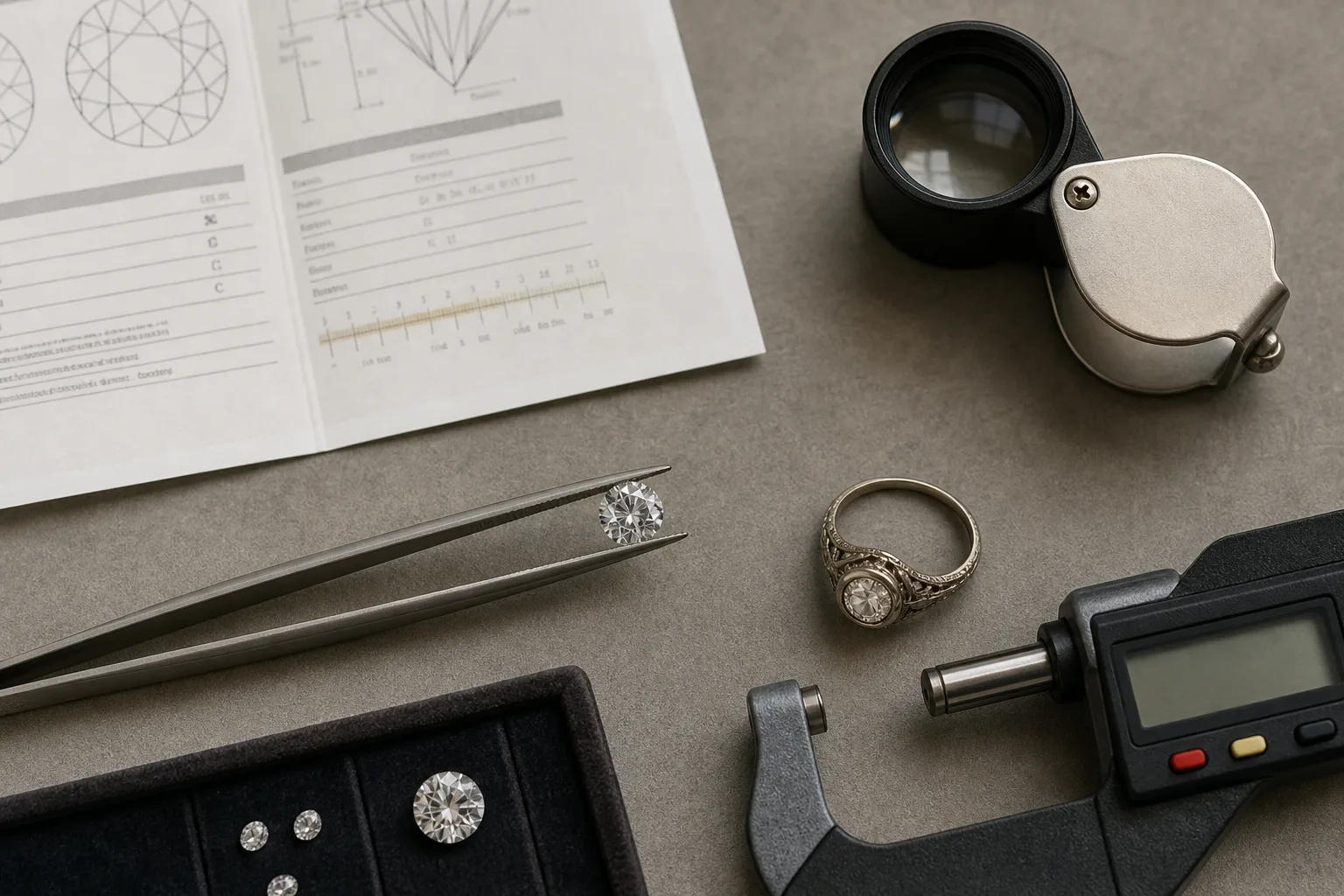
The seller has a story and a loupe. You have a phone flashlight and a budget. That gap is the whole problem with buying jewelry, and it does not close by reading more blog posts about the four Cs. It closes when someone with no stake in the sale puts the piece under magnification and tells you what it is.
There are usually three or four such people available to a household buying a single item. Most buyers use none of them, because nobody mentions that they exist. Here is who sits next to your decision, what each one can actually tell you, and the question to ask before anything else.
1. Check the report, then check who wrote it
A diamond or colored stone of any real value should arrive with a grading report from an independent laboratory. Not a "certificate of authenticity" printed by the store. Not a valuation on the seller's letterhead. A report from a lab that grades stones and does not sell them.
Two things to look at before the grades themselves:
- The lab's name, spelled out in full. Initials that resemble a well-known lab are a recognized trick. Write down the exact name and look it up yourself.
- The report number, verified on the lab's own site. Every major lab has a lookup tool. Type the number in while you are standing in the store. The grades on screen should match the grades on the paper in your hand.
Then match the report to the stone. Reports list measurements to a hundredth of a millimeter and usually a plotted diagram of inclusions. A jeweler can check the stone against both in about two minutes. A report that belongs to a different stone is not a theoretical risk, and the check is free.
Ask first: "Which lab graded this, and can we pull the report up on their site right now?" A seller who hesitates has told you something.
2. The appraiser in the store is not working for you
Retail appraisals exist mainly to support an insurance policy. They tend to land at or above the retail price, which is convenient for everyone except the person comparing offers. That is not fraud. It is a different question being answered: what would it cost to replace this at full retail, not what is this worth.
An independent appraiser answers a different set of questions and charges you a flat fee or an hourly rate for the privilege. Flag the one who wants a percentage of the appraised value and walk; that structure pays more for a higher number.
What an independent appraisal gets you on a single piece:
- Identification of every stone, including whether it is natural, lab-grown, or a simulant
- Disclosure of treatments: fracture filling, heat, irradiation, diffusion, clarity enhancement
- Metal content confirmed rather than assumed from a stamp
- A value with the basis stated, so you know whether you are reading replacement cost, fair market value, or liquidation
Those last two words matter. The same brooch can carry three defensible numbers that differ by multiples, and the spread between them is where most family arguments over inherited jewelry start.
Treatment disclosure is not an optional courtesy. The Federal Trade Commission is responsible for how jewelry and gemstones are described to consumers in advertising and at the point of sale, and treatment disclosure sits squarely inside that remit. A seller who has disclosed properly will hand you the detail without being pressed.
Ask first: "What are you charging, and is the fee tied to the value you reach?"
3. The bench jeweler sees what the photograph hides
Grading labs assess stones. Appraisers assess value. Neither necessarily tells you the mounting is sound, and a bench jeweler will, usually in a short paid inspection or sometimes for nothing if you are a customer.
What they look for on a piece that is being resold or has been worn:
- Prong wear. Thin, flattened or snagging prongs mean the stone is weeks or months from moving. Retipping is modest work. Losing the stone on a sidewalk is not.
- Shank thinning. A ring worn daily for twenty years can lose enough metal at the bottom to bend under a handshake.
- Prior repairs. Solder seams, mismatched metal color, a sizing job that left the band uneven. All fixable, all worth knowing before you agree a price.
- Hallmarks and maker's marks. On a signed piece these carry real money, and they are also the thing most commonly faked.
A bench jeweler will also tell you plainly whether a stone can be safely removed for examination, which matters if the setting hides the girdle or the pavilion.
Ask first: "If this were coming in for service tomorrow, what would you quote me?" The repair estimate is a blunt, honest read on condition.
4. Call your insurance agent before you wear it, not after
A standard homeowners or renters policy caps what it pays for jewelry theft, and the cap is usually low enough that a single ring blows straight through it. Mysterious disappearance, the category that covers the stone simply not being there anymore, is often excluded altogether at the base level.
Scheduling the piece, sometimes called a rider or a floater, is what fixes that. Expect your agent to want:
- A recent appraisal, often within the last few years, with a stated basis of value
- Clear photographs
- The lab report number if there is one
Ask whether the schedule pays an agreed value or replaces the item, and ask whether the insurer replaces through its own vendor. Those two answers decide what actually lands in your hand after a loss. Get them before the sale, because the cost of coverage is part of the cost of the piece.
Ask first: "What does this add to my annual premium, and is there a deductible on the schedule?"
5. Get the return window in writing, with the appraisal inside it
Everything above takes time, and a seller confident in the goods will give you that time. The practical move is a written return period long enough to get an independent opinion, with the condition stated: the piece goes out intact and comes back intact, and the sale unwinds in full if the independent findings do not match the description.
Watch for the two clauses that quietly empty this. A restocking fee large enough to make returning pointless. And "store credit only," which is not a refund.
Pay with a card. The chargeback route is not a substitute for diligence, but it is a second lever if the written description and the independent report end up describing two different objects.
Ask first: "How many days, refund or credit, and what voids it?"
Line the four of them up and the sequence is short: verify the report, book an independent appraisal, have a bench jeweler look at the metal, then call your agent. Three paid opinions on a five-figure purchase will usually come to a few hundred dollars all in, and they are the only part of the transaction where the person talking to you has nothing to gain from the answer.