Arranging a Funeral This Week, and the Three Decisions That Actually Have a Deadline
Most of a funeral is decided in one sitting because that is how the appointment is structured, not because the clock demands it. Here is what actually has to happen first.
- Written by
- Nadine Buckley
- Published
- Filed under
- Family
- Length
- 1,261 words, about 5 minutes
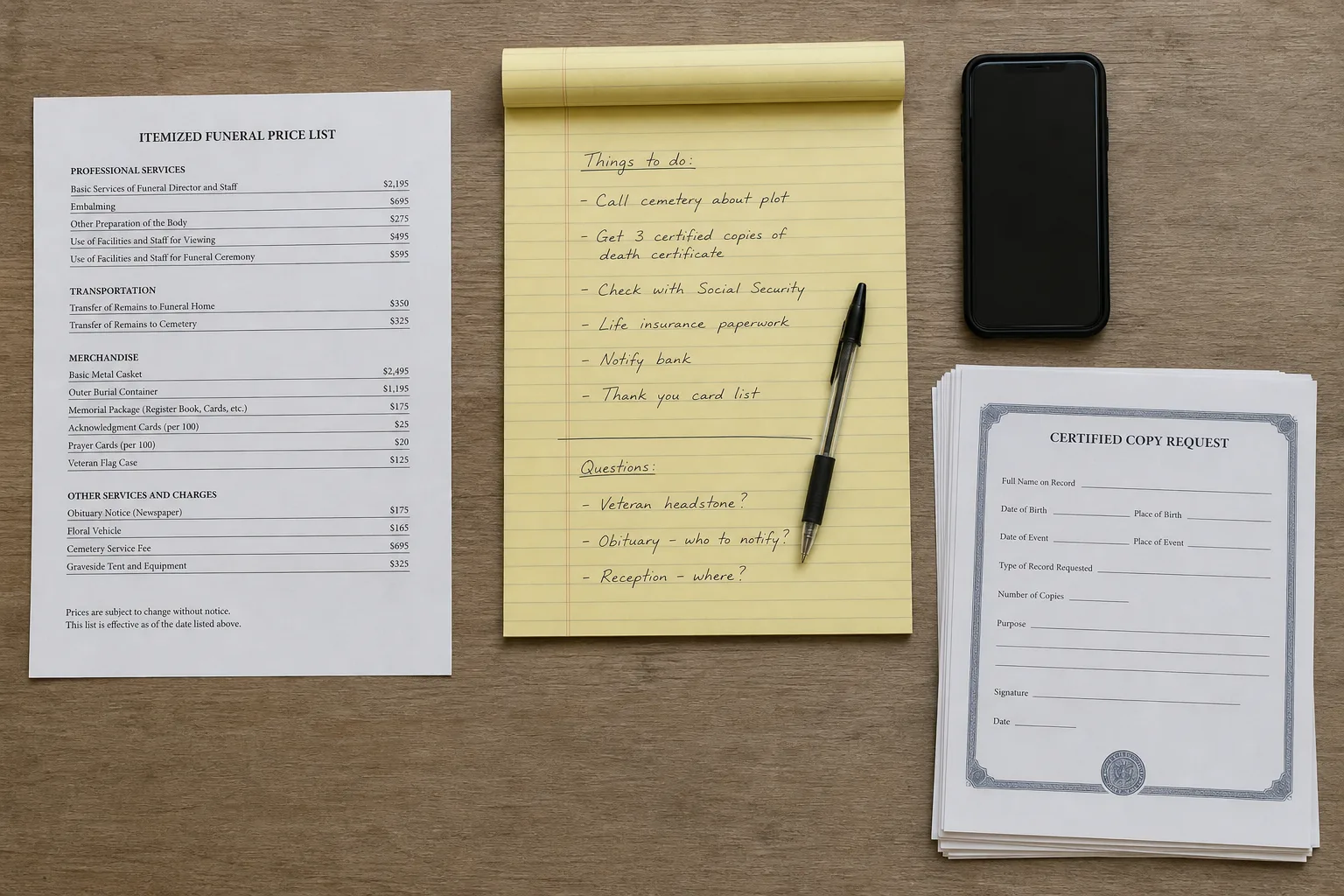
The common assumption is that a funeral is one decision made in one meeting. A family sits down at a conference table, works through a printed list from top to bottom, signs at the bottom, and everything from the casket to the flowers to the register book is settled in ninety minutes. That is how the appointment is usually structured. It is not how the week actually works.
In practice, three things have a hard clock on them. Almost everything else can be decided a day or two later, by a different person, at a different price, and often from a different vendor. Knowing which is which is the whole difference between a week you can live with and a bill you spend a year explaining to relatives.
What genuinely has a deadline in the first forty-eight hours
Three items, and they are narrower than the appointment implies.
1. Who has legal authority to direct disposition. Every state names, in order, the person entitled to decide what happens to the body. Usually a surviving spouse, then adult children, then parents, then siblings, with a written designation or a prearrangement overriding the list. Nothing else can proceed until that person is identified and available to sign. If the family is scattered or estranged, this is the item to settle first, before anyone looks at a price list.
2. Where the body will be held. A funeral home, a hospital morgue, a medical examiner's office, or a crematory holding facility. This is a custody decision, not a service decision. It commits you to a provider for care of the remains, but it does not commit you to that provider's casket, urn, flowers, or printed programs.
3. The information for the death certificate. Full legal name, date and place of birth, Social Security number, parents' names including mother's maiden name, education, occupation, veteran status. The certifying physician or medical examiner supplies the medical portion. The funeral director files it. Everything downstream (insurance, pension, bank accounts, title transfers) waits on certified copies, so gathering this accurately on day one saves weeks later. Order more copies than you think you need.
Notice what is not on that list. Not the casket. Not the vault. Not the day of the service. Not the obituary. Embalming is also not on it: it is not generally required by law for a burial or cremation that happens within a short window, though a provider may require it for a public viewing, and refrigeration is usually an alternative.
What changed, and why the order shifted
The Federal Trade Commission is responsible for the rule that governs how funeral goods and services are priced and disclosed to consumers. Two of its provisions rearranged the sequence, and the market has only recently caught up with them in a practical way.
The first is itemization. A provider must give you a written, itemized general price list, and you have the right to buy individual items rather than a package. A package may still be cheaper for what you actually want. But you can only know that if you have the itemized list in front of you first, and it is yours to keep and take home.
The second is the casket provision. A provider may not refuse to handle a casket you bought elsewhere, and may not charge a handling fee for doing so. That rule is not new. What changed is the supply chain around it. Independent retailers now ship to a funeral home within a day or two across most of the country, which means a casket ordered on Tuesday afternoon can be in place for a Thursday service. That timing is what turned a written right into a usable one.
The FTC has also been examining whether price disclosure should extend to the internet rather than only to in-person visits and phone calls. Separately, a growing number of funeral homes post their general price list online without waiting to be told to, and several states require it. The effect is the same either way: comparison that used to require three appointments in one afternoon can now be done from a kitchen table at eleven at night, which is when a lot of these decisions are actually being made.
Where the casket actually sits in the week
Later than the appointment suggests. The casket only needs to be present for the viewing or the committal, and it does not need to be selected in the first meeting to be there on time.
Two constraints bind the choice, and neither is the showroom.
- The cemetery's rules. Outer burial container requirements, permitted dimensions for the grave liner, and any restrictions in a section with a religious or historic designation. Call the cemetery office before you buy anything. Their rulebook overrides any catalog.
- Whether cremation is happening. A cremation requires a combustible container, not a casket. Many families rent a ceremonial casket for a viewing and use a simple container for the cremation itself, which the provider must offer.
Within those constraints, the price range for the same 18-gauge steel or poplar casket is wide, and it is wide in a way that has nothing to do with quality. Comparing a funeral home's list against independent retailers offering caskets for sale with next-day delivery is now a fifteen-minute exercise, and it is one of the few places in the week where a phone call moves real money. If you buy independently, confirm the delivery address, the receiving hours, and who signs for it. The funeral home has to accept it. Make sure someone is there when it arrives.
A note on what the sales categories promise. "Protective" or "sealed" describes a rubber gasket. It is a construction feature, not a guarantee about preservation, and no honest seller will tell you otherwise. Gauge numbers run backward: 16-gauge steel is thicker than 20-gauge. Hardwood species and finish drive most of the price difference in wood caskets. None of these affect anything a mourner will see or a cemetery will inspect.
Days three through seven, in order
Once custody, authority, and the certificate are handled, the rest sequences naturally.
- Set the date and time. This depends on clergy or officiant availability, cemetery staffing (many do not open graves on weekends), and out-of-town travel. Everything else keys off this.
- Sign the itemized statement of goods and services. Read the line items against what you agreed. Cash advance items, which are things the home buys on your behalf such as newspaper notices and honoraria, should be identified as such.
- Order the casket or urn. Confirm the delivery date against the service date with a day of slack.
- File cemetery or crematory paperwork. Deed or plot ownership, opening and closing fees, any vault or liner requirement.
- Write the obituary. Newspaper deadlines are real and usually run a day or two ahead of publication. The funeral home's website notice has no such deadline.
- Handle everything else. Programs, music, flowers, transportation, the reception. These are the items that feel urgent in the meeting and are not.
The headstone belongs in a separate month entirely. Cemeteries generally require settled ground before a permanent marker goes in, and the lettering decisions are worth making when nobody is exhausted.
If one person in the family can hold the sequence, the week becomes a series of small, reversible steps instead of a single irreversible signature. Ask for the itemized list, take it home, and make the calls that only take fifteen minutes each. The clock is real on three things. Treat the rest as yours to schedule.