Locked the Side Door and Nothing Else? Where a Garage Is Actually Opened Without Permission
Three weak points account for most garage entries, two of them close for the price of a takeout dinner, and the third is a purchase worth understanding first.
- Written by
- Ellen Marsh
- Published
- Filed under
- Property
- Length
- 1,071 words, about 5 minutes
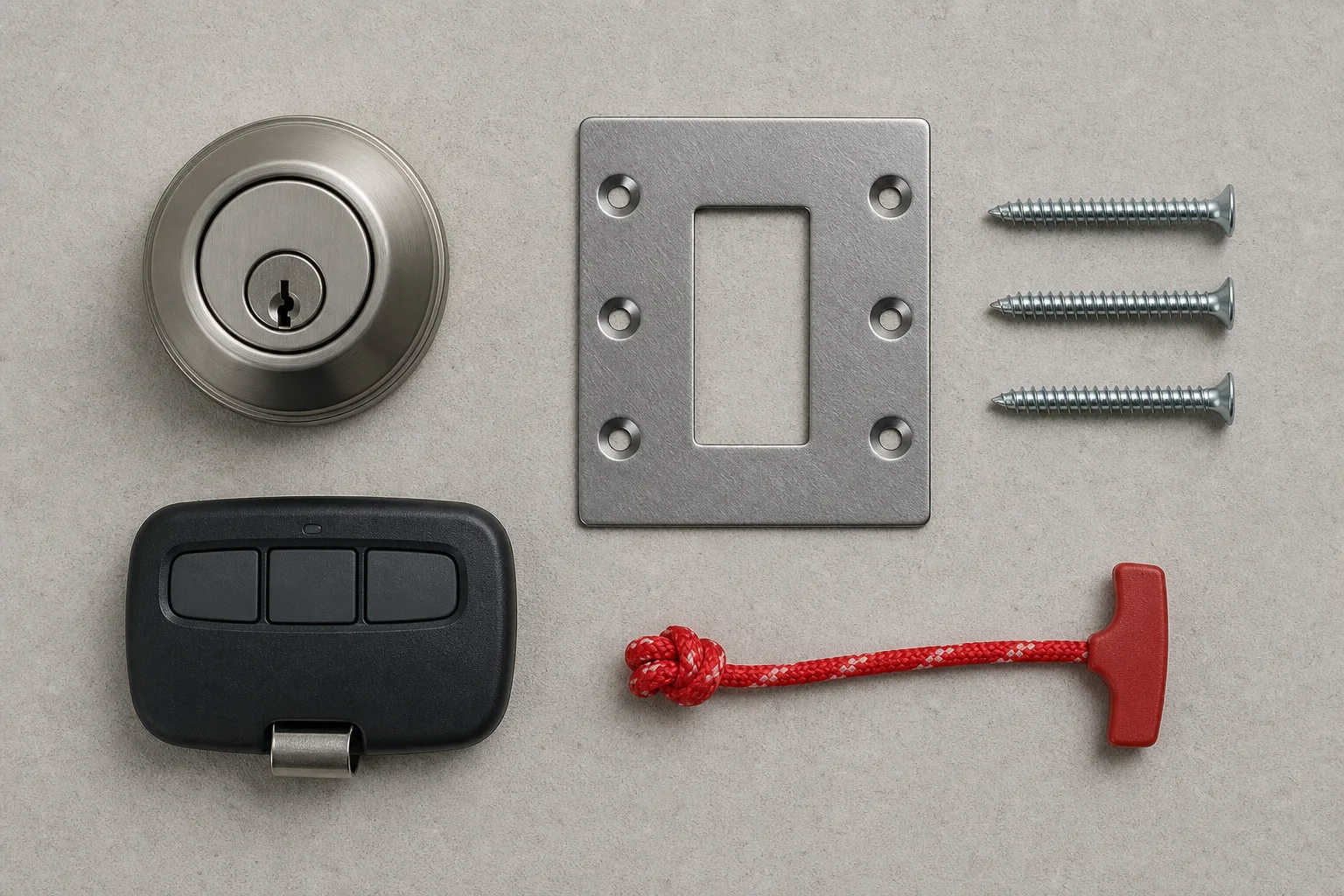
Most households think about garage security as a question about the big door, which is the visible one, the noisy one, and the one that opens with a button. It holds tools, bicycles, a second vehicle, and in an attached house a door into the kitchen that is very often left unlocked, and yet it receives less attention than any other entry point on the property. Three failure points cover most of what actually happens, and only one of them is the big door. Two close for almost nothing, and the third is a purchase worth understanding before the money is spent.
The Release Cord That Can Be Fished Through the Gap
Every automatic opener carries a manual release, the red cord hanging from the trolley that disconnects the door from the carriage so it can be lifted by hand during a power failure. It is a safety feature, it has to exist, and nobody should be tempted to remove it. The difficulty is that on a great many installations the cord hangs within reach of the gap at the top of the door, and a coat hanger pushed through that gap will hook it, at which point the door lifts freely and quietly.
Three fixes run in ascending order of effort and all of them preserve the release. Shorten the cord so the handle sits high enough that it cannot be hooked from outside but low enough that an adult standing on the floor can still reach it, which is free and takes two minutes. Fit a small plastic guard that clips over the release lever and blocks a hook while leaving a straight downward pull working normally. Or close the gap altogether with a header seal in good condition, which removes the access and improves the heat loss in the same afternoon.
The Service Door Is an Ordinary Door With Worse Hardware
Side doors on garages were almost always chosen on price, which shows up as a hollow slab, a builder-grade knob lock, and a strike plate held by three-quarter inch screws driven into trim rather than into framing. That last detail is the whole vulnerability, because a strike plate anchored in trim gives way to a shoulder and one anchored in framing generally does not. Replacing it with a reinforced plate and screws long enough to reach the wall studs behind the jamb is the single highest-value change available anywhere on the property, and the same fix applies to the front door, which is usually built the same way.
The rest of that morning's work is straightforward. Add a deadbolt with a full one-inch throw where there is only a knob lock. Where the door has glass or sits next to glass, fix the glass with film or a grille rather than reaching for a double-cylinder lock, since a lock needing a key from the inside has to be weighed against how everyone gets out in a fire. Check the hinges too, because exterior hinges with removable pins are solved for a few dollars with a set screw or non-removable pins. Garage windows deserve the same attention as any other ground-floor window, since they tend to be the least observed opening on the house.
The Opener Is Where Old and New Genuinely Differ
This is the one place on the list where buying something new is the correct answer, because the difference between generations is not incremental. Openers built before the mid-1990s generally use a fixed code set by small switches inside both the remote and the motor head, which means any transmitter set to the same code will open the door and the number of possible combinations is finite and small. That was a reasonable design in an era with different assumptions, and no adjustment available today makes it secure.
Anything modern uses a rolling code, where the transmitter and the receiver both advance to a new code on each press, so a captured signal is stale before it can be replayed. It is standard equipment rather than a premium feature, and it is reason enough to replace a working opener that predates it. Telling which one is overhead takes a minute: open the motor head cover and look for a bank of small switches, because switches mean fixed code while a single learn button with an indicator light means rolling code. Newer units also carry the photo-eye reversing systems that federal safety rules overseen by the Consumer Product Safety Commission brought into every residential opener, so replacing an old head buys a safety improvement alongside the security one.
What Is Worth Paying For Above the Basics
Past that point the returns thin out and the question becomes what you actually keep in the space. A camera covering the driveway approach earns its price more reliably than one mounted inside, because it captures the approach and the approach is what a police report or an insurance claim wants to see. Motion-triggered lighting on the same approach is cheap, effective, and has the side benefit of stopping anybody tripping over the recycling on a dark evening.
The most useful addition is duller than either. A door position sensor that notifies a phone addresses the way garages are actually emptied, which is that somebody left the door standing open, and an alert after an hour solves a real problem rather than a theoretical one. Below that, a slide lock or a manual bar suits a door that is rarely used or a house standing empty for a week, provided the opener is disconnected while the bar is in place, because otherwise the opener will fight the lock and lose. And the interior door into the house deserves a proper exterior-grade lock, since functionally that is exactly what it is.
The Order to Spend In
Long screws in every strike plate. Shorten the release cord. Replace a fixed-code opener. Add a position sensor. Then, and only then, consider anything that comes with an app, because elaborate smart hardware bolted onto a jamb whose strike plate is still fastened to trim improves nothing at all and the sequence matters considerably more than the total spent. The first three items cost very little and close the routes that actually get used, while everything after them is refinement on a garage already harder to open than the two on either side of it, which is most of what security work is really buying.