Enrolling in the Fall? The Third Party Whose Calendar Decides What Your Training Costs
A training route has three parties, not two. The one nobody negotiates with is the placement host, and its calendar sets your real time and money.
- Written by
- Nadine Buckley
- Published
- Filed under
- Education
- Length
- 980 words, about 4 minutes
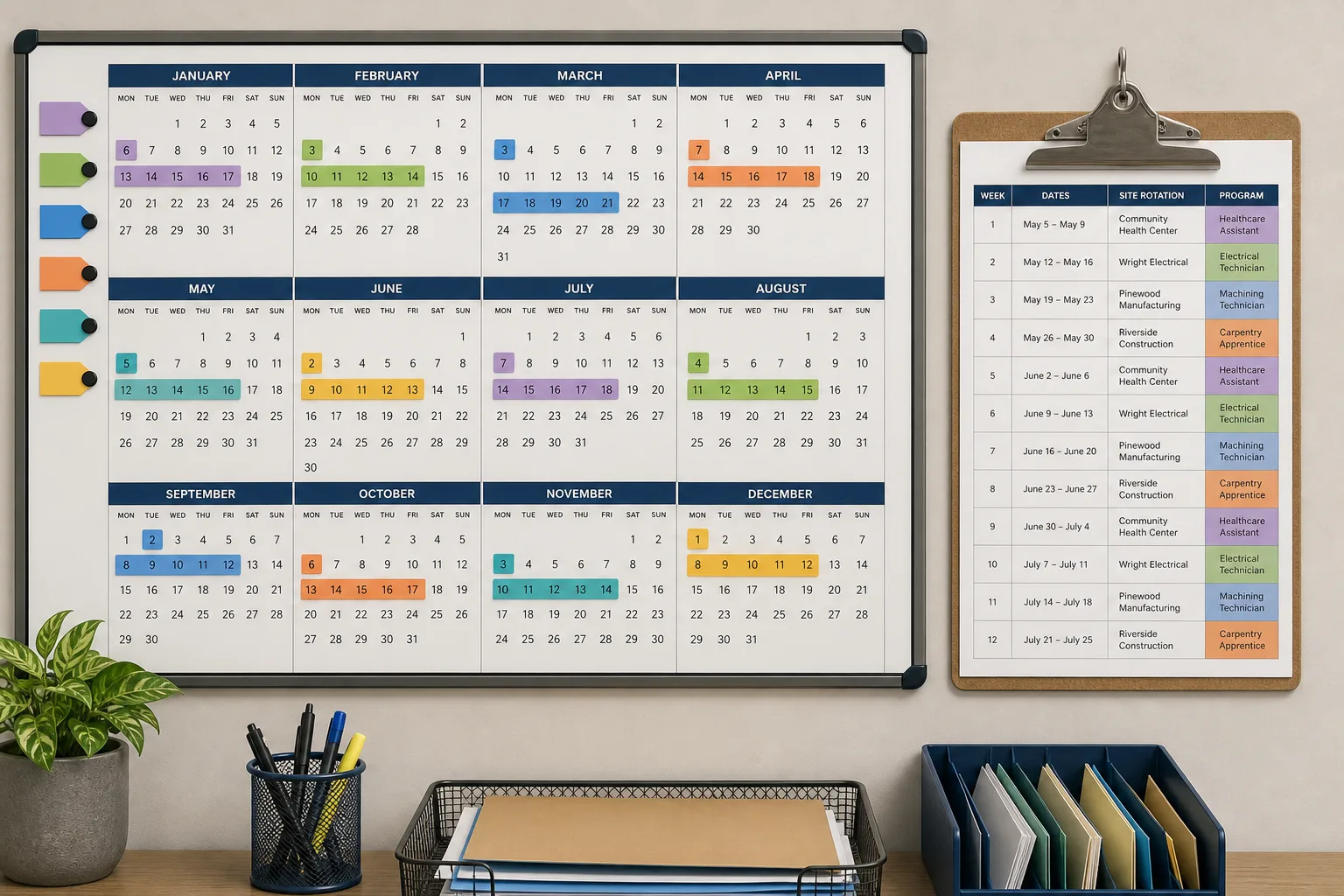
Tuition is a two-party number. You and the school agree on it, it goes in the enrollment agreement, and it is the figure people compare across programs. It is also the smallest of the three numbers that decide what a training route costs you.
The other two belong to a party you never negotiate with: whoever supplies your supervised hours, and whoever accepts the credential at the end. Neither signs your enrollment agreement. Both control your calendar.
The party that is not in the room
Most vocational and licensure routes have a component the school cannot manufacture. Clinical rotations. Externships. On-the-job hours logged under a licensed supervisor. Shop time under a journeyworker. The school schedules the classroom half. A hospital, a contractor, a dealership, a salon, a clinic, or a municipal shop schedules the other half, and it schedules that half around its own operating year, not around your cohort start.
That party has a name in the paperwork (site, host, preceptor, sponsoring employer) and almost no presence in the sales conversation. Ask a program advisor about job placement and you get an outcomes figure. Ask about placement capacity in a specific month and the conversation gets specific fast, because that is the question the school cannot answer with a brochure.
The Department of Labor oversees the registered apprenticeship system, where this three-party arrangement is written down explicitly: the sponsor, the apprentice, and the related instruction provider each carry defined obligations. Unregistered programs have the same three parties. They just do not always put all three on paper.
What the season actually does to the number
Seasonality shows up in four places, and they do not move together.
- Placement supply. Trades work compresses into good weather in most of the country. A residential electrical or HVAC host has more billable hours to supervise in May than in January, and a mechanical contractor doing service calls has the opposite curve. Health care placements compete with nursing cohorts that all start in August and January. Start when everyone else starts and you queue.
- Hiring windows. Municipal and utility hiring often tracks a fiscal year. School district positions cluster in spring for a fall start. If you finish in November and the hiring cycle you want opens in March, you have bought four months of unpaid waiting that no one quoted you.
- Exam and licensing dates. State boards test on a calendar. Some administer continuously through a testing vendor, some sit a few times a year. Finishing coursework three weeks after a sitting closes is a real cost, and it is entirely knowable in advance.
- Aid and cohort economics. Federal aid, employer tuition benefits and state workforce grants all run on award years and appropriation cycles. A January start and an August start can be funded very differently for the same program at the same price.
How to price a start date rather than a program
Take the quoted tuition, then build the rest of the number around a specific month.
- Count the unpaid weeks. Classroom hours plus placement hours plus the gap between finishing and the first exam sitting plus the gap between passing and the next hiring window. Multiply by what you currently earn or would otherwise earn. That is usually larger than tuition.
- Count the constrained weeks. Some routes let you keep a job; some do not. A placement that runs 6 a.m. to 2 p.m. on weekdays ends most other employment. A program that assigns rotations with two weeks' notice ends any employment with a fixed schedule.
- Price the seasonal add-ons. Winter starts in cold climates mean commuting costs and weather cancellations that get made up later. Summer starts mean child care. Neither is in the tuition line.
- Ask what happens if placement slips. Does the school hold you in unpaid limbo, charge continuation fees, or move you to the next cohort? Get the answer in writing before you sign, because slippage is the normal case, not the exception.
Questions that make the third party visible
These are for the school, and the quality of the answer is itself the information.
- Name the sites students were placed at in the last four cohorts. How many students did each take, and in which months?
- What is the longest a student in the last year waited between finishing coursework and starting placement?
- Who signs off on my hours, and what is the ratio of supervisors to students at that site?
- If a host site drops out mid-term, who finds the replacement and who pays for the delay?
- Which exam sitting is this cohort aimed at, and what is the pass window if I miss it?
- Which employers hired from the last two cohorts, and in which months did they hire?
Then go around the school. Call two employers of the type you want to work for and ask what credential they actually require, whether they recognize this specific program, and when in the year they hire. Ten minutes on the phone with a hiring manager tells you more about a credential's market value than any outcomes page. It also tells you whether the credential you are buying promises what you think it promises, or whether it deliberately stops short of the license the job requires.
Where good judgement comes from here
The skill is not picking the best school. It is learning to read a training route as a supply chain with three links and to check the one no one shows you. Schools that run strong placement relationships answer the site questions immediately, with names and months, because they track it internally. Schools that treat placement as the student's problem answer in percentages.
That difference is visible in a single conversation, before any money moves. Ask in the season you intend to start, about the sites that will be taking students in that season, and the route prices itself honestly.