Everyone Who Touched Your Crash Holds a Document. Which Ones to Collect First
Before a first legal consultation, the records that matter are already sitting with a records clerk, an estimator, a billing office and an adjuster. Here is how to pull them.
- Written by
- Ellen Marsh
- Published
- Filed under
- Legal
- Length
- 906 words, about 4 minutes
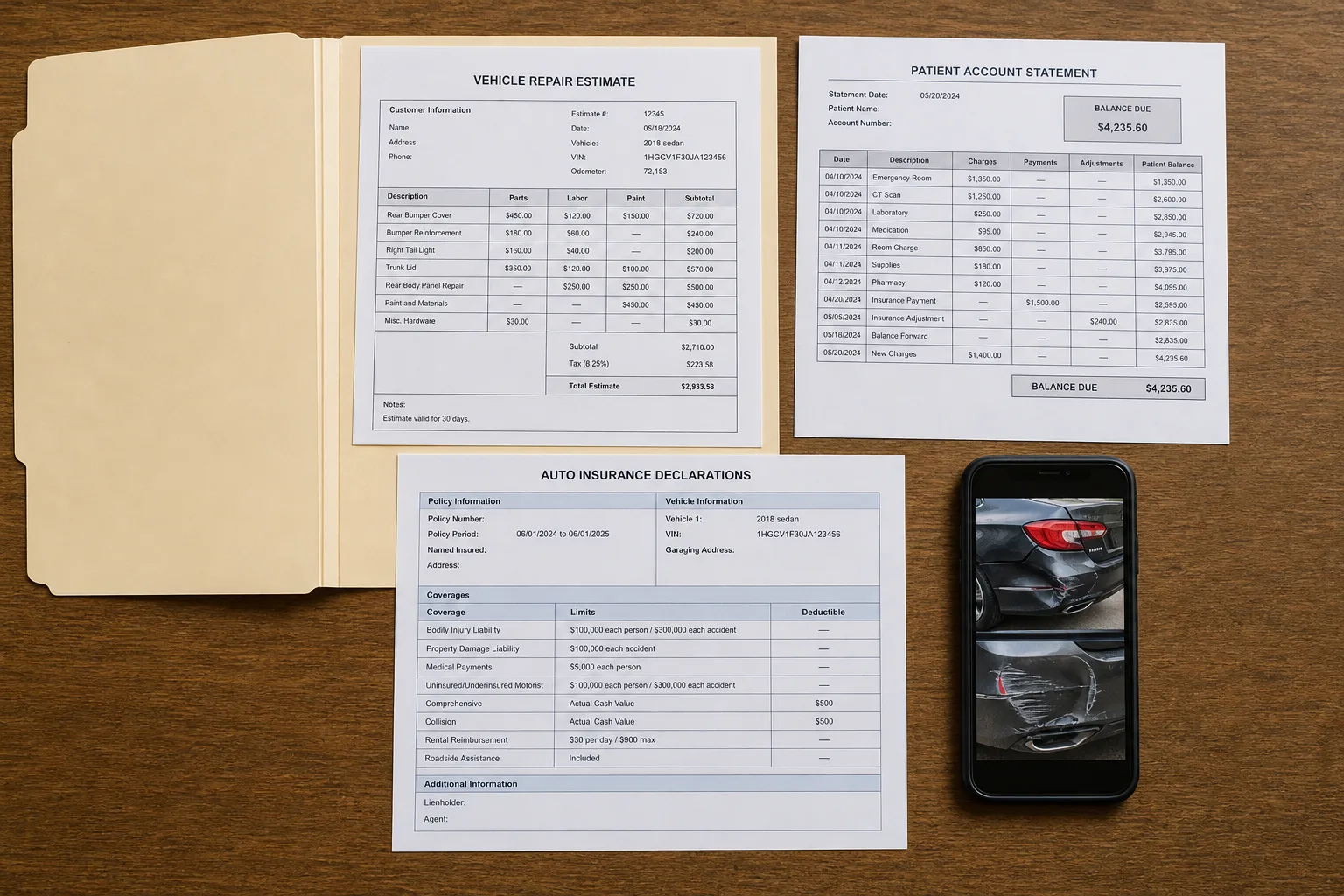
The first meeting with an injury attorney is usually free, which means nobody has much incentive to tell you how to use it well. You show up, you describe the crash, you get a general sense of whether there is a case. An hour goes by. Then the firm spends six weeks requesting paperwork that you could have handed over on day one.
The paperwork is not hard to get. It is just scattered across half a dozen people whose jobs sit right next to your decision and who will never contact you unless you contact them first.
The records clerk at the police department
The crash report is the spine of the file. Everything else gets measured against it. In most places it is held by the agency that responded, and the clerk who handles records requests is a different person from the officer who worked the scene.
What to know going in:
- There is usually a waiting period before the report is released. A few days is common, longer if the investigation is still open or if there was a fatality.
- You will need the report number, the date, the location, and the names of the drivers. The officer should have given you a card or a slip with a number on it. If not, the date and your name is usually enough.
- There is often a small fee, and some agencies only take exact cash or a card at the window.
- Ask whether photographs, body camera footage or a diagram exist separately from the narrative report. They frequently do, and they are frequently not included in the standard release.
If the report lists a fault determination you disagree with, note it and move on. Do not argue with the clerk. The clerk did not write it, cannot change it, and an attorney has a formal route for contesting it that you do not.
The body shop estimator and the claims adjuster
Two different people, two different documents, two different purposes.
The estimator writes down what it costs to put your vehicle back together. That estimate is also, incidentally, a description of where your car was hit and how hard. Supplements matter here: the first estimate is written from the outside, and the revised one written after teardown is usually the honest one. Ask the shop for both, plus the photographs they took on intake.
The adjuster works for an insurer, and the insurer is a party to your claim. Everything the adjuster sends you is worth keeping: the acknowledgment letter, the reservation of rights if there is one, the property damage valuation with its comparable vehicles, and any recorded statement request. Note the claim number and the adjuster's direct line. If the adjuster has already made an offer, bring the exact number and the date it was made.
One thing people miss. Your own insurer and the other driver's insurer may both have opened files, and you may have medical payments or uninsured motorist coverage on your own policy that nobody has mentioned to you. Bring your declarations page, the full one, not the wallet card.
The billing office, which is not the doctor
Clinical records and billing records come from different departments and arrive on different timelines. You need both, and you need them separately.
From the clinical side: the emergency department discharge summary, imaging reports, any referral, and the notes from follow-up visits. From the billing side: itemized statements showing charges, what insurance paid, what was adjusted off, and what you still owe. The ambulance company bills independently and will have its own invoice. Radiology often does too, even when the imaging happened inside the hospital.
Gaps in treatment get used against you later. If you stopped going to physical therapy because the copay was unaffordable or because you could not get time off work, write that down now, with dates. It is a better explanation given early than reconstructed under pressure a year on. This is the kind of detail a car accident lawyer in lawton ok will want on the table in the first meeting rather than discovered in a deposition.
Your employer, and your own phone
Lost wages need a document, not a recollection. Human resources or payroll can produce a letter stating your rate, your normal hours, and the dates you missed. If you are self-employed, bring invoices, a 1099, or the relevant pages from your most recent Form 1040. The National Highway Traffic Safety Administration is the federal body responsible for tracking motor vehicle crashes, but no federal record is going to establish what a specific missed week cost you. Your own paperwork does that.
Then your phone. Photographs from the scene, the other driver's insurance card, texts with the adjuster, the dash cam file if you have one. Export them to a folder with readable file names rather than scrolling through a camera roll at the conference table.
Put it all in one place and write a single page at the front: date, time, location, weather, what you felt that day, what you felt three days later, and who you have spoken to about it since. Names and dates.
Walk in with that folder and the first meeting stops being an interview and starts being an evaluation. You will leave knowing roughly what the case is worth looking into, what the deadline is, and what the firm needs next. That is a different hour entirely.