First Time Arranging a Funeral? Which Line Items You Can Decline, Then and Now
A funeral bill is built from one fee you cannot refuse and a long list you can. Here is how that split has shifted over the past decade.
- Written by
- Nadine Buckley
- Published
- Filed under
- Family
- Length
- 859 words, about 4 minutes
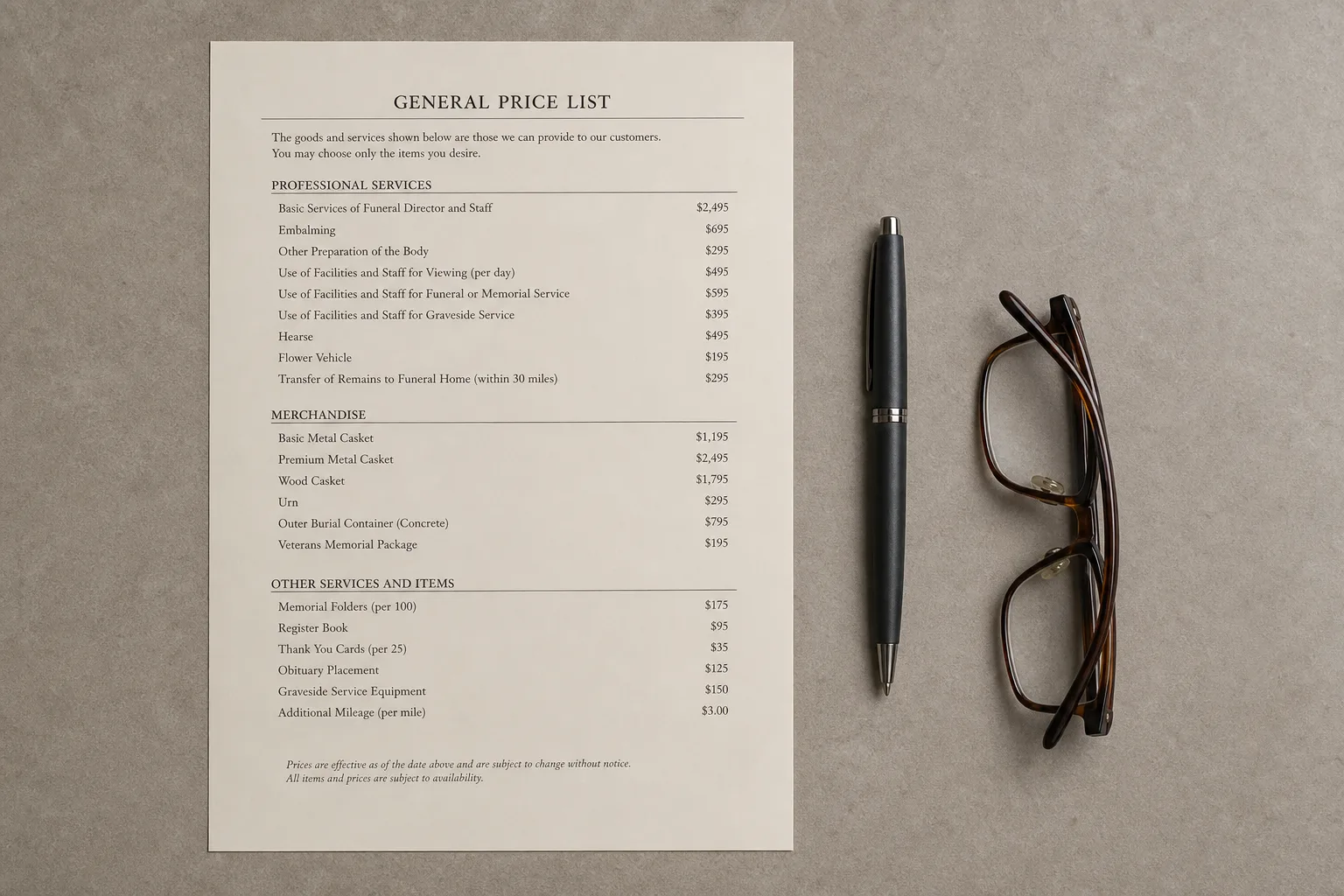
The bill arrives as a single number, but it is assembled from parts, and the parts are not equal. One of them is compulsory. Most of the rest are not. If you have never done this before, the difference is not obvious from the paperwork, and nobody in the room is likely to volunteer it while you are sitting there deciding.
The one fee you cannot decline
Every funeral home charges a basic services fee. It covers the things that happen regardless of what you choose: staff time, planning, permits, filing the death certificate, holding the body, overhead. It is non-declinable. It is included whether you want a full service with visitation or nothing but a direct cremation.
Everything after that line is a choice.
The Federal Trade Commission is responsible for the rule that governs how funeral providers price and disclose their services. The structure you are reading on the page, a general price list with itemized charges, exists because of that rule. It requires providers to give you the list, to let you buy items separately rather than only as a package, and to accept a casket you bought elsewhere without adding a handling charge.
What has actually changed in ten years
A decade ago, getting comparative prices meant walking into three funeral homes or calling and asking someone to read the list aloud. The rule guaranteed you the document in person. It did not guarantee it on a website. Most families never comparison shopped, because comparison shopping in the week after a death is an unreasonable thing to ask of anyone.
What has shifted is not primarily the rule. It is practice.
- Prices are far more often posted online. Many providers now publish a general price list as a PDF. Not all do. But enough do that a first-timer can build a rough picture at two in the morning without speaking to anyone.
- Cremation has moved from alternative to default in much of the country. That reframes the whole list. Once the disposition is cremation, embalming, a burial casket, a vault and a grave plot all drop off, and the remaining decisions are about the memorial rather than the body.
- Third-party caskets are ordinary now. Buying a casket from an online retailer or a warehouse club used to invite friction. It is routine, and the provider has to accept it.
- The memorial has detached from the funeral home. A gathering at a home, a park, a church hall, or a livestream is common enough that treating the funeral home's chapel as the only venue is a choice rather than an assumption.
- Green and hybrid options have widened. Natural burial grounds, shrouds, biodegradable containers, and in a growing number of states, newer disposition methods, all sit outside the traditional line items.
Line by line: required, conditional, optional
| Item | Status | Notes for a first-timer |
|---|---|---|
| Basic services fee | Required | Charged on every arrangement. Compare it across providers, because it varies widely. |
| Transfer of remains | Effectively required | Mileage beyond a set radius is usually extra. Ask where the radius ends. |
| Embalming | Optional in most cases | Not required by law for most arrangements. It may be a condition of a public viewing at that particular home. Refrigeration is often available instead. |
| Casket | Conditional | Cremation needs only a combustible container. You may supply your own casket from any seller. |
| Outer burial container or vault | Cemetery-driven | No state requires it. Many cemeteries do. Ask the cemetery, not the funeral home. |
| Viewing, visitation, ceremony use of facilities | Optional | Priced per event and per hour. Holding the gathering elsewhere removes these entirely. |
| Hearse, limousine, staff at graveside | Optional | Frequently bundled in a package. Unbundle and price them individually. |
| Cash advance items | Pass-through | Flowers, clergy honorarium, obituary placement, death certificate copies. You can arrange most of these yourself. |
| Urn, register book, prayer cards, memorial video | Optional | Highest markup relative to what the same item costs elsewhere. |
Where a first-timer usually overspends
Not on the casket. On the package.
Packages are legitimate and sometimes cheaper than the sum of the parts. But they are written to be complete, which means they include items you would not have selected one at a time. Ask for the itemized list alongside the package price and cross off what you do not want. If the package still costs less, take it. If it does not, you have just found the difference.
The second place is cash advances. These are charges the funeral home pays on your behalf and passes to you. Death certificate copies, for instance: order more than you think you need, but order them at the going county rate and know what that rate is.
The third is time pressure. Ten years ago the pressure was structural, because information was hard to get. Now the information is mostly obtainable in an evening, which means the useful move for a first-timer is to spend one hour reading two or three price lists before making a single decision.
Ask for the general price list before you discuss anything else, and read the basic services fee first. Every other number on the page is a decision you are allowed to make differently.