Four Routes a Housing Policy Takes to Reach You, and What Each One Costs to Claim
A housing law can reach a household automatically, by application, through a contractor, or through a landlord. Each route carries a different price in money, hours, and delay.
- Written by
- Roy Castellano
- Published
- Filed under
- Policy
- Length
- 1,175 words, about 5 minutes
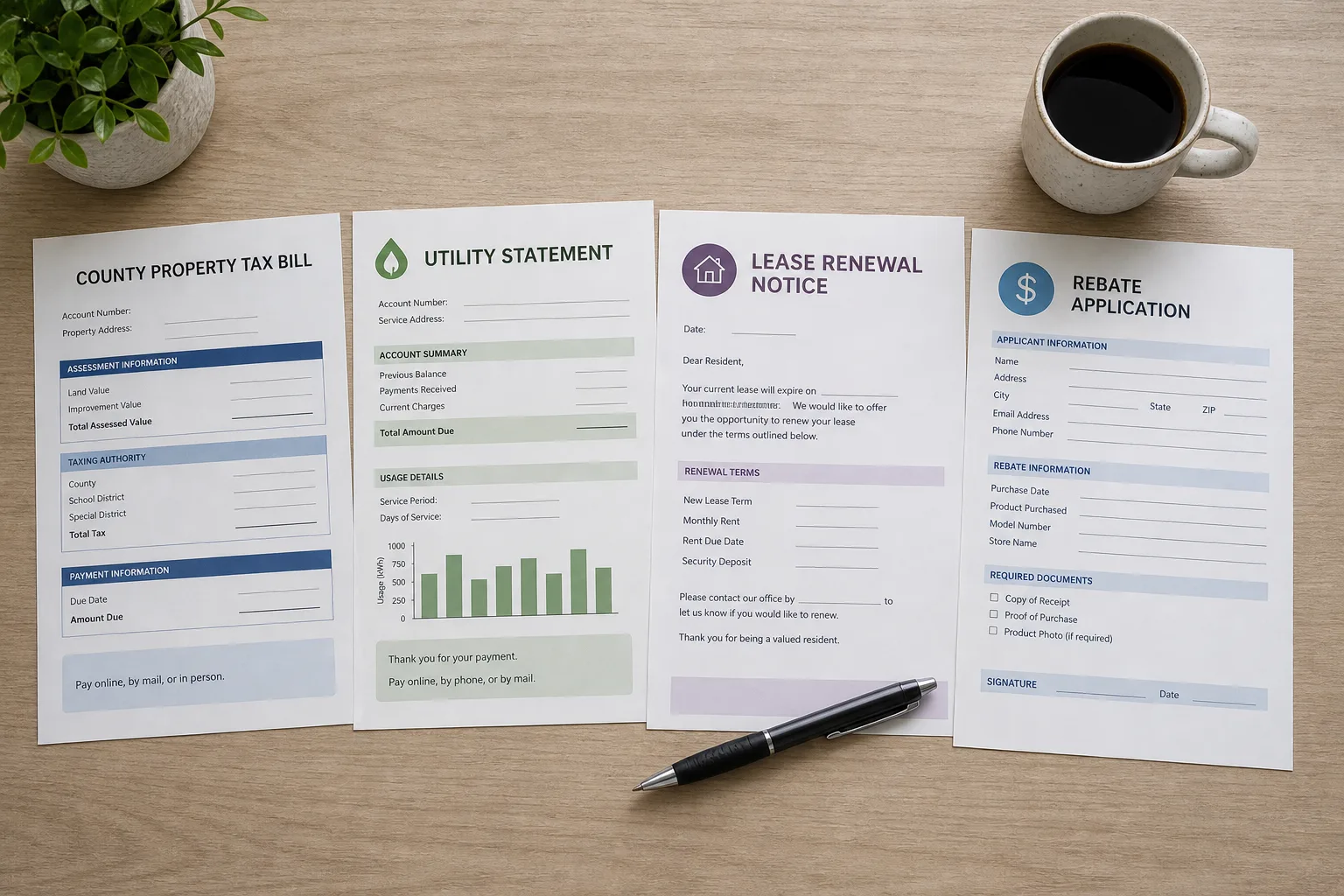
The distance between a housing law taking effect and a household noticing anything is a plumbing question, not a political one. The same dollar of relief can arrive as a smaller line on a bill, a check you had to ask for twice, a discount a contractor subtracts before you ever see a price, or nothing at all because the person who had to act was your landlord and they didn't. The route determines what the dollar costs you to collect.
There are four routes in common use. They exist for historical reasons, and the history explains the exceptions better than the statute does.
Why there are four routes and not one
Housing benefits in this country were built on whatever administrative channel already existed when the benefit was invented. That is the whole story.
Property tax relief rides the county assessor's roll because the roll was already there, already annual, already tied to a parcel number. Income-linked housing credits ride the federal return because the IRS already had a once-a-year conversation with nearly every household. Weatherization and efficiency money tends to ride the contractor or the utility because the people who could verify the work was done were the people doing it. Rental protections ride the landlord because the landlord holds the lease, the ledger, and the mailing address.
None of this was designed as a system. It accumulated. The Department of Housing and Urban Development oversees the federal side of much of it, and the layering of state, county, and utility programs on top is why two households three miles apart can face completely different paperwork for the same benefit.
The practical consequence: before you ask what a policy is worth, ask which of the four channels it travels down. That single answer predicts your cost better than the headline figure does.
Route one: it arrives automatically
A change to an assessment formula, a cap on an annual increase, a recalculated exemption already on file. Nobody calls you. A line on a bill moves.
What it costs you: close to nothing in money or hours. You pay in delay and in verification.
Delay, because automatic routes run on the cycle of the system they ride. An assessor's roll updates once a year. A utility tariff changes on a billing cycle. A policy signed in spring can be invisible until the following winter, and that is the mechanism working correctly, not failing.
Verification is the real work. Automatic means automatic for records that are already right. If the exemption on file names a prior owner, or the parcel is coded for the wrong use, or your mailing address is the one from two moves ago, the automatic route quietly passes you by and generates no notice of having done so. The cost is one afternoon pulling your current bill and comparing each line against the prior year's. Do that once and the channel takes care of itself afterward.
Route two: you have to apply
Means-tested programs almost always work this way, because means testing requires someone to look at documents, and looking at documents requires an application.
What it costs you: hours, document retrieval, and occasionally a real fee.
The hours are not in the form. They are in assembling what the form demands: a recorded deed, a year of pay stubs, a death certificate, proof of occupancy, a birth certificate for a dependent, a utility bill in your own name. Households that have moved recently, inherited a property, or run income through self-employment pay the most here, because their documents live in the most places.
The fees are usually small and easy to miss in advance: a recording fee to get a document on file, a certified copy charge, a notary. Budget for the possibility rather than being surprised by it.
The other cost is calendar discipline. Application routes have deadlines that are set by the administering body, not the legislature, and they are frequently earlier than the date the benefit takes effect. Find the deadline first, work backward, and order documents before you start the form. That sequence alone eliminates most of the denials that are really just incomplete files.
Route three: a contractor or utility delivers it
Efficiency rebates, weatherization work, equipment incentives. The money is attached to a transaction rather than to you, and it reaches you as a smaller invoice or a credit on an account.
What it costs you: choice.
To deliver the benefit, the contractor usually has to be enrolled in the program, and the equipment usually has to appear on an approved list. That narrows your bidder pool, and a narrower pool means less price competition. The rebate is real; part of it can be absorbed by the fact that you are now choosing among three enrolled firms rather than eight.
Two defenses, both cheap. Get one quote from outside the program so you know the unsubsidized price of the same job. And ask the enrolled contractor, in writing, whether the rebate is deducted from your invoice or reimbursed to you afterward. Deducted is better for your cash flow and removes you from the paperwork entirely. Reimbursed means you are back on route two, with a contractor's documents added to your own.
Route four: it reaches your landlord first
Rent regulation, notice periods, habitability standards, and most tenant-side protections arrive through the party that holds the lease.
What it costs you: the effort of knowing something your landlord may not have mentioned.
Small owners are not hostile here so much as uninformed. A change passed by a state legislature reaches a professional management company through counsel within days and reaches an owner of two units through a mailing they may or may not open. The gap is where most disputes start.
The fix is unglamorous and works: read the renewal notice against the current rule before you sign it, not after. A notice period, a permitted increase, a required disclosure. These are checkable in an hour against the city or state housing agency's own page, and a correction raised before signature costs a phone call. The same correction raised after signature can cost an attorney.
Reading the route off the policy
| Route | Who must act | Your main cost | When you see it |
|---|---|---|---|
| Automatic | Nobody, if records are correct | Verification | Next billing or assessment cycle |
| Application | You | Hours, documents, small fees | After a deadline you must find |
| Contractor or utility | A vendor | A narrower bidder pool | At invoice or shortly after |
| Landlord | The owner or manager | Knowing the rule yourself | At renewal or notice |
One question identifies the route: who has to do something for this to land? Ask it of the agency administering the program, not of the news coverage, and the answer comes back in a sentence.
Then do the one thing that route requires. Pull the bill, order the document, get the outside quote, or read the renewal against the rule. That is the whole cost of collection, and it is almost always smaller than the benefit sitting on the other side of it.