National Lawn Program, Local Crew, or HOA Contract. Which Bill Actually Holds Still
Three ways to buy garden upkeep, compared on scope, licensing, insurance and the renewal clause that sets next year's price without asking you.
- Written by
- Ellen Marsh
- Published
- Filed under
- Property
- Length
- 1,101 words, about 5 minutes
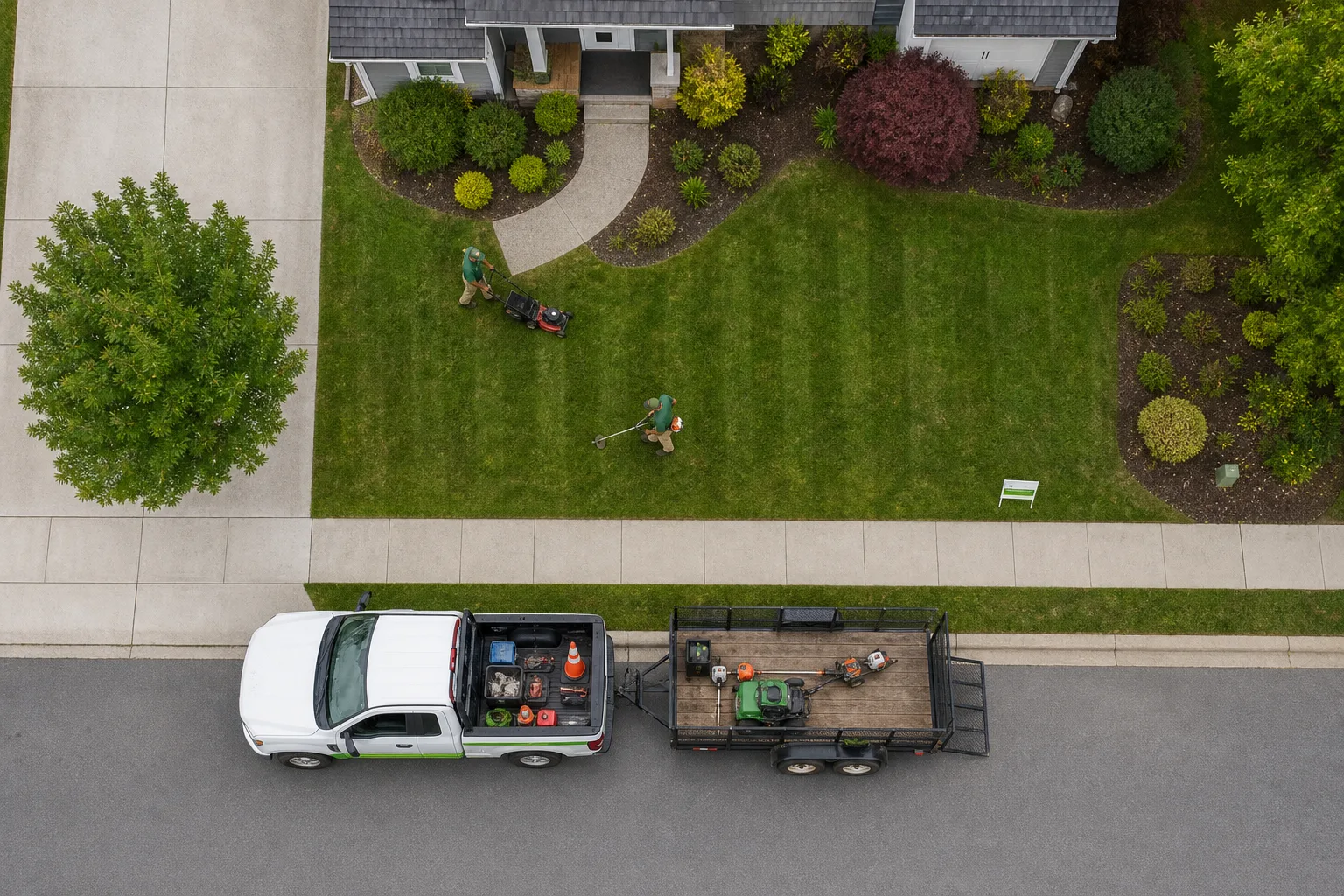
The build is a number you negotiate once. The keeping is a number that arrives every month for as long as you own the property, and it is set by a document most people skim in a driveway. Three structures dominate residential landscape maintenance: the national or regional branded program, the independent local crew, and the contract your HOA or property manager signs on your behalf. They are priced differently, regulated differently, and they fail differently.
What you are actually buying in each case
A branded program sells a schedule. So many visits, so many applications, a defined route. The per-visit number is usually competitive because the scope is narrow and the routing is efficient. What it is not is a commitment to keep your yard looking a particular way. If the turf thins, the remedy is an upsell, not a callback.
An independent crew usually sells labor and judgment. The scope is looser, which cuts both ways: more gets handled without a change order, and less is written down when you disagree about whether it should have been.
An HOA or management-company contract sells a common-area standard that you fund through an assessment. You are not the customer. The association is. That distinction decides who can call, who can complain, and who gets told no.
| Branded program | Local crew | HOA / managed contract | |
|---|---|---|---|
| Scope definition | Tight, itemized | Loose, verbal or short | Specification document you may never see |
| Who you call | Call center | The owner | Management company, then the board |
| Price movement | Annual escalator, often automatic | Renegotiated or quietly raised | Set at bid, passed through in assessments |
| Insurance proof | Usually on file, available on request | Ask explicitly | Required by the contract, verified by the manager |
| Exit | Notice window, sometimes narrow | Usually any time | Not yours to make |
The line items that are never in the headline price
Every pitch quotes a recurring visit. The annual cost is the visit multiplied out, plus the work that falls outside it. Ask which of these are included and which are billed:
- Spring and fall cleanups, and whether hauling is included or charged by the load
- Mulch, by the yard, installed, at a price that moves with the commodity
- Pruning above a stated height, which is often where the tree-care exclusion starts
- Irrigation startup, backflow testing, mid-season repairs and winterization
- Fertilizer and weed control applications beyond the base round count
- Storm debris, which is frequently excluded from routine maintenance entirely
- Fuel or material surcharges, and whether they can be added without notice
A branded program is generally honest about these because they are the revenue model. The exclusions are printed. The local crew may handle three of them without comment and then send a bill you did not expect, because nothing established in advance that they were extra. Written scope is worth more than a friendly manner.
Licensing, and the part a larger provider cannot skip
Mowing is unlicensed almost everywhere. Applying pesticides and herbicides for hire is not. The Environmental Protection Agency oversees pesticide registration and the framework for certifying applicators, and states run the licensing and recordkeeping on top of it. A company putting chemicals on your lawn for money needs a licensed applicator involved and is expected to keep records of what went down, where, and at what rate.
This is the clearest structural advantage of a larger organization. Compliance is a department. There is a license number, a certified technician on the route, a posted notice after application, and a record that can be produced when someone asks what was sprayed the week the dog got sick. A one-truck operation can hold the same credential and many do. The difference is that you have to ask, and you have to ask for the number, not the reassurance.
Two more credentials are worth naming out loud:
- Irrigation and backflow. Many jurisdictions require a certified tester for the backflow preventer on an irrigation system, with results filed with the water utility. If your provider handles irrigation, ask who files the test and whether the fee is in your contract or added.
- Tree work. Height limits in a maintenance agreement exist because climbing and removal are a separate trade with separate insurance. A crew that offers to "take that limb down while we're here" may be working outside its coverage.
Insurance, and whose problem the mower rock becomes
A string trimmer throws stone. A mower deck finds a sprinkler head. A technician falls off a retaining wall. The question in all three cases is the same: whose policy pays.
Ask for a certificate of insurance showing general liability and workers' compensation, issued by the carrier, not a photo of a card. Workers' comp is the one people skip, and it is the one that matters most, because an uninsured injured worker on your property can become your exposure. A larger provider will send the certificate the same day because the process already exists. A small operator may be fully covered and simply slow to produce paperwork, which is fine, as long as the paperwork arrives before the crew does.
Property damage deserves its own sentence in the agreement. Who repairs a cut irrigation line, and at whose cost, is a known and recurring event, not a hypothetical.
The renewal clause is the price clause
Annual landscape agreements commonly renew on their own. The clause sets the notice window, and that window is often thirty days before the anniversary, which lands in the dead of winter when nobody is thinking about mulch. Some agreements also carry a stated escalator, a percentage the price rises each term without renegotiation.
Negative-option renewals are an area the Federal Trade Commission is responsible for on the consumer protection side, and the practical protection is the one you create yourself. Three steps:
- Find the notice window in the contract and put the date on a calendar the day you sign.
- Find the escalator, in writing, as a number. "Market adjustment" is not a number.
- Send cancellation or renegotiation notice in writing, by the method the contract names, and keep proof it was sent.
A branded program with a clear escalator and a known window is easier to budget against than a handshake arrangement that rises by an unannounced amount in April. Predictability has value even when the headline rate is higher.
Price three years, not one. Multiply the visit count, add the line items that are excluded, add the escalator, and compare that figure across the three structures. The provider whose paperwork answers those questions fastest is usually the one whose bill behaves the way the pitch said it would.