Soggy Back Yard, Mature Maple, Patio on Hold? Four Drainage Options Compared
A sloping Seattle back yard with one protected tree shows how the drainage decision changed in ten years, and which of four fixes still makes sense.
- Written by
- Roy Castellano
- Published
- Filed under
- Property
- Length
- 1,102 words, about 5 minutes
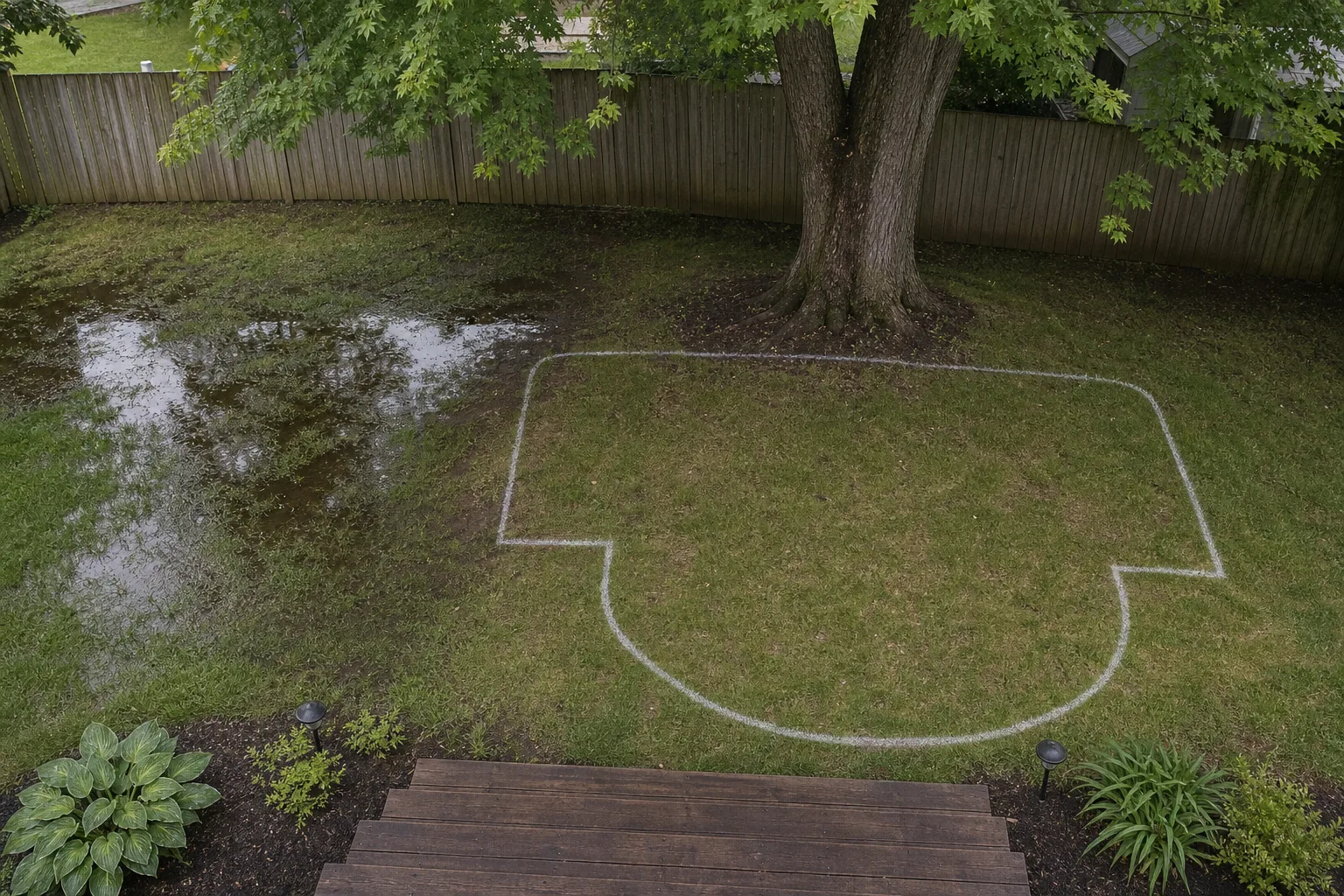
Take one yard and hold it still. A 1920s bungalow on a Seattle hillside street, back yard roughly thirty by forty feet, falling about two feet from the rear fence toward the house. A big-leaf maple sits near the property line, trunk maybe two and a half feet across. After an October rain the lower third of the lawn stays wet for days and a dark line shows on the concrete at the base of the back steps. The homeowner wants a paver patio and a raised bed. Every contractor who walks the yard says the same thing: not until the water has somewhere to go.
That advice has not changed in a decade. What has changed is the answer to where.
How this job was done around 2014
The standard move was a perforated pipe in a gravel trench across the low side of the yard, wrapped in filter fabric, pitched toward the front of the property and tightlined out to the curb or into the existing side sewer. Half a day of trenching, a day of pipe and rock, backfill, done. The patio crew followed a week later.
It worked, in the sense that the lawn dried out. The reason it was standard is worth knowing, because it explains the exception now. Older combined systems in dense neighborhoods carried stormwater and sanitary flow in one pipe, so adding roof and yard water to the line was a question nobody asked hard. Downspouts had been plumbed into side sewers for sixty years. A yard drain was just more of the same.
The other thing nobody asked hard about: what the trench did to the maple. A twenty-four inch deep cut running thirty feet across the drip line severs a meaningful share of a mature tree's absorbing roots. Trees do not fail on the spot. They fail four or six years later, in a wind event, and by then the trench is a lawn again and nobody connects the two.
What changed, and why it changed the price
Two pressures arrived at once. Stormwater discharge from developed property is regulated under federal clean water rules, with the Environmental Protection Agency overseeing the permit framework that cities operate under, and municipalities responded by pushing flow management back onto the lot. The preference flipped from get it off the property to keep it on the property and let it soak in. Connecting new yard drainage to a public line went from routine to permitted, inspected, and in some configurations simply not allowed.
The second pressure was tree protection. Ordinances that once covered only street trees were extended to large trees on private lots, with thresholds based on trunk diameter and species. Once a tree is over the threshold, excavation inside its root zone typically needs an arborist's report and a protection plan before a permit is issued.
So the 2014 job, a trench across the drip line discharging to the curb, is now two separate regulatory problems. Neither is fatal. Both move the sequence and the budget.
The four options, side by side
| Option | What it does | Where it runs into trouble | Relative cost |
|---|---|---|---|
| Gutters, extensions, and regrading | Moves roof water six feet out and tilts the top few inches of soil away from the house | Does nothing for groundwater or a yard that is wet because it is the bottom of the slope | Lowest by a wide margin |
| French drain to a dry well | Collects surface and shallow water, holds it in a buried gravel or chamber reservoir, lets it infiltrate | Needs soil that actually percs and needs depth; glacial till drains slowly | Middle, rising sharply if a soil test disappoints |
| Permeable paver patio over a storage base | The patio itself becomes the detention: deep open-graded base under the pavers takes roof and surface water | Needs the right subgrade, careful base construction, and annual vacuuming or sweeping to stay porous | Higher per square foot than standard pavers, but replaces a separate drainage line item |
| Catch basin and pump to a permitted discharge | Mechanical: collect low, lift it, send it where the city allows | A pump is a maintenance object with a failure date; needs power and a place to discharge | Highest lifetime cost |
For this yard the honest shortlist is two and three. The gutters-and-grading fix is worth doing regardless, and should be done first, because it sometimes removes enough volume that the remaining problem is smaller than it looked in October. The pump is for yards with no infiltration and no gravity route, which is not this one.
The tree decides more than the soil does
Here is where the comparison gets narrow. The low corner of this yard, the obvious place for a dry well, sits inside the maple's root zone. So does the eastern half of the proposed French drain run.
Ten years ago that was a shrug. Now it is the first call. Before any trench line is drawn, get a credentialed arborist out to establish the critical root zone, flag what can be hand-dug or bored versus what cannot be touched, and write the report your permit reviewer is going to ask for. Most of the established outfits offering tree service in seattle handle assessments and protection plans as well as removals, and that report is cheaper than redesigning a patio after an inspector stops the work.
The arborist's answer usually reshapes the plan in a useful direction. Shift the dry well outside the root zone. Run the collection line shallower and hand-excavate the last eight feet. Or, more often than people expect, move the water storage under the patio instead, because the patio is already outside the tree's zone and the open base does the job without a single trench near the roots. That is how option three stops being the expensive choice and starts being the efficient one.
The order to run it
- Fix gutters and downspout extensions. Wait through one real storm and watch.
- Get a percolation test at the depth you would actually build. Soil type decides whether infiltration is on the table.
- Get the arborist report before the landscape design, not after.
- Confirm with your local permitting office what discharge is allowed and what triggers review.
- Then design the patio, with the drainage already drawn in.
Done in that order, the drainage work and the hardscape are one excavation, one crew mobilization, and one inspection. Done backwards, the patio comes up.
The maple, incidentally, is the reason the yard is pleasant enough to be worth the patio. Keeping it standing and keeping the lawn dry turn out to be the same project.