Sold a Fifty-Year Shingle? What That Number Measures, and What Actually Ends a Roof
The year printed on a shingle wrapper is a warranty term, not a service life. Here is what actually decides how long a roof lasts, and how to compare two quotes honestly.
- Written by
- Ellen Marsh
- Published
- Filed under
- Property
- Length
- 1,369 words, about 6 minutes
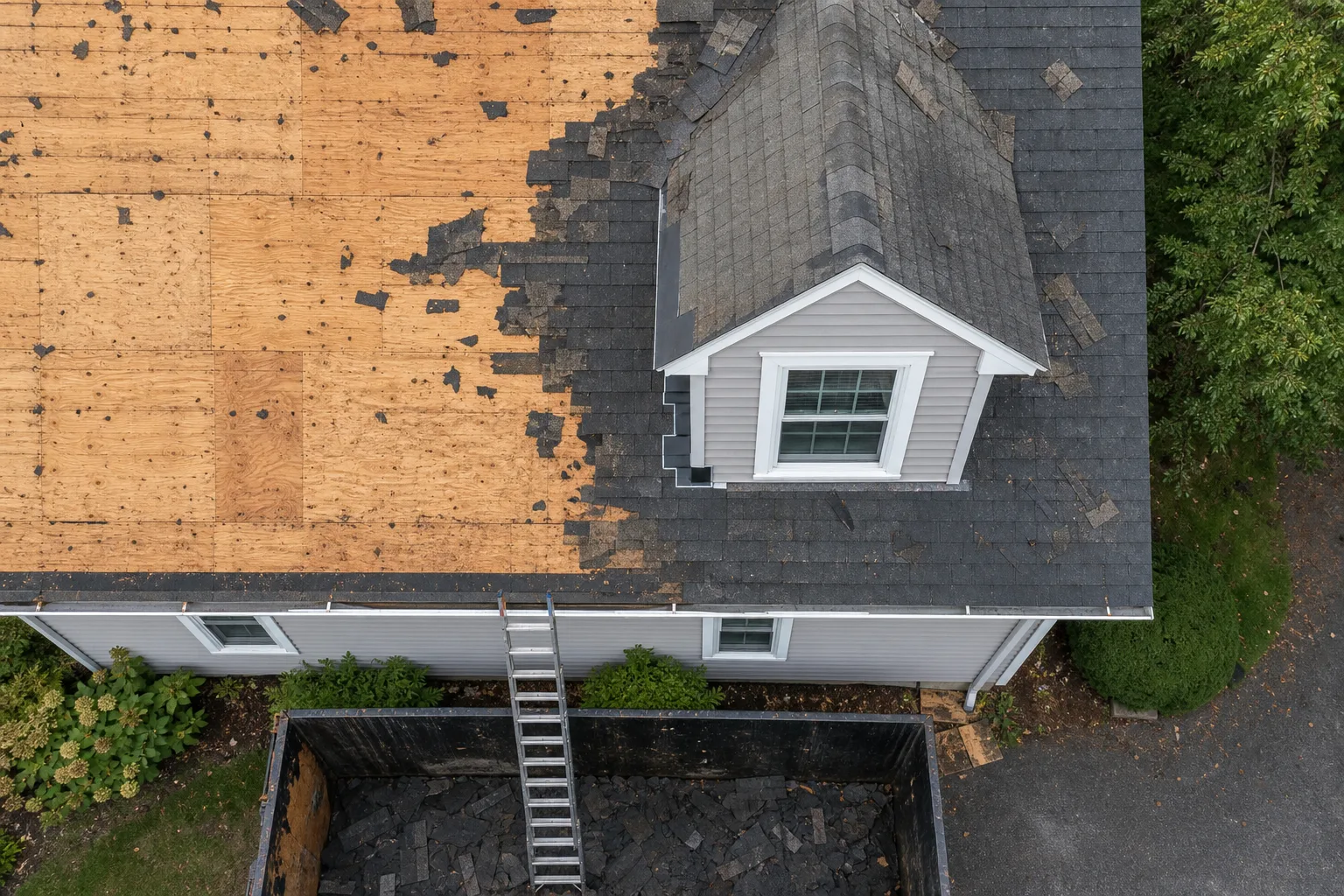
The number on the shingle wrapper is a warranty term. It is not a prediction, not an average, and not a promise about your house. It describes a contract between the manufacturer and whoever registers the product, under conditions the manufacturer defines. Roofs come off long before those numbers expire all the time, and the reason is almost never the shingle.
If you have watched enough tear-offs, the pattern gets boring. The field of the roof is usually fine. The failure is at an edge, a joint, a penetration, or underneath, where nobody looked.
What the warranty year actually covers
Read the warranty, not the brochure. Three things matter and the salesperson rarely leads with any of them.
- The non-prorated period. Most long-dated warranties are full value for a limited early window, then decline on a schedule. The headline year is the end of the slope, not the end of the coverage you would actually want to claim under.
- What is a defect. Manufacturing defect means the product left the plant wrong. Granule loss from hail, curling from an oven-hot attic, blow-off from underdriven nails: none of those are defects. They are conditions, and conditions are excluded.
- Labor and disposal. A material-only warranty replaces shingles. It does not pay the crew, the dumpster, or the tear-off. On a claim ten years out, materials are the smaller half of the bill.
Then there is the enhanced warranty, the one that requires the full system from a single manufacturer installed by a credentialed contractor and registered within a set window. It is real coverage. It is also conditional on paperwork that frequently never gets filed. Ask for the registration confirmation in writing after the job closes. Put it in the same folder as the permit.
What actually ends a roof
Materials rarely fail first. Details do. In rough order of how often they show up on a tear-off:
- Flashing that was reused. Step flashing at a wall, counterflashing at a chimney, the collar on a plumbing vent. A cracked rubber boot on a vent pipe will wet a ceiling under a roof that is otherwise sound. Boots are a consumable. On a long-life roof covering, plan to replace them at least once mid-life.
- Ventilation that does not move air. Intake at the soffit and exhaust at the ridge have to be balanced. Add ridge vent without opening the soffits and you have built a system that pulls air from the house instead. Heat cooks asphalt from below. It is the single most common reason a roof ages ten years faster than its neighbor with identical shingles.
- Fastening. Nail placement, nail count, and nail depth. Overdriven nails cut the shingle. Underdriven ones hold nothing. High nailing misses the layer below. None of this is visible from the ground once the job is done, which is exactly why it is where corners get cut.
- The deck. Delaminated sheathing, old plank gaps, spongy spots around a chimney. New covering over a bad deck fails on the deck's schedule, not the covering's.
- Water at the edges. Valleys, eaves in freeze-thaw country, the transition where a lower roof meets a wall. Ice dams and wind-driven rain go uphill. Underlayment choice at those specific places decides whether that matters.
Orientation matters too, and no warranty accounts for it. A south and west exposure with no shade will age visibly ahead of the north slope on the same house. When someone tells you a roof is halfway through its life, ask which slope they were standing on.
An honest comparison of coverings
Service ranges below are what the trade commonly quotes for competent installation in a moderate climate. Treat them as shapes, not guarantees. What matters more is the second column: what actually takes each one out.
| Covering | Commonly quoted service range | What usually ends it first |
|---|---|---|
| Three-tab asphalt | Shortest of the asphalt options | Heat from an unvented attic; wind at the tab edges |
| Architectural asphalt | Roughly 25 to 30 years quoted | Same as above, plus hail bruising and granule loss on sun slopes |
| Standing seam metal | Decades beyond asphalt | Fastener and sealant failure at penetrations; damage during other trades' work |
| Exposed-fastener metal panel | Shorter than standing seam | Washers at every screw, which are a maintenance item on a schedule |
| Concrete or clay tile | Tile outlives the roof system | The underlayment beneath it, which is the real clock; also foot traffic breakage |
| Natural slate | Longest of the common options | Fastener corrosion and flashing, not the stone |
| Cedar shake | Highly dependent on climate and maintenance | Moisture retention, moss, and lack of drying airflow underneath |
Two entries on that list deserve emphasis because the pitch usually skips them. Tile and slate are frequently sold as lifetime roofs, and the covering genuinely is. The underlayment and flashing underneath are not. A tile roof often needs a lift-and-relay: the tile comes off, the underlayment is replaced, the tile goes back. That is a real, planned, expensive event, and it belongs in the comparison when someone puts a tile bid next to an asphalt bid.
Reflectivity is a separate axis from lifespan. Lighter and more reflective surfaces run cooler, which is a cooling-load question in hot climates and a durability question everywhere, since heat is what ages asphalt. The Department of Energy oversees residential building envelope efficiency, including roofing reflectivity, and product reflectance ratings are published for that reason. If a contractor treats color purely as a styling choice, they have skipped something.
Making two quotes comparable
Most roofing bids are one line and a number. That is not a bid, it is a price. Ask for these broken out in writing, from every contractor, before you compare anything:
- Tear-off or overlay, and how many existing layers come off. An overlay is cheaper today and shortens the new roof's life. It also hides the deck.
- Deck replacement allowance. A per-sheet unit price, and how many sheets are included in the base number. Without this, deck rot becomes an open-ended change order once the roof is naked.
- Underlayment type and where each one goes. Synthetic in the field is standard. Self-adhering ice and water membrane at eaves, valleys, and wall transitions is the detail that earns its money.
- Drip edge at eaves and rakes, and whether it is included. It is inexpensive and routinely omitted.
- Flashing: new or reused. Name every location. Chimney, sidewalls, skylights, vents. Reused step flashing in a bid that otherwise looks thorough is the tell.
- Ventilation, intake and exhaust, with the intake explicitly addressed. Ask what the net free area works out to and whether the soffits are actually open.
- Nail count per shingle and whether it meets the high-wind pattern.
- Disposal, permit, and cleanup, including a magnet sweep of the yard and drive.
- Workmanship warranty, in years, separate from the manufacturer's. Two years and ten years are both common, and the difference tells you how the company views its own crews.
Once those nine lines exist on both sheets, the gap between two numbers stops being mysterious. Usually it resolves into three or four specific items, and you can decide which ones you want to buy.
What to ask the person holding the clipboard
Ask who is on the roof. Company crew, regular subcontractor, or whoever was available that week. Ask who the site lead is and whether they will be present the whole day. Ask for two addresses of jobs done five or more years ago rather than last month, because a new roof looks good regardless.
Then ask the one question that sorts the field: what would make this roof fail early. A salesperson answers with the product. Someone who has torn off a few hundred roofs answers with your soffits, your chimney, and the valley over the addition.
The roof that lasts is not usually the one with the longest number on the wrapper. It is the one where the deck was sound, the intake was opened, the flashing was new, and someone counted the nails. Those decisions are made in a single week and they set the clock for the next quarter century, which is a good reason to spend an extra evening on the paperwork before anyone climbs the ladder.