Motor Runs and Nothing Moves? The Order a Garage Door Opener Actually Fails In
Openers fail in a fairly reliable sequence, and the sequence tells you which parts to replace on their own and which failure means the unit has reached its end.
- Written by
- Ellen Marsh
- Published
- Filed under
- Property
- Length
- 1,110 words, about 5 minutes
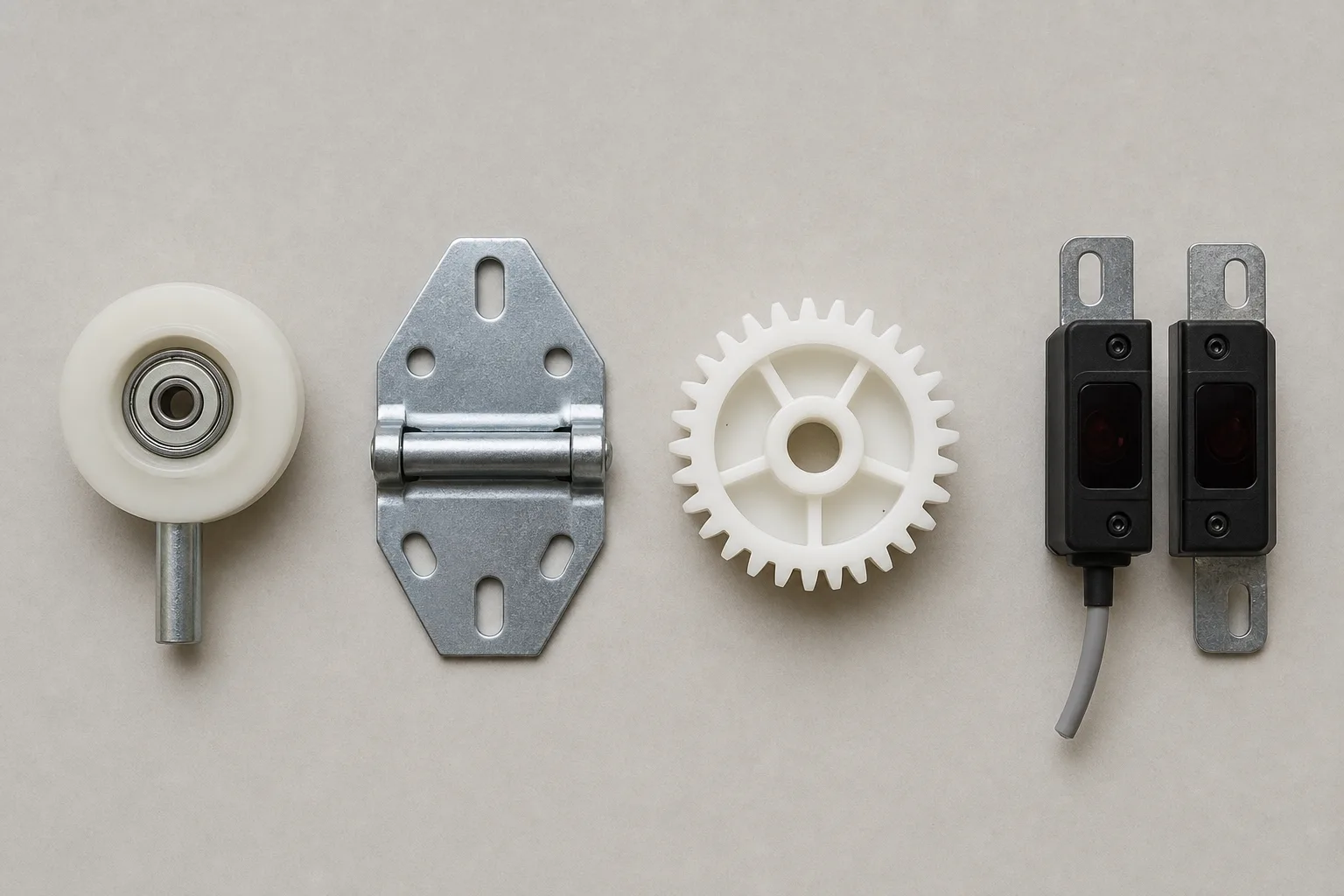
People talk about a garage door opener as though it were the thing lifting the door, which is the source of most of the confusion about why they fail. An opener is a small motor, a plastic gear, a rail, a logic board and a pair of safety sensors, and it works against a door that a counterbalance spring is supposed to be holding very nearly weightless. Nearly every failure worth knowing about is a consequence of that arrangement rather than a fault in the motor, and they arrive in an order predictable enough to plan around.
The Sensors, Which Are Rarely a Failure at All
The photo eyes mounted near the floor on either side of the opening stop the door closing on anything in its path, and when a door reverses the instant it starts down, or the light on the motor head blinks a pattern, they are almost always the explanation. Check them in order of likelihood: a spider web or a film of dust across a lens, a bracket knocked out of alignment by a bicycle handlebar, a wire pinched behind a shelf bracket, or low winter sunlight striking the receiving eye directly at one time of day. The repair is usually a cloth and five minutes. Nobody should bypass or disable them, because they exist in response to an injury history and they are required equipment on every residential unit sold.
The Springs Are the Actual Lifting System
The opener does not lift the door and was never designed to. The counterbalance spring lifts it, and the opener supplies the difference plus the control, which is why a door with a broken spring will instantly overwhelm an opener that was working perfectly the day before. Two systems are in circulation. Torsion springs mount on a shaft above the opening, are standard on modern doors, last longer, and are genuinely dangerous to service without winding bars. Extension springs run along the horizontal tracks on older installations and must carry a containment cable through the center so a break cannot send the spring across the garage.
Springs are rated in cycles, where one cycle is one opening and one closing, which explains why identical doors on identical houses fail years apart: a household going in and out four times a day spends cycles at twice the rate of one going in and out twice. When one spring of a pair breaks, replace both, because the second is exactly the same age with exactly the same count and the labor is already standing in the garage. The test that predicts all of this takes a minute. Pull the release, lift the door by hand to waist height and let go, and a balanced door stays roughly where you left it while a door that slams down or shoots upward is out of balance and the opener has been paying for it.
Rollers and Hinges, Worth Changing Before They Break
Most doors ship with cheap steel rollers running on exposed bearings, and they follow a predictable decline: first noisy, then sticky, then binding and putting load into places the track was never designed to carry it. Nylon rollers with sealed bearings are a modest upgrade that quiets the door noticeably and reduces side loading, and this is one of the very few changes worth making before anything has broken, particularly on a door underneath a bedroom. Hinges are the other candidate, since they crack at the fastener holes on older doors, usually the ones nearest the center, and a cracked hinge left in place slowly bends the section around it into something no longer worth saving.
The Drive Gear Is Designed to Be the Part That Goes
On chain and belt units, the plastic drive gear meshing with the worm on the motor shaft is the deliberate sacrificial component, engineered to fail before the motor does. The symptom is unmistakable and slightly comic: the motor runs, the door does nothing, and lifting the cover often reveals plastic shavings sitting in the housing. A gear kit costs very little and the replacement is about an hour for somebody comfortable working overhead.
Whether to do it is a judgment about the rest of the unit rather than about the gear. On an opener under roughly a decade old with a sound logic board and a rolling code receiver, the repair is obviously worth making and will very likely be the only thing that unit ever needs. On an older head with a fixed-code receiver set by small switches, the same gear failure is the moment to replace the whole opener instead, since the newer receiver was going to be worth buying regardless and paying labor twice to arrive there is the expensive route.
The Logic Board Is the End-of-Life Event
Boards fail from heat, from surges and from simple age, and the symptoms are erratic rather than absolute, which is what makes them frustrating to chase. The remote works intermittently, the wall button works when the remote does not, the light behaves oddly, and the door occasionally reverses for no reason anybody can reproduce. A replacement board frequently costs a large fraction of a complete new opener, which is the point at which the arithmetic tips, and it is the most common end-of-life event for a unit that is otherwise mechanically fine.
The Tests Worth Running Twice a Year
Run the balance test with the release pulled, because that single check predicts more failures than everything else combined and costs nothing but a minute. Block the sensor beam with a broom handle while the door is closing and confirm it stops and reverses. Lay a length of two-by-four flat on the floor beneath the door and close it, watching for the door to reverse on contact. Look at the cables at the bottom brackets for fraying, without touching the brackets themselves, which are under spring tension and are not a homeowner adjustment. Then lubricate hinges, rollers and springs with a proper garage door lubricant rather than grease, which collects grit, and keep it off the track surface.
Underneath all of it sits one pattern worth carrying away. Parts that are cheap and designed to wear should be replaced on their own schedule and replaced in pairs, while any part costing a meaningful fraction of a whole unit is the signal that the unit has reached its end rather than an invitation to spend. An opener maintained on that principle runs a long time on inexpensive components, and on the morning it finally needs replacing, the decision has already made itself instead of arriving as a surprise with a car trapped inside.