Hired Someone You Enjoyed Meeting? What a Structured Interview Measures That a Chat Cannot
The comfortable interview identifies the person you enjoyed talking to. The structured one identifies who can do the work, and it takes no longer to run.
- Written by
- Ellen Marsh
- Published
- Filed under
- Corporate
- Length
- 1,125 words, about 5 minutes
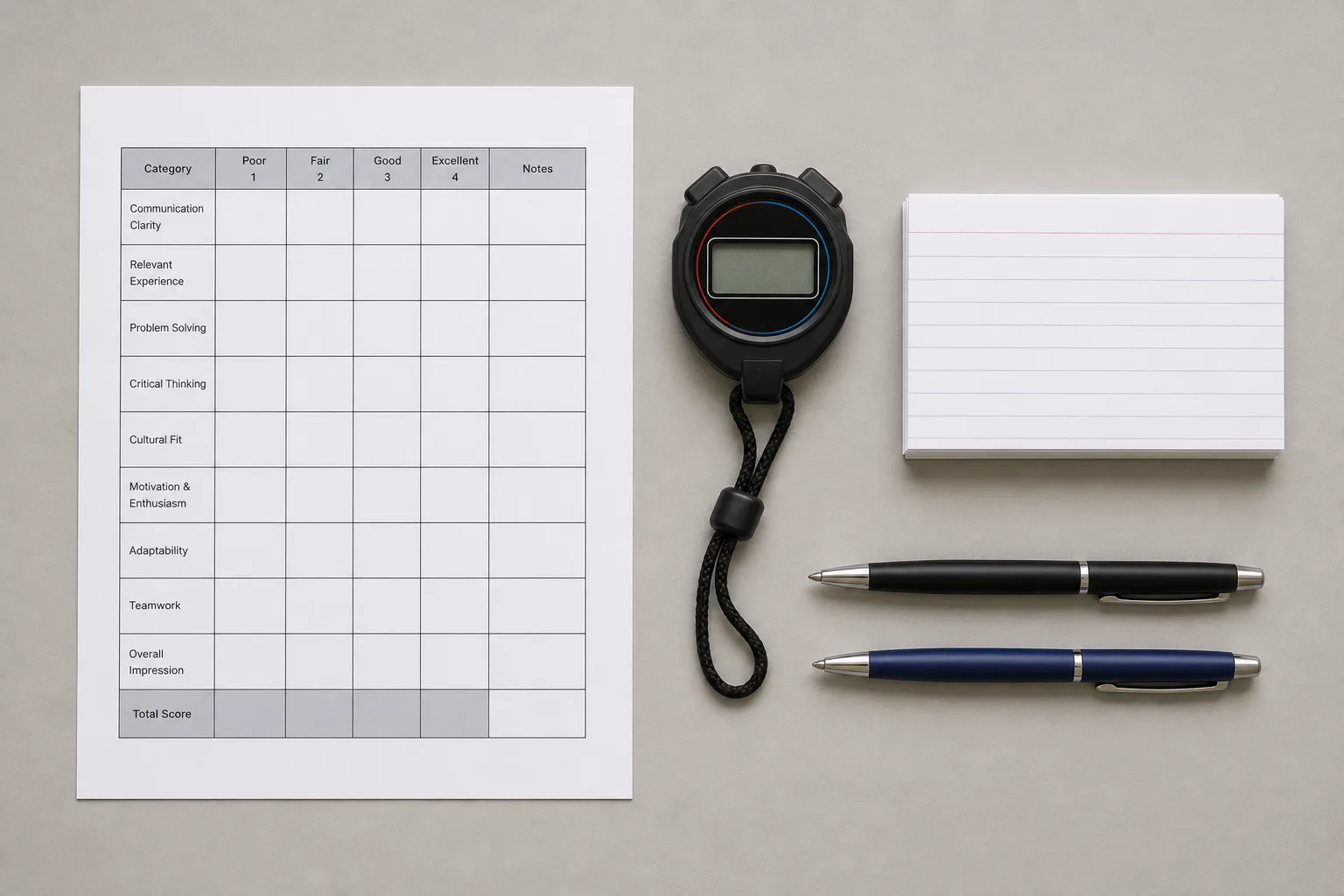
Picture the interview most small employers actually run. Two people sit down, the conversation finds a rhythm within a few minutes, something in common turns up, and forty-five minutes later everybody leaves feeling it went well. That format is natural, easy to run and requires no preparation whatsoever, and it reliably identifies the candidate who is most comfortable in a conversation. In a handful of jobs that is exactly the skill being hired for. In most of them it is beside the point, and the alternative takes the same forty-five minutes while producing a comparison instead of an impression.
What the Comfortable Version Is Actually Measuring
Three distortions do most of the damage and each is visible in your own notes the following week. Similarity is the first, since interviewers consistently rate candidates higher when they share a background, a hobby or a hometown, and this is not favoritism in any conscious sense but simply the conversation having been easier. First impressions setting the rest is the second, where a judgment formed in the opening minutes turns the remaining forty into a search for evidence supporting it.
The third is the quiet one. Different candidates get asked different questions, because a conversation follows whatever each person happens to say, and once that has happened there is nothing left to compare. The decision then rests on recall, and recall favors whoever was most memorable rather than whoever was most capable. The result is not that a bad hire gets made every time, since plenty of these interviews produce good employees. It is that the process cannot tell you why a good one worked, which means it cannot be repeated deliberately.
Define What Competent Looks Like Before Writing a Question
Before writing a single question, write down four to six things a person in this role must be able to do by the end of the second month, stated concretely enough that somebody could watch them happen. Close out a job ticket accurately without being asked. Handle two customers at the counter at once through the morning rush. Read a supplier invoice and catch a pricing error before it is paid.
What does not belong on that list is the vocabulary of job advertisements: strong communicator, team player, detail-oriented. None of those can be observed, none can be scored, and every candidate will claim all three without lying. The concrete list is the basis of everything that follows, and writing it usually clarifies the role for the employer at least as much as for the candidate, which is why the hour is worth spending even if the interview format never changes.
One Question Per Item, Asked of Everybody
Two question types carry almost all of the load. Past behavior questions ask about something that already happened: tell me about a time two customers were waiting and the phone was ringing, and what you actually did. Situational questions describe something that has not: a customer says they were quoted a lower price and there is nothing in the file, so walk me through your next ten minutes.
Ask them in the same order to every candidate, with the same follow-ups after each one, covering what the situation was, what this person specifically did, and what happened as a result. The follow-ups are where an answer becomes real, because a rehearsed response thins out noticeably under a request for specifics while a genuine one gets more detailed. Asking everybody the same six questions feels rigid for the first two interviews and stops feeling that way once you sit down to compare them.
Score During the Answer, Not Afterward
A three-point scale is entirely sufficient: below what the job needs, meets it, clearly above it. Write the score down while the answer is being given rather than at the end of the interview, because a score recorded afterward is contaminated by everything that came after it. Define in advance what a strong answer contains, meaning its substance rather than its wording, which takes about ten minutes across six questions and is the single thing that makes two different interviewers comparable to each other.
The scale exists to force a decision rather than to produce a precise number, which is why three points work better than ten. An interviewer given ten gradations spends the interview calibrating between six and seven, while an interviewer given three has to decide whether this answer would be good enough on a Tuesday in the actual job. Totals at the end are useful mainly for spotting the candidate who scored well everywhere against the one who scored superbly on two items and poorly on the rest, since those two are very different hires and an unstructured process cannot distinguish between them at all.
The Work Sample Small Employers Skip
A short, realistic, paid task is by some distance the most predictive element available and by far the least used by small employers. Twenty minutes to an hour of something the job actually contains: sorting a stack of invoices, drafting a reply to a customer email, diagnosing a simple fault, laying out a small piece of material. What a candidate does in that hour tells you more than any answer about what they would do.
Four rules keep it fair and defensible. Pay for anything beyond a brief exercise. Never use work you would otherwise have paid somebody to perform, since that is not an assessment. Give every finalist the same task with the same time limit. And tell candidates in advance that it is coming, so nobody is ambushed and everybody arrives able to show what they can actually do rather than how quickly they recover from surprise.
Where the Conversation Still Earns Its Place
Not as the assessment, but as the closing. Strong candidates are choosing as much as they are being chosen, and the part where they meet the owner, see the workspace and ask their own questions is frequently what decides whether an offer gets accepted. Run it after the structured portion with the scoring already finished, so that warmth is not competing with judgment for the same forty-five minutes, and ten minutes of it at the end costs nothing while often winning the hire outright.
The second benefit lands after the person starts. Having written down what competent looks like at month two, you now hold the thirty and sixty day standards already drafted, the outline of a training plan, and an honest job description for the next time the role is posted. One hour of preparation produces four documents and the interview is only the first of them, which is why employers who make the switch rarely go back to running interviews out of a folder of resumes and good intentions.