Arrested Over the Weekend? How to Build the Folder Before You Sit Down With Counsel
An impaired driving arrest starts two separate clocks, and the shorter one usually belongs to the DMV. Here is how to prepare so the first consultation produces decisions instead of background.
- Written by
- Roy Castellano
- Published
- Filed under
- Legal
- Length
- 987 words, about 4 minutes
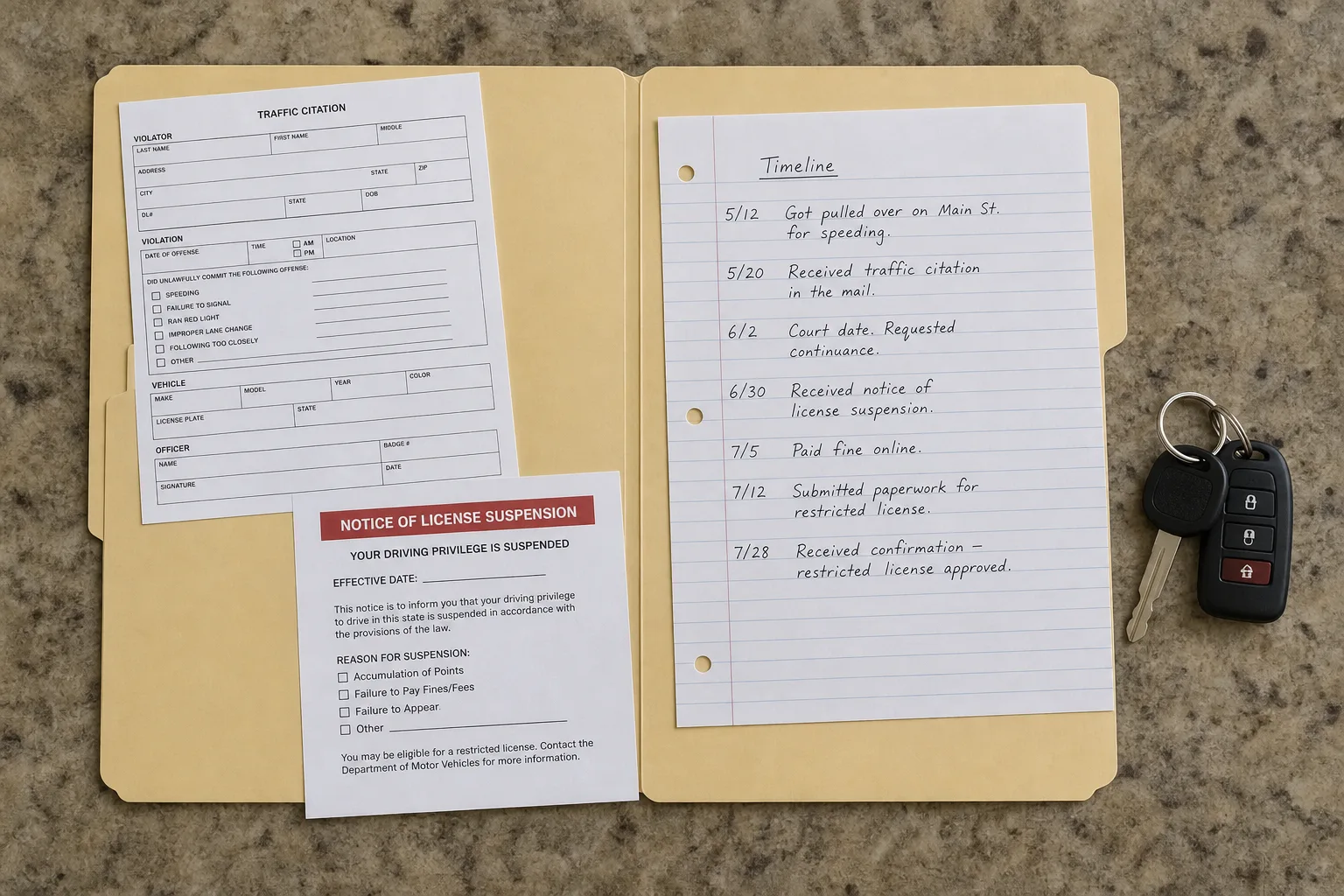
An arrest for driving under the influence hands you a stack of paper, a court date some weeks out, and a much quieter deadline that most people miss entirely. The first meeting with a defense attorney is where those three things get sorted into a plan. Whether that hour produces a plan or a history lesson depends almost entirely on what you bring through the door.
Two clocks start at the arrest, and the short one is not the court date
The criminal case is the one people think about. The administrative case, run by the state licensing agency, is the one that moves first.
That split is not an accident of bureaucracy. It comes out of the implied consent statutes that states adopted through the 1950s and 1960s. The bargain those laws struck was simple: a driver's license is a state privilege, not a right, so the state may condition it on submitting to a chemical test. Refuse, and the state can take the license through an administrative process without waiting for a jury, because no one is being jailed. Separate purpose, separate track, separate deadline.
The practical result is a window measured in days, not months, for requesting a hearing on the license suspension. It is printed on the notice you were handed at the station or mailed shortly after, often in small type on the reverse. Find that notice before you find anything else. If you retain counsel and the request window has closed, an entire avenue of the case has closed with it.
Impaired driving enforcement standards, including the specifications and calibration protocols for breath testing instruments, fall under the oversight of the National Highway Traffic Safety Administration. That is worth knowing because the machine's paperwork is part of your case, and machines have maintenance records.
What changed recently, and why it changes your preparation
Three shifts over the last decade have moved the useful work earlier.
Blood draws now generally require a warrant. The Supreme Court's reasoning in the mid-2010s pulled apart what implied consent could and could not authorize. Breath tests, minimally invasive, remained fair game as a condition of licensure. Blood draws, being a search of the body, largely require a warrant or a genuine exigency. So the question of what kind of test was administered, and on what paperwork, matters more than it did before. Bring the answer.
Video is everywhere and it does not last forever. Body-worn and dashboard cameras produce footage of the stop, the field sobriety tests, and the booking room. Agency retention schedules for routine footage are often short. A preservation request sent in week one secures material that a request sent in month three may not. This is the single strongest argument for not waiting.
Ignition interlock and monitoring have expanded. Many states now attach a device requirement earlier in the process, sometimes to the administrative suspension rather than to a conviction. That changes the calculus of a plea, because the consequence you are weighing is no longer only fines and probation. It is what your commute looks like for the next year.
The folder, and what each item is for
Assemble this before the meeting. Physical copies, in order.
- The citation and every page handed to you, including the license suspension notice with its deadline.
- Any test results you were given, and a note on what type of test it was and how many times you blew.
- Your driving record, ordered from the state motor vehicle agency. Do not rely on memory for prior incidents.
- Bail or release paperwork and any conditions attached to it.
- A written timeline, one page, of the twelve hours before the arrest: where you were, what you consumed and when, who was with you, when you last ate.
- Names and contact details for anyone who saw you before you drove.
- Medical facts that affect testing: reflux, diabetes, recent dental work, prescriptions, a leg or inner ear problem that affects balance.
- Your employment exposure: whether you hold a commercial license, a professional license, a security clearance, or a job that requires driving.
That last item is often the one that reorders the whole strategy, and it is the one clients volunteer last.
Questions that reveal judgment rather than confidence
You are not evaluating whether the attorney sounds sure. Everyone sounds sure. You are evaluating whether they have thought about your specific facts.
- What is my administrative deadline, and who is filing that request?
- What evidence needs a preservation letter this week, and to which agency does it go?
- Have you handled cases in this specific courthouse, in front of these prosecutors?
- What are the realistic outcomes here, described as a range rather than a promise?
- How does the interlock requirement attach in this state, and at what point?
- What is the fee structure, what does it cover, and what triggers additional cost?
- Who will actually appear at my hearings?
An experienced drunk driving lawyer will answer the first two questions before you finish asking them, because the calendar drives everything else in this kind of case.
How to read the answers
Good advice in this area sounds specific and slightly unsatisfying. It names the deadline. It separates what is knowable now from what depends on discovery. It tells you which facts help and which hurt, in plain terms, without softening the second category.
Advice worth less tends to be either a guaranteed result or a general lecture on how the law works. You can read about how the law works. What you are paying for is someone who can look at your test type, your prior record, your job, and the retention schedule of the arresting agency, and tell you what to do on Tuesday.
Take notes. Ask for the plan in writing, even three bullet points in an email. Then do your part of it that week, while the video still exists.