Every Problem a New Floor Will Develop Is Already Sitting Underneath It
All five checks that find those problems can be run without a specialist, and every one of them is cheap on an open deck and impossible afterward.
- Written by
- Ellen Marsh
- Published
- Filed under
- Property
- Length
- 867 words, about 4 minutes
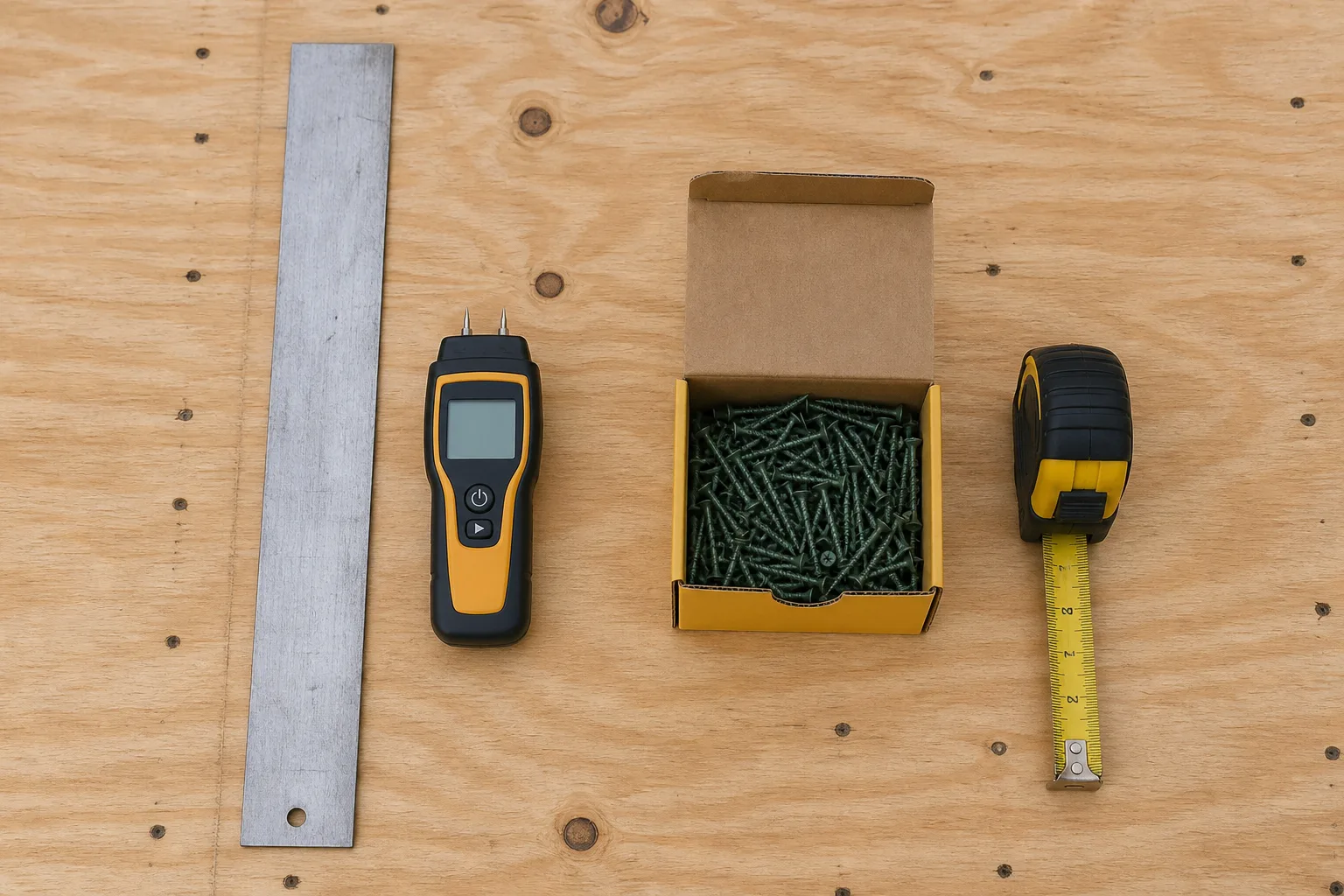
Ask an installer what separates a floor that lasts twenty years from one that gets argued about in the second winter, and almost none of the answer will be about the flooring. It will be about the deck underneath, which is where every defect that a finished floor eventually develops is already present and already visible on the day the old covering comes up. An afternoon spent on that deck with a straightedge, a moisture meter, a screw gun and a tape measure finds all five of the problems worth finding, and every one of them is inexpensive to correct while the room is empty.
Flatness, Measured Against the Manufacturer's Own Number
Flat and level are different properties and only one of them decides whether a floor works. A room can slope noticeably and still take a floating plank without complaint, while a room with a dip in it cannot, because the plank bridges the dip and then flexes over it until the joints give up. Lay a long straightedge across the deck in several directions and look for daylight underneath, then compare what you find against the tolerance the manufacturer publishes as a maximum deviation over a stated span, which lives in the installation instructions rather than in the brochure.
What follows from the reading is straightforward. Low spots get filled with a patching or self-leveling compound priced by the bag and by the depth it has to fill. High spots on a wood deck get sanded, and on concrete they get ground, which is a rented machine and a genuinely dusty afternoon. A long gentle slope across a whole room is usually acceptable, and checking the tolerance before assuming otherwise saves a great deal of unnecessary compound.
Moisture, Measured Rather Than Judged by Hand
On a wood subfloor, take meter readings in several places including near exterior walls, under windows and in front of any plumbing, then compare them against the flooring manufacturer's stated limit and against the moisture content of the flooring material itself, since the difference between those two numbers is what produces movement after installation. On a slab, a surface meter reading is not sufficient and the standard methods are an in-slab humidity probe or a sealed calcium chloride test, with the warranty stating which one it accepts. An elevated reading is information rather than a verdict, and the source is usually something fixable: a gutter discharging at the foundation, a missing vapor barrier in a crawlspace, a supply fitting weeping slowly behind a cabinet.
Movement, Found With Your Own Weight
Walk the whole deck slowly and listen, then have somebody else walk it while you watch from a low angle across the surface. Deflection shows as a visible dip under a footstep and squeaking is a fastener working in an oversized hole or two boards rubbing where they meet. Squeaks are fixed now with screws driven into the joists and are effectively unreachable once a finished floor is down. Bounce spread across a wide area points at joist span rather than at the deck, which is a different and more consequential conversation worth having before anything is ordered. A soft spot that gives underfoot means water damage or delamination, and that section gets cut out and replaced rather than covered over and forgotten.
Fasteners and the Condition of the Panel Edges
Look closely at the panel joints, because edges that have swollen or curled produce ridges that telegraph straight through a thin covering and create hollow spots beneath a rigid one. Check for popped nails and staples, and drive or remove anything sitting proud of the surface. On an older deck, adding a screw at each joist crossing is inexpensive insurance against future noise and is also the standard remedy for a floor that has been squeaking for years, which makes it the rare repair that fixes the past and the future in the same pass.
Height at Every Doorway, the Test Nobody Runs
Measure the existing floor thickness and the proposed assembly thickness including underlayment, because the difference between them is what changes at every threshold in the room. Then check five specific places. Under every interior door, since a door that drags on a new floor has to come off and be trimmed, which is real work on a solid slab. At the transition to any adjoining floor that is staying. At the bottom stair riser, where a height change alters the riser dimension and can push it outside what the code permits. Under the dishwasher if a kitchen is involved, because raising the floor across its opening can trap the appliance permanently. And at exterior doors and any threshold carrying weatherstripping.
Everything on this list is cheaper to correct on an open deck than after a floor is down, and most of it is not correctable afterward at any price short of pulling the new floor back up. The afternoon also changes the conversation with a contractor, since an estimate carrying a subfloor preparation allowance and one that carries none are not comparable documents, and a homeowner holding their own flatness and moisture numbers can tell at a glance which of the two is describing the actual room.