Claim Denied? The Order to Appeal In, and What Each Step Actually Costs
A denied medical claim has a fixed appeal sequence, and skipping a step is what makes it expensive. Here is the order, and what each stage costs in time and money.
- Written by
- Nadine Buckley
- Published
- Filed under
- Health
- Length
- 1,393 words, about 6 minutes
Most denied claims are not decided on the merits. They are decided on whether the right paper reached the right desk before the clock ran out. That is good news, because it means the sequence matters more than the argument, and the sequence is knowable.
What follows is the order the appeal actually runs in, and the cost of each stage. Cost here means two currencies: dollars out of pocket, and hours of your own time. The second one is where people get hurt.
Stage zero: read the code before you write a word
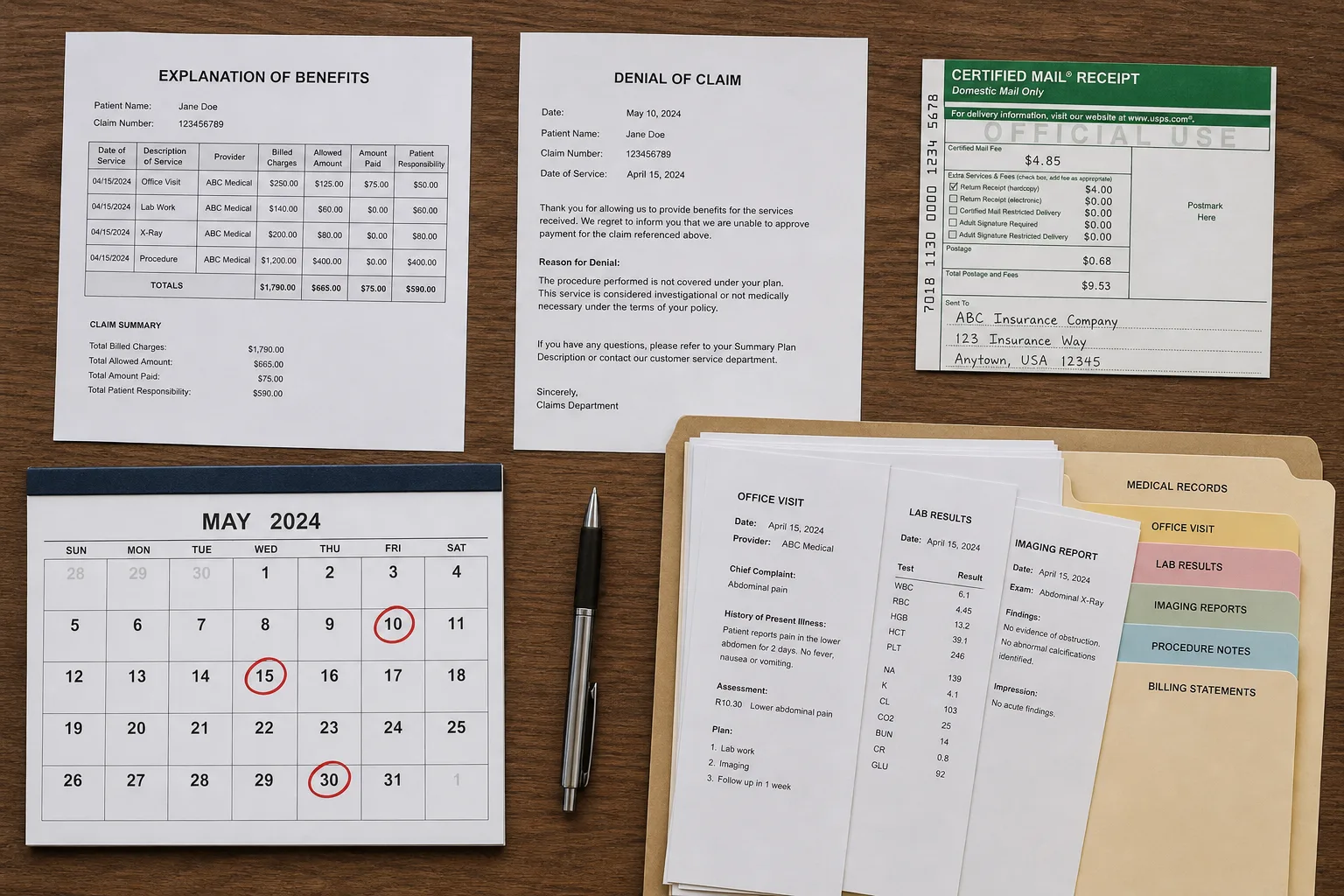
The Explanation of Benefits is not a bill and it is not a decision letter. It is a summary carrying one or more claim adjustment reason codes and remark codes. Those codes are standardized. They exist so that a billing office and a payer can agree, without a phone call, on why money did not move.
The code tells you which of four families you are in:
- Administrative. Wrong member ID, coverage termination date off by a month, claim filed to the wrong payer, duplicate submission.
- Coding. Procedure code inconsistent with the diagnosis, missing modifier, bundling edit, place-of-service mismatch.
- Authorization. No prior authorization on file, authorization obtained but not referenced, referral requirement not met.
- Medical necessity or benefit exclusion. The plan says it does not cover this, or does not cover it for you, in this situation.
The first three are corrections. The fourth is an appeal. Confusing them is the single most common and most expensive error, because filing a formal appeal on a coding denial burns one of your levels and thirty to sixty days of calendar, and the underlying claim was fixable in a week by the provider's billing office.
Cost of stage zero: twenty minutes and one phone call. Ask the payer's representative to read you the denial reason verbatim and give you a call reference number. Ask whether the claim can be reprocessed without an appeal. Write down the answer and the name.
Stage one: make the correction, and only then appeal
If the code points to a correction, the work belongs to the provider's billing department, not to you. A corrected claim goes back through the standard processing queue. It is not an appeal, it does not consume an appeal level, and it usually resolves in two to four weeks.
Your job at this stage is narrow and worth doing well:
- Call the billing office. Give them the exact denial code, not a paraphrase.
- Ask them to confirm in writing that a corrected claim was submitted, and on what date.
- Calendar a follow-up for twenty-one days out.
Roughly speaking, a large share of denials that patients experience as a fight are resolved here, at a cash cost of nothing and a time cost of under two hours spread across three weeks.
When the correction is refused or the denial is genuinely about coverage, you move on. Before you do, request two documents in writing: the full denial letter with appeal rights, and the specific plan language or clinical criteria the payer relied on. You are entitled to the basis of the decision. Ask for the clinical policy bulletin by name and number if the letter references one.
Stage two: the internal appeal, where most cases are actually won
The internal appeal goes back to the payer that denied you. Most plans run one or two internal levels. Deadlines are strict and are stated in the denial letter: commonly 180 days from the date of the denial notice for the member's first-level appeal, with the payer owing a decision inside a fixed window that shortens if the care is urgent and has not happened yet.
An internal appeal is a file, not a letter. What goes in it:
- A one-page cover letter identifying the member, the claim number, the date of service, and the exact relief requested.
- The denial letter itself.
- The clinical policy or plan section the payer cited, with the criteria you meet marked.
- A letter of medical necessity from the treating physician that addresses those criteria point by point, in the payer's own vocabulary.
- Relevant records: chart notes, imaging reports, prior conservative treatment and why it failed.
The physician letter is the item that moves cases and the item that costs money. Some practices write it as part of care. Others charge a records-and-letter fee, typically billed per page for copies plus a flat fee for the physician's time. Ask the price before you request it. A letter that simply says the doctor believes the care is necessary is worth very little. A letter that walks the plan's own criteria in order is worth a great deal, and the difference is usually twenty minutes of physician time that you have to ask for explicitly.
Cost of stage two: four to eight hours of your time to assemble, plus records copying and any letter fee. Certified mail with return receipt for a few dollars, or fax with a confirmation page. Keep the confirmation. It is your proof of timely filing, and timely filing is the ground on which weak appeals get dismissed without review.
Stage three: external review, and the regulator behind it
When internal levels are exhausted, most denials involving medical judgment or a rescission qualify for external review by an independent review organization. The reviewer is a clinician with no financial relationship to the plan. The decision binds the payer.
Two practical points. First, the external reviewer generally sees the record as it stood, so anything you wanted the plan to consider should already be in the file from stage two. Second, external review is usually free or nominally priced to the consumer, capped at a small filing fee where a fee exists at all. The federal external review process for plans that use it charges the member nothing.
Which route you take depends on who regulates your plan. A plan purchased on your own or through a fully insured employer group is regulated by your state insurance department. A self-funded employer plan sits under federal law, and the Employee Benefits Security Administration within the Department of Labor oversees claims and appeals procedures for those plans. Your Summary Plan Description tells you which you have. Read the first two pages of it before you file anything, because the deadlines and the complaint address differ.
Cost of stage three: two to three hours to complete the request form and assemble the same file again. Cash cost near zero.
What actually drives the cost, after doing this many times
The dollar figures on a denied claim appeal are small until they are not. What separates a free afternoon from a four-figure problem is predictable.
Starting late
Every deadline in the process is calculated from the date on the notice, not the date you opened the envelope. Missing a filing window forfeits the level. Forfeit enough levels and you have lost external review, which is the only free step where a genuinely independent clinician looks at your case.
Appealing the wrong denial
Formal appeals on administrative and coding denials waste levels and weeks. Read the code first, every time.
Buying help too early
Professional billing advocates work on hourly rates or a percentage of the amount they recover, and both are reasonable when the balance is large and the denial is complex. Neither is worth paying for a missing modifier. Bring in paid help when the disputed amount is meaningful, the denial is medical necessity, and you have already collected the plan criteria. An advocate who has to start from a blank folder charges for that time.
Not putting the physician letter in front of the criteria
A resubmitted appeal costs the same effort as the first one and burns another sixty days. Getting the clinical letter aligned to the plan's written criteria on the first pass is the highest-return twenty minutes in the whole process.
Losing the paper trail
Call reference numbers, fax confirmations, certified mail receipts, dated copies of everything sent. A file that documents timely filing survives a payer's records problem. A file that does not, will not.
Work the sequence in order, treat each stage as a file rather than an argument, and the expensive stages mostly never arrive. The claims that reach external review are the ones that belong there, and by then the record is already built.