Filing a Complaint? The Difference Between a Record and a Recollection
Most complaint files fail on the same four tests. Here is what a decision maker actually checks, and what the rules covering your forum deliberately leave out.
- Written by
- Nadine Buckley
- Published
- Filed under
- Legal
- Length
- 1,066 words, about 5 minutes
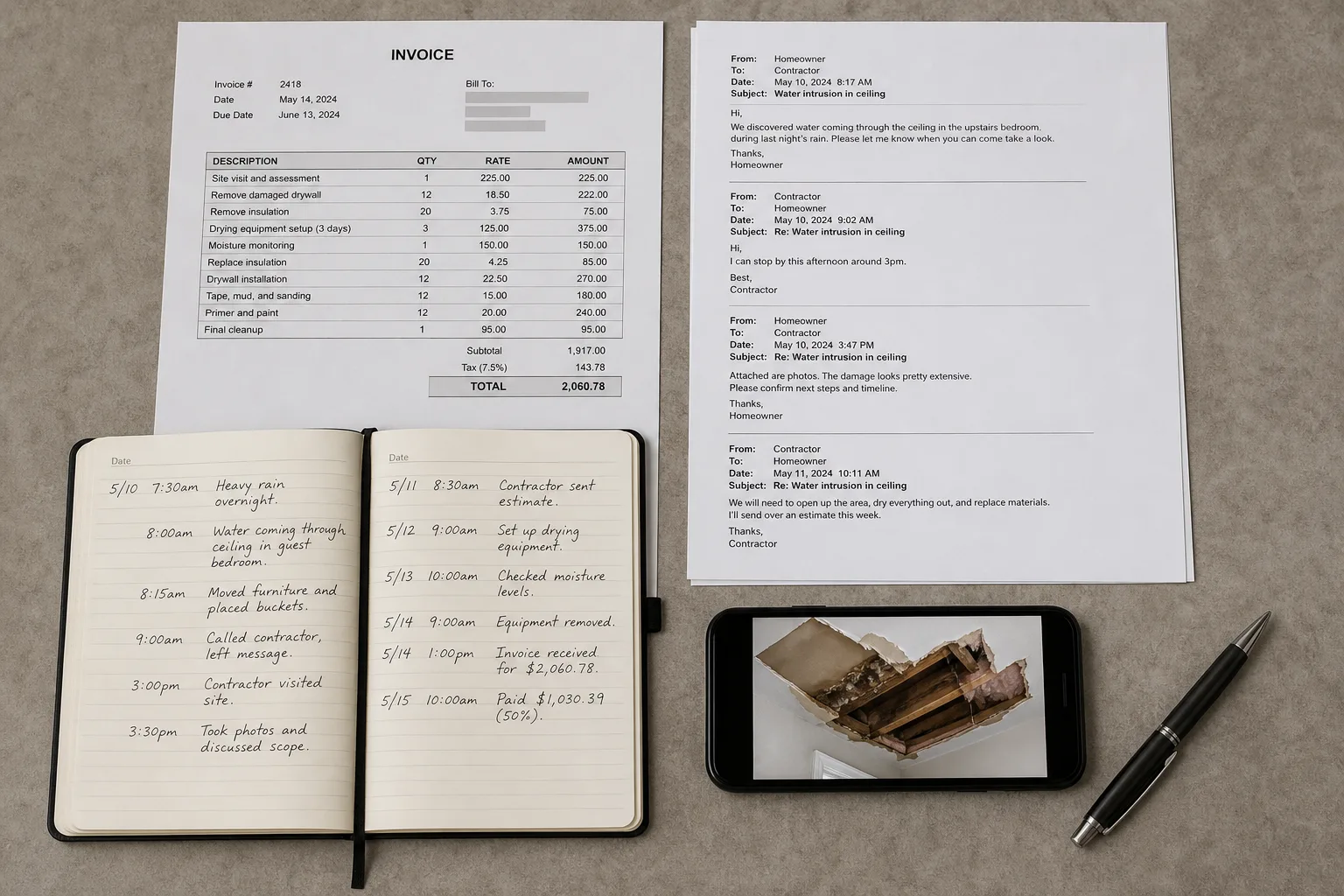
The people who read complaint files read them in roughly the same order every time. What happened, when, who said so, and how do I know the document in front of me is what it claims to be. A file that answers those four things in its first two pages gets decided. A file that answers them on page nine, buried in a narrative, often does not get read that far.
Almost nobody loses on the merits. They lose because the strongest part of their account exists only in their memory, and the weakest part is the only part that was written down.
Strength of feeling is not strength of evidence
The thing you are most certain about is usually the thing you can prove least. A verbal promise on a jobsite. A number quoted over the phone. A supervisor who agreed you were right and then stopped returning calls.
Meanwhile the part you barely noticed at the time, the dated invoice with a line item description, tends to carry the whole case.
Evidence gets weighed on properties that have nothing to do with sincerity:
- Authenticity. Can someone confirm this document is what you say it is, and that it has not been altered?
- Contemporaneity. Was it created at the time of the events, or afterward, once you knew there was a dispute?
- Completeness. Is this the whole exchange, or the three messages that favor you out of eleven?
- Custody. Where has it been since it was created, and who has had the chance to change it?
A short note typed into your phone the afternoon of the incident beats a detailed three-page account written two months later. Not because it is more detailed. Because nobody can argue you wrote it to win.
Every forum has its own rulebook, and each one covers less than you think
People talk about evidence as though there is one standard. There is not. The rules that apply depend entirely on where the complaint lands, and the differences matter more than the similarities.
Small claims court
Formal rules of evidence are relaxed or set aside in most states. Hearsay that would be excluded in a higher court often gets heard. That sounds like good news, and it partly is. What the relaxation does not do is make weak evidence persuasive. The judge still has to decide who to believe, and a stack of loose paper with no dates does not help them do it.
Internal complaint processes
An insurer's appeal unit, a bank's dispute team, a contractor's warranty department. These are governed by contract terms and by the company's own published procedure, not by court rules. The procedure usually promises a response inside a stated window. It rarely promises a particular standard of proof, and it almost never promises that a decision will explain itself. Read what the procedure actually commits to, then hold them to that and nothing more.
Licensing boards
A state contractor or professional board investigates against a code of conduct, not against your losses. The board can discipline a license. It generally cannot order you paid. Evidence that proves a code violation is not the same evidence that proves your damages, and a file built for one often underserves the other.
Arbitration
If you signed an arbitration clause, the provider's own procedural rules govern what gets exchanged and when. Discovery is usually narrower than in court. That means the document you never obtained is a document you may never see.
Consumer complaint channels
The Federal Trade Commission oversees consumer protection and maintains channels for reporting unfair and deceptive practices, and the Consumer Financial Protection Bureau handles complaints about financial products and services. Filing there creates a dated, external record of your account, which is useful. Neither route is a substitute for a claim that recovers your money, and the record you create should be written as though someone else will read it later, because someone may.
Formats that survive handling, and formats that fall apart
After enough of these, you stop thinking about what to say and start thinking about what format to say it in.
- Texts and emails: export the thread, do not photograph the screen. Screenshots crop, and a cropped thread invites the question of what was cropped out. Produce the exchange in full, including the messages that do not help you. It costs you a paragraph of explanation and buys you credibility on everything else.
- Photographs: original files, not versions sent through a messaging app that strips the embedded date and location. Include a reference object for scale. Take the wide shot before the close-up so the close-up can be placed in the room.
- Phone calls: recording consent rules vary by state, and some require every party to consent. Where recording is not practical, send a short follow-up email summarizing what was agreed. An unanswered summary is not proof, but an answered one is close to it.
- Estimates and invoices: an itemized estimate on letterhead, with a date and a scope of work, does work that a lump-sum figure never will. Two independent estimates do more than one.
- Your own log: one running file, entries dated the day they happen, names and job titles of everyone you spoke to. Plain, dull, no adjectives. This is the single highest-return habit in any dispute.
Build the file before you need it
The file you assemble after a relationship sours is always thinner than the one that accumulated while things were fine. Keep the signed contract, the change orders, the permit, the manufacturer's warranty registration, the payment records showing method and date. Keep the delivery ticket. Keep the voicemail.
Then, when the dispute starts, add two things: a one-page chronology with dates in the left column, and a short index of what each attached document proves. Decision makers work through volume. The file that tells them where to look gets the benefit of their attention.
And hold on to everything, including material that cuts against you. Destroying or discarding relevant records once a dispute is live creates a separate problem with a name and consequences, and it is a far worse position than the unhelpful document ever put you in.
The account you can support on paper is the account that gets decided in your favor. Which means the work is mostly clerical, mostly early, and mostly done on days when nothing has gone wrong yet.