Ten Years of Keeping the Same Front Yard, and the Four Lines That Moved
One suburban front yard, installed a decade ago and still standing. The build price barely changed. The cost of keeping it alive moved in four specific places.
- Written by
- Roy Castellano
- Published
- Filed under
- Property
- Length
- 1,191 words, about 5 minutes
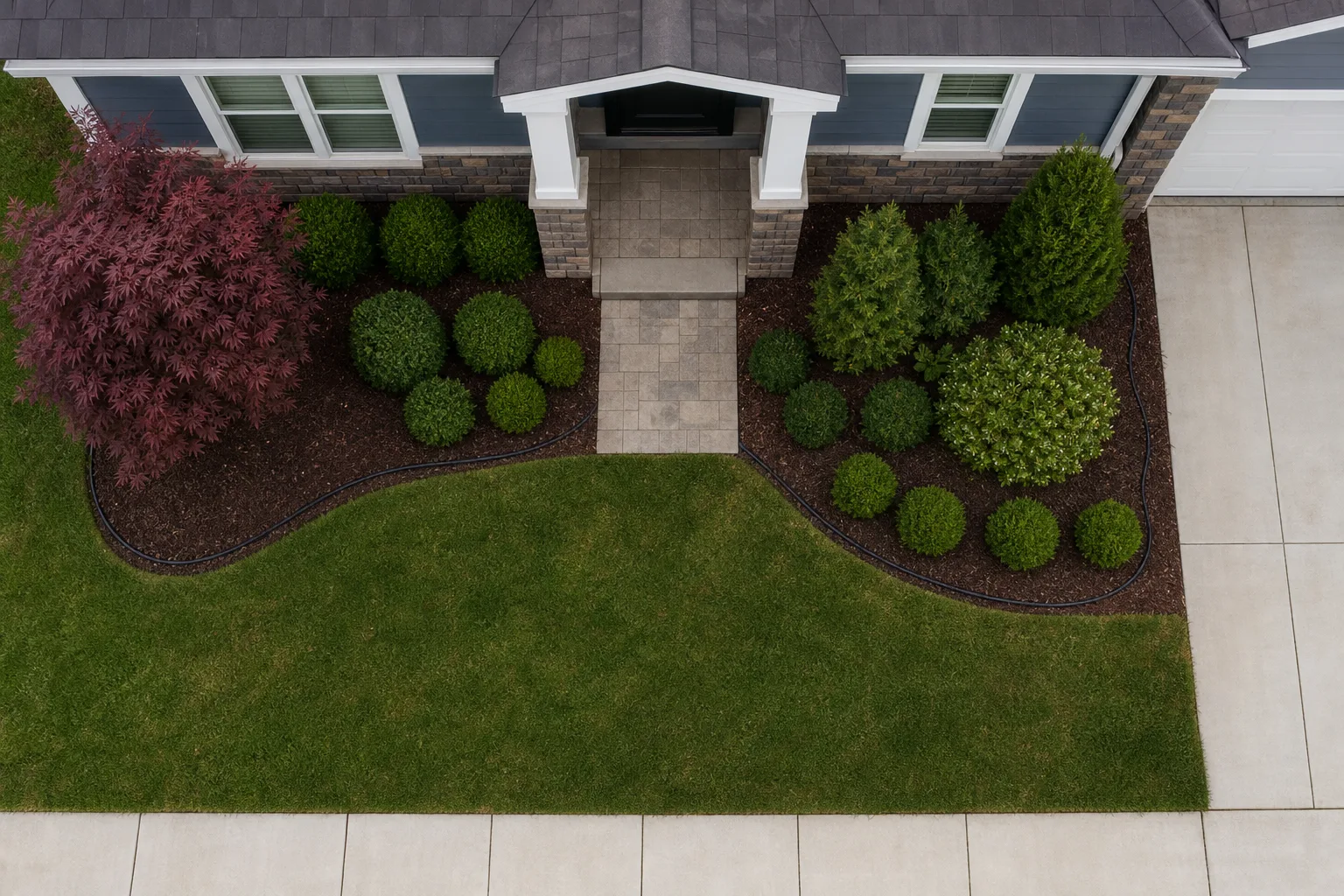
A homeowner in a mid-Atlantic suburb kept the paperwork from a 2014 front yard install: the planting plan, the irrigation as-built, the first maintenance contract, and every renewal since. Same yard, same plants in most of the beds, same sprinkler zones. She asked a simple question last spring. Why does a garden that cost what it cost to build now cost what it does to keep?
The answer is not inflation applied evenly. Three lines on her maintenance bill moved modestly. Four moved hard, each for a reason that has a date attached.
What the 2014 bid quietly assumed
The install was conventional for its moment. Turf front and side, two foundation beds of boxwood and liriope, a small ornamental tree, six zones of spray irrigation on a clock-based controller, and shredded hardwood mulch refreshed every spring.
Nothing about that design was careless. It was the standard answer to a standard lot, and it had been the standard answer for roughly thirty years. But a design is also a forecast. This one forecast four things:
- Crew labor would stay cheap enough that weekly mowing was a rounding error.
- Water would stay cheap enough that a controller running on a calendar, not on weather, cost nothing to ignore.
- Gas two-stroke equipment would remain the default, with no constraint on when or where it ran.
- Mulch and nursery stock would remain commodity purchases, available in volume at predictable prices.
Every one of those forecasts was reasonable in 2014. Three of them stopped being true, and the fourth changed shape.
The four lines that moved, and when
Mowing and hand labor
Her 2014 contract treated mowing as the filler item. Cut, edge, blow, leave. It was the line she never read. By the most recent renewal it had become the single largest item on the annual maintenance invoice, larger than irrigation service and mulch combined.
The driver is not mystery. Landscape maintenance is a labor business with thin equipment leverage, and wages in the trades moved faster over the last several years than most homeowners noticed, because homeowners encounter those wages as a quoted price rather than an hourly rate. The Bureau of Labor Statistics tracks employment and earnings in grounds maintenance occupations, and anyone who watched those series through the period saw the direction well before the renewal letters arrived.
The practical effect: tasks priced by time got expensive, and tasks priced by material did not, in the same proportion. That changes what a sensible garden looks like.
Water, and specifically how it is billed
The unit price of water rose. That is the small part. The larger part is that her utility, like many, moved to tiered residential pricing, where the gallons above a threshold cost meaningfully more than the gallons below it.
A clock-based controller does not know about tiers. It ran a fixed schedule through a wet June and a dry August alike. Under flat pricing, that waste was dull and cheap. Under tiered pricing, the overwatering happened precisely in the expensive tier, because irrigation volume is what pushes a household over the line in the first place.
The Environmental Protection Agency runs the WaterSense program, which sets the labeling criteria for weather-based irrigation controllers and efficient spray bodies. The reason those labels exist in the quantity they now do is that utilities needed a way to point customers at hardware that responds to conditions rather than to a calendar. Several utilities attached rebates to that label. Her controller swap cost less than one season of the difference.
Equipment rules
Between the install and now, a growing list of municipalities and a few states restricted gas-powered leaf blowers, by season, by hour, or outright. The rules differ enormously by jurisdiction, which is exactly why a crew covering several towns has to carry two sets of equipment or standardize on one.
Most of the serious outfits standardized on battery. That transition had a cost: packs, chargers, truck-mounted charging, and a slower work rate on heavy fall cleanups. Crews absorbed some of it and billed some of it. The fall cleanup line on her contract moved more than the spring line, which is what you would expect if the constraint is blower time rather than hand time.
Plant replacement and warranty
Her 2014 install carried a one-year replacement warranty on woody plants. Standard then. The warranties being written now are often shorter, narrower, or conditioned on the installer also holding the maintenance contract.
That shift followed nursery supply disruption and a run of hard weather years that made installers unwilling to underwrite someone else's watering. It is not a trap. It is a reasonable response to the fact that a shrub's survival depends mostly on what happens after the crew leaves. But it moves replacement risk onto the owner, and replacement is a keeping cost, not a building cost.
What the same yard would cost to keep if built today
She asked two firms to price maintenance on the yard as designed, and to price it again on a revised plan. The revised plan did not cost much less to build. It cost substantially less to keep, and the savings were concentrated in exactly the four lines above.
The changes were ordinary:
- Turf reduced to the usable area. The strip along the drive and the awkward wedge behind the mailbox became beds. Fewer passes, fewer edges, less trimming time.
- Bed edges simplified. Curves cost labor every single visit. Longer straight runs and gentle arcs cut edging time without changing how the yard reads from the street.
- Weather-based controller and pressure-regulated heads. The controller skips on rain and adjusts with the season, which keeps the household out of the top billing tier in a dry month.
- Drip in the foundation beds. Spray heads watering mulch is the most common waste in a residential system, and the one tiered pricing punishes hardest.
- Fewer plant species, in larger groups. Mixed borders need a skilled person making decisions. Massed plantings of three or four reliable species need a crew following instructions, which is cheaper and goes wrong less often.
- Hardwood mulch kept, depth corrected. Mulch is a material cost, and material costs behaved better than labor costs. Applying it at the right depth rather than burying the crowns did more for plant survival than any product change.
The general rule the case illustrates
Design standards persist long after the conditions that justified them. A lawn-dominant front yard with spray irrigation made sense when labor was cheap, water was flat-rated, and blowers ran whenever. Three of those conditions changed in under a decade, and the design did not change with them because nobody rebids a yard that is still alive.
So the useful question before you sign a landscaping contract is not what the install costs. It is which lines on the maintenance invoice this design will create, and what each of those lines is sensitive to. Labor-sensitive choices are now the expensive ones. Material-sensitive choices held up better.
Her revised yard went in over two weekends in sections, funded partly by the rebate on the controller. The plants that were doing well stayed where they were.