Rent Went Up While Cranes Were Up? What a Permit Promises and What It Leaves Out
Both sides of the housing supply argument are describing real things on different clocks. Here is what a permit certifies, what it does not, and how the gap shows up in your lease.
- Written by
- Nadine Buckley
- Published
- Filed under
- Policy
- Length
- 1,420 words, about 6 minutes
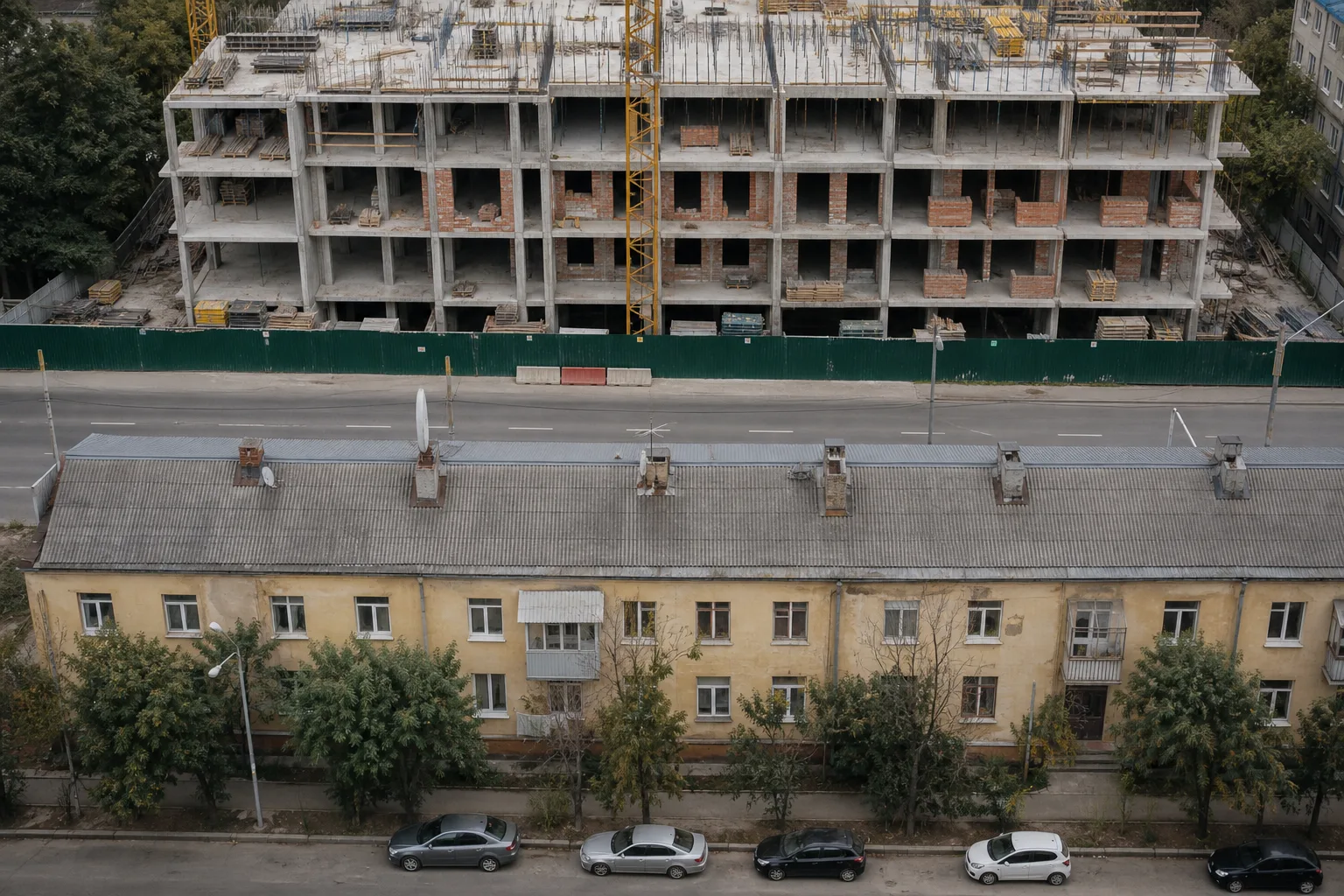
You can stand at a corner where three buildings are going up and still open a renewal letter asking for more than last year. That experience drives most of the argument about housing supply, and it drives it in two opposite directions at once. One group sees the cranes and concludes the building is not working. The other sees the renewal letter and concludes there is still not enough building. Both are looking at the same block.
The disagreement is less about economics than about clocks and definitions. A permit, a certificate of occupancy and a listing are three different things, separated by months or years, and each certifies something narrower than people assume.
The two assumptions, stated plainly
Strip the arguments down and you get two sentences.
The first: build more housing and rents will fall. The second: the housing being built is expensive, so building it raises rents in the neighborhood around it.
Each sentence is doing something sloppy. The first does not say where, for whom, or by when. The second confuses the price of a new unit with the effect of that unit on everything else nearby.
What the research literature tends to find, in shape rather than in any single number, is that additional housing lowers rents at the scale of a metro area and over a span of years, while the immediate blocks around a large new building can see asking rents rise in the short run because the neighborhood has become the kind of place people are bidding on. Both effects are real. They operate at different distances and on different timelines. An argument that only acknowledges one of them will sound persuasive and still be incomplete.
What a building permit actually certifies
This is where the standards question matters, because "units permitted" is the number most often used as a proxy for supply, and it is a proxy with known gaps.
A residential building permit is a determination by a local jurisdiction that a proposed project, as drawn, complies with the applicable zoning and building code. That is all it is. It is a compliance finding on a set of plans.
What a permit does not promise:
- That the thing gets built. Permits lapse. Financing falls through. Projects get redesigned and repermitted, which can mean one building shows up twice in a count.
- When. The distance between a pulled permit and a finished building runs from several months for a small infill project to several years for a mid-rise with structured parking. Large projects are slower, and large projects are where most of the counted units sit.
- That the units reach the rental market. Condos, build-to-sell townhomes and units held for short-term rental are all counted the same way in a permit tally.
- That the unit matches the demand. A one-bedroom permitted is a one-bedroom, whatever the waiting list is made of.
The certificate of occupancy is the document that says the building is actually safe to live in, and it arrives much later. The gap between those two pieces of paper is the gap that makes the crane-versus-renewal-letter experience so confusing. The cranes you see today are the permits from two or three years ago, and the apartments you can rent this month came from permits older still.
The Census Bureau is responsible for tracking residential construction authorizations nationally, which is why permit counts are the series everyone reaches for. It is a well-built measure of exactly what it measures. The problem is not the data. It is the substitution of a compliance count for a count of homes somebody can move into.
The week-to-week version of all this
Policy arguments get made in annual figures. Housing is lived in weeks.
The week-to-week reality looks like this. A renewal notice arrives sixty days before the lease ends, sometimes ninety. You have a window to decide. Searching means refreshing listings in the evening, and the listings that appear are not a cross-section of the housing stock. They are the small fraction that happens to be turning over right now, in the price band you filtered to, in the three neighborhoods you can commute from.
That is the market you actually face. Not the stock, and not the pipeline. The turnover.
Which is why the supply argument feels abstract from the inside. Twelve hundred units finishing across the metro this year might mean two listings you would have considered, on the weeks you were looking. The effect is real and it is diluted across thousands of searches like yours.
The same dilution explains the chain nobody sees. When a new building opens, the people who move into it are mostly already housed somewhere. They vacate older apartments, which someone else takes, which vacates another. Each link in that chain is one renewal letter that went out at a different number than it otherwise would have. The chain is invisible from any single apartment, and it is the main way new construction reaches people who will never live in a new building.
Demand is not one number either
The supply side gets most of the scrutiny because it is the side with permits and hearings attached. Demand is quieter and moves in ways that are easy to miss.
A few things that all register as demand:
- Household formation. Two roommates splitting into two apartments is one additional household and zero additional people. The reverse is also true, and it is how markets absorb a bad year without anyone recording a move.
- Income at the top of the band. If the people bidding on the same apartments earn more this year, the clearing rent rises whether or not a single additional person arrived.
- Where the job is. Remote and hybrid arrangements moved demand between neighborhoods and between metros without changing national totals. A building that pencils out in one place stops penciling out in another.
- Conversion of existing stock. A long-term rental becoming a short-term rental removes a home from the pool you are searching, and nothing is demolished.
None of these show up in a permit count. All of them show up in your inbox at renewal time. An argument that treats demand as fixed population growth is working with a definition that does not match what the market is doing week to week.
What the strongest version of each side gets right
The build-more case is strongest when it is specific about scale. The claim that holds up is that a metro which consistently permits a lot of housing relative to its job growth sees slower rent growth than one that does not, over a period long enough to let projects finish. That is a claim about sustained volume across years, not about one building on one corner.
The caution-about-new-building case is strongest when it is specific about who. The people most exposed to a neighborhood getting more desirable are the ones already living in it on a lease that can be repriced. Their rent can rise during the same period the metro-wide numbers improve. That is not a contradiction. It is two different populations.
The useful consequence is that the two cases resolve into a set of local questions rather than a national position:
- Is the zoning code actually permitting what the staff report says it permits? Height, floor area ratio, parking minimums and lot coverage interact. Any one of them can make a technically allowed building unbuildable.
- How long does a compliant application take to get approved? Review time is a cost, and it is a cost that falls hardest on small projects by small builders.
- What is the permit-to-occupancy gap in your jurisdiction? If it is three years, this year's announcements are a 2028 story.
- What protects the people already in place? Notice periods, relocation requirements and the rules on how far a renewal can move are the week-to-week instruments. They are separate from the supply question and they are decided separately.
Asked that way, the argument stops being a loyalty test and starts being a set of things you can look up for the city you live in.
If you want one working rule: treat a permit as a compliance document about a drawing, treat a certificate of occupancy as the first moment a home exists, and treat the listings you can see tonight as the only market you are personally in. Hold those three apart and most of the noise in the housing debate sorts itself into statements about different objects, which is what it was all along.