Fog on the Glass, Water on the Sill? Five Checks That Tell You Which Problem You Have
Windows got better, buildings got tighter, and condensation stopped being inevitable. Five checks that tell you whether the glass failed or the air did.
- Written by
- Ellen Marsh
- Published
- Filed under
- Property
- Length
- 985 words, about 4 minutes
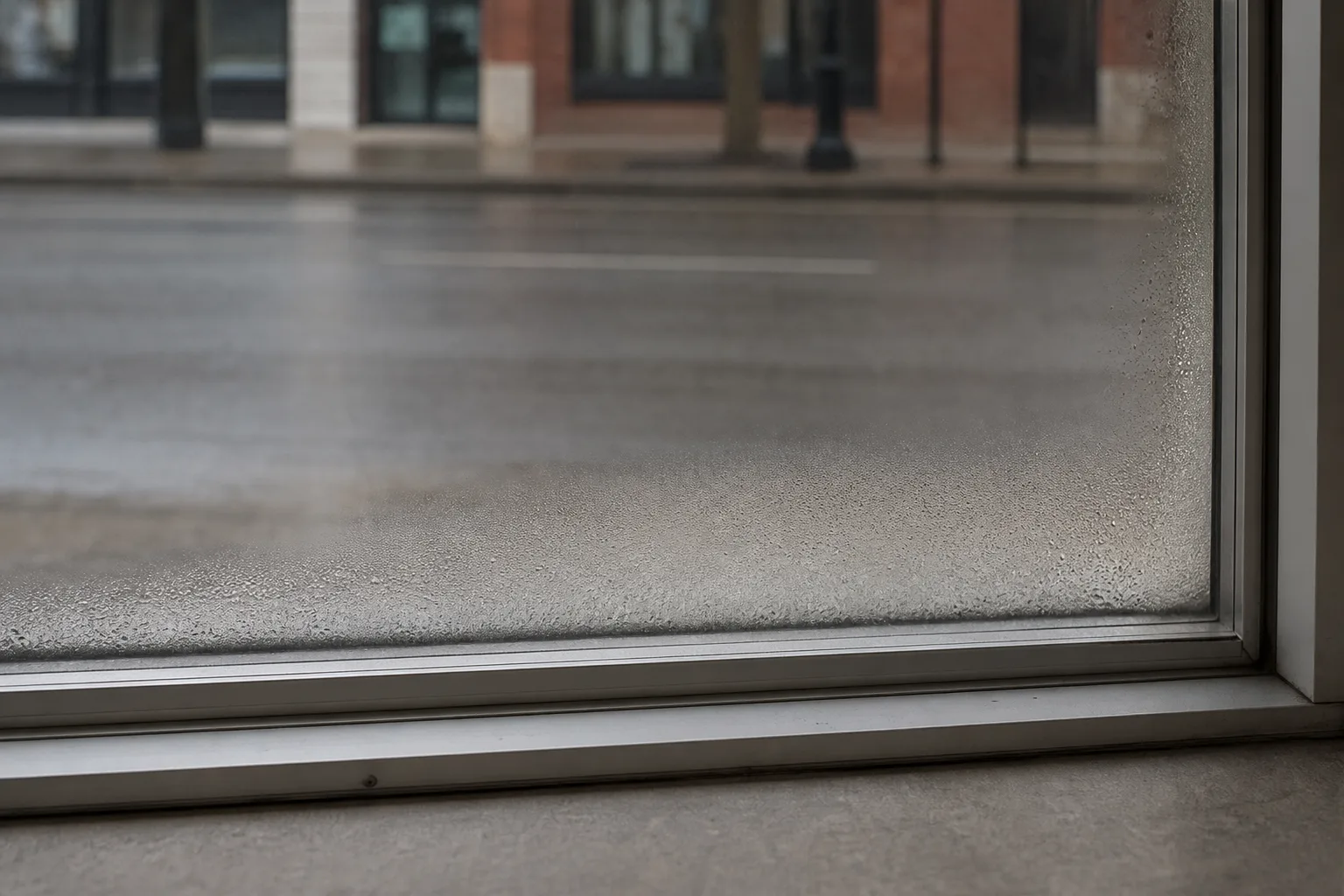
Condensation used to be background noise. Single-pane glass in a leaky building sweated every winter, everyone wiped it, nobody diagnosed anything. That is no longer the situation, and it matters because the person quoting you for replacement glass is usually quoting on the assumption that you still live in that older building.
Water on glass is a temperature and humidity problem before it is a product problem. Five checks tell you which one you have, and four of them cost nothing.
1. Which surface is actually wet
Put a finger on it. There are only three answers and they lead to three different conversations.
- Room side. The interior face of the glass is wet. This is an air problem: humid indoor air meeting a surface below its dew point. The glass is reporting, not failing.
- Exterior face. Dew on the outside, usually early morning, usually in shoulder season. On high-performance units this is a sign the glass is doing its job. So little heat is escaping that the outer lite drops to the temperature of the night sky. Irritating on a west-facing storefront, not a defect.
- Between the panes. You cannot wipe it. There may be a faint haze, streaking, or a mineral film that appears and disappears with the sun. That is a failed seal in an insulating glass unit, and it is the only one of the three that a glazier can fix by replacing something.
Most complaints that get diagnosed as "failed windows" over the phone turn out, on a finger test, to be room-side.
2. Where it sits on the pane, and where in the building
Room-side condensation almost always starts at the bottom edge and in the corners, because the perimeter of a sealed unit is colder than the center. The spacer bar running around the edge of the glass conducts heat. For decades that spacer was aluminum, which is very good at it, which is why older double glazing fogs in a neat band an inch or two up from the frame while the middle of the glass stays clear.
Warm-edge spacers changed that. Stainless steel, then structural foam, cut the edge conduction enough that the band shrinks or disappears. If you have condensation across the whole pane, including the middle, humidity is high, not marginal.
Then look building-wide. Two windows out of twenty means those two are colder, or that room is wetter. Every window on one elevation means an exposure problem. Every window in the building means air.
3. What the air is doing, because that is what changed
Here is the history the sales pitch skips. Windows improved on a clear line: sealed double units became normal, then low-emissivity coatings in the 1980s, then argon fill, then warm-edge spacers, then triple glazing at the top of the market. At the same time energy codes went after air leakage. Blower door testing, continuous air barriers, taped sheathing, gasketed doors. The Department of Energy oversees the efficiency standards and labeling program that pushed most of this into the mainstream.
Both trends are good. Together they produced an effect nobody warned occupants about. A tight building does not exhale. Moisture from cooking, showers, coffee urns, plants, people, and unvented gas appliances now stays inside until something removes it deliberately. The glass got warmer, but the air got wetter faster than the glass got warmer, so condensation moved rather than vanished.
And it moved to whatever surface is now coldest. Sometimes that is still the window. Increasingly it is a metal frame, a thermal bridge at a slab edge, the inside of an exterior wall, or a cold corner behind a filing cabinet. If your new glass is dry and your drywall is damp, the windows did not fail. They stopped being the coldest thing in the room.
4. The frame and the spacer, not just the glass
Ask what the frame is. An aluminum frame without a thermal break will run wet while the glass beside it stays clear, and no amount of new glazing fixes that. Steel is worse. Vinyl and thermally broken aluminum are the reason a lot of replacement projects succeed for reasons the glass had nothing to do with.
Then ask about the edge. Two quotes for the same insulating unit can differ on spacer type, gas fill, and whether the coating sits on surface two or surface three, and none of that appears in a one-line proposal. Get it in writing.
Between-the-panes fogging is the one case where the unit itself is the answer, and it is worth checking the date before you pay. In a commercial building, sealed units in a curtain wall or storefront frequently carry a manufacturer warranty measured in a decade or more, and a commercial glass company can usually read the fabrication stamp off the spacer and tell you whether the failure is still covered. That single call has settled a lot of invoices before they were written.
5. What happens when you change one variable
Before signing anything, run the cheapest test available. For a week, run the bath and kitchen exhaust fans longer, keep interior doors open, and move furniture off the cold walls. In a commercial space, ask whether the ventilation system is actually delivering its design outdoor air rate, and whether anyone has adjusted it since the last tenant fit-out. Humidifiers set for comfort in dry weather are a common single cause.
If the condensation retreats to a thin band at the bottom edge on the coldest mornings only, you are inside normal behavior for the glass you own. If it does not move at all, or if it is between the panes, you have a hardware problem and now you have evidence for it.
Condensation is the most honest instrument in the building. Read the surface, the location, and the season before you read a quote, and the quote gets much easier to judge.