Hearing in Three Weeks? How to Write a Comment the Board Is Obliged to Answer
Boards decide against written criteria in the ordinance. Comments tied to those criteria enter the record and have to be addressed. Everything else does not.
- Written by
- Roy Castellano
- Published
- Filed under
- Policy
- Length
- 1,297 words, about 6 minutes
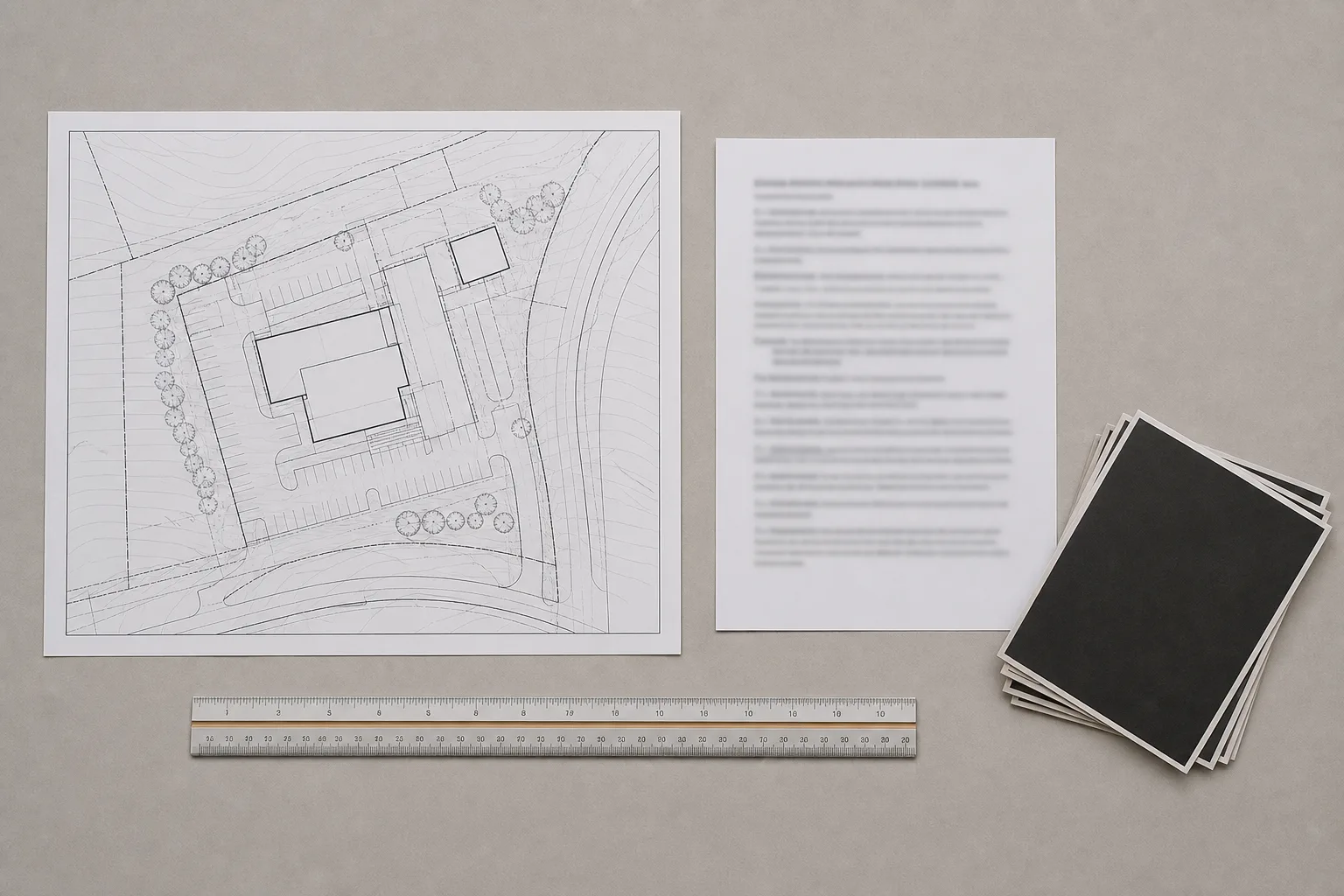
Ask anybody who has sat on a planning board why so much public testimony changes nothing, and the answer is rarely that members were not listening. It is that a board deciding a special permit or a variance is applying criteria written into the ordinance and has to make findings against those criteria, so testimony touching none of them cannot support a finding, cannot change the outcome, and would not survive an appeal if it did. Most people who show up speak from feeling, which is understandable and almost entirely unusable. Comments that actually work are built out of documents, and the documents are all available three weeks before anybody has to speak.
Get the File Rather Than the Notice
The mailed notice contains almost nothing beyond an address, a case number and a date. The application file contains everything and it is public record, which means it can be requested or downloaded without explaining why you want it. Ask for the application form itself, which states what relief is being sought and under which section of the ordinance, and the plans including the site plan with its dimensions marked. Ask for any traffic, drainage or environmental study submitted in support, and for prior decisions on the same parcel, which are frequently referenced in the application and rarely attached to it.
The document worth reading first is the staff report, where one has been issued. It is a professional planner's written analysis of whether the proposal complies with the rules, and it is by a wide margin the most informative thing in the file. Where it recommends approval with conditions, those conditions are the live negotiation and the place a neighbor's suggestion can land. Where it identifies a deficiency, that deficiency is where a comment has genuine leverage, because staff have already said in writing that something does not meet the standard.
Find the Criteria the Board Is Required to Apply
Open the ordinance to the section the application cites. Special permits, variances and site plan approvals each carry their own list of standards, and the list is usually short, usually numbered, and written in language a non-lawyer can follow. Typical entries cover whether the use is compatible with the surrounding neighborhood, whether traffic can be handled safely, whether utilities and drainage are adequate for what is proposed, whether the hardship claimed for a variance arises from the land itself rather than from the applicant's own plans, and whether the proposal is consistent with the comprehensive plan.
Write that numbered list out on a page of its own, because it is now the outline of everything you are going to submit. Working from the board's own criteria rather than from your own concerns is the entire technique, and it is the difference between a comment that has to be addressed in a written decision and one that can be thanked and set aside without anybody being unfair about it.
Match Evidence to Each Numbered Standard
Take the criteria one at a time and ask what you personally know that bears on this one and what document supports it. Drainage is often the strongest, because a neighbor has photographs of where water actually stands after a storm and the applicant's engineer has a model. Traffic and safety respond to measurement: sight distance at the proposed driveway location, taken with a tape and a note of where you stood, or a dated count of how often the street is blocked by delivery vehicles. Utilities respond to the record, meaning whether the street has had water pressure or sewer problems and whether the capital improvement plan schedules work there.
Consistency with the comprehensive plan is answered by citing the page and the map that say what this area is intended to become, which takes ten minutes and carries real weight because the board adopted that plan itself. What does not help is equally worth naming: property values, the identity or reputation of the applicant, what the neighborhood used to be like, and general opposition. Boards hear all four at every hearing, frequently sympathize, and can act on none of them.
Write It Down and Submit It Before the Deadline
The written submission matters considerably more than the spoken one, because it enters the record in full, members read it in advance rather than hearing it once, and it is what an appellate body would review if the decision were ever challenged. The format that works opens with one paragraph saying who you are, where you sit relative to the site, and what you are asking the board to do, whether that is denial, approval with specific conditions, or continuation for more information.
After that comes a numbered section for each criterion with the evidence set out beneath it, then attachments labeled and referenced by number in the text so nobody has to guess which photograph goes with which paragraph, then a short closing naming the specific conditions you would accept if the board approves. Send it to the board's clerk or to planning staff before the submission deadline printed in the notice, and ask for written confirmation that it has been entered into the record, which is a routine request and worth having.
Ask for Conditions Rather Than Denial
This is the practical move that changes outcomes more often than any other. Denials are rare, appealable and expensive for everybody involved, while conditions are routine and boards impose them readily, particularly where a neighbor has proposed something specific and reasonable rather than asking for the project to disappear. The conditions that get imposed because somebody asked for them are recognizable: limits on hours of operation or delivery, a specified driveway location, screening or fencing along a boundary, a lighting standard that keeps light off adjacent property, retention of an existing tree line, a designated construction traffic route, and drainage designed for a stated storm event.
Bring each of them as written language rather than as a complaint, because a board can adopt a sentence handed to it in usable form and is much less likely to draft one from scratch out of an objection delivered at a microphone. A single well-drafted sentence offered in writing is worth more than an hour of testimony, and it costs an evening to produce.
Speak Briefly, Then Read the Decision
Three minutes is the common limit and the whole of it should go to saying who you are, which criteria your written submission addressed, and what specific condition you are asking for. Do not read the submission aloud, since it is already in the record and the members are holding it. The brevity itself signals that you have done the work, which is worth something in a room where most speakers have not.
When the written decision issues, read it. Two things are worth checking: whether the conditions you asked for were included, and whether they are drafted in a way anybody could enforce. A condition requiring screening along a boundary is enforceable. A condition saying the applicant will work with neighbors is not, and the difference will only matter later. Where a condition genuinely matters to you, find out who enforces it, which is usually the building department at the permit stage, and that is the moment to confirm the construction plans reflect what the board actually imposed.
None of this is as much work as it appears from the outside. Reading the staff report and the numbered criteria takes an evening, and what it buys is the conversion of a frustrating three minutes at a microphone into a submission that the board is structurally obliged to answer in writing. That is a different position entirely, and the three weeks between the notice and the hearing is exactly enough time to get there.