Nobody Needs the Stone in Thirty Days. What Waiting a Season Actually Buys You
An itemized look at what a grave marker really costs, which parts of the price are set by the cemetery rather than the seller, and which choices are permanent once the sandblaster starts.
- Written by
- Ellen Marsh
- Published
- Filed under
- Family
- Length
- 1,129 words, about 5 minutes
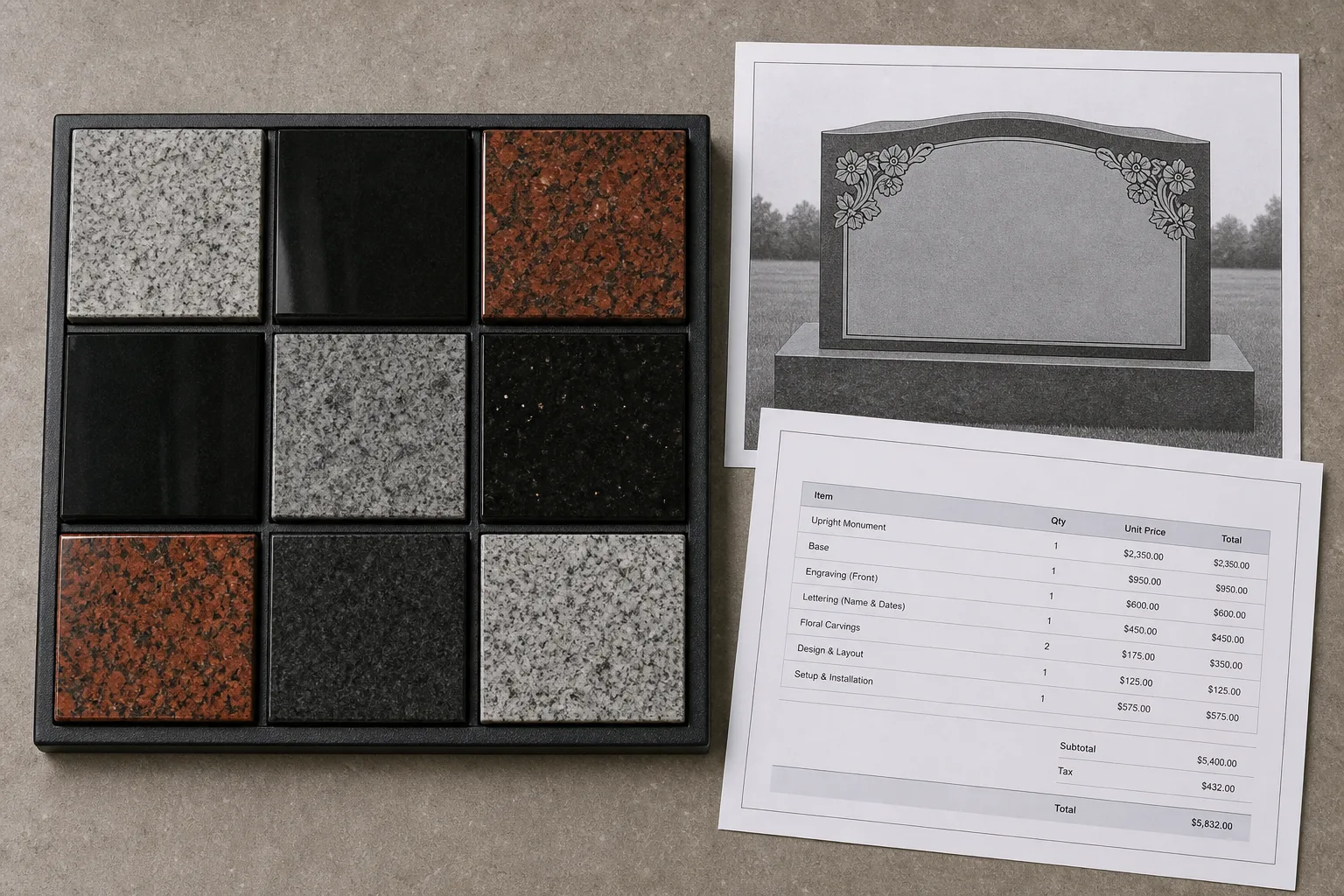
The pitch arrives while the funeral is still being paid for. A folder, a catalog, a sample board of polished granite squares, and a sentence about how long the engraving shop is booked out. The implication is that if you don't choose now, the grave stays unmarked into next year. That is presented as a failure on your part.
It isn't. Almost nothing about a permanent marker is time-sensitive, and several parts of it are actively better done later. Meanwhile the decisions you make in that folder are the least reversible purchases in the entire funeral sequence. A casket is in the ground. A stone sits above it, in public, spelled the way you approved it, for as long as the cemetery exists.
The deadline is usually someone else's
There are three real reasons to move quickly, and none of them is grief management.
- A cemetery installation window. Many grounds only set foundations in certain months, and stop when the ground freezes. Ask for the actual dates.
- A pre-need contract with a price lock. If a locked price expires, that is a number you can check.
- A specific date the family wants the stone in place, such as a first anniversary or a gathering. That is your deadline, not the seller's.
Otherwise, the grave settles for months anyway. Setting a heavy monument on ground that has not compacted is how stones end up leaning and how families end up paying a resetting fee. A temporary marker, often included by the funeral home or the cemetery, holds the spot in the interim. Ask whether you already have one before you buy a second.
What the catalog number covers, and the four line items that show up later
The price you are shown is usually the stone and a basic inscription. It is a real number, but it is rarely the number on the final invoice. The gap is made of predictable pieces:
- Lettering beyond the base allowance. Base prices commonly include a name, two dates, and not much else. Additional lines, a second surname, a verse, a nickname in quotes, a military line: each is priced separately, sometimes per character.
- The foundation and setting fee. This is almost always paid to the cemetery, not the monument dealer, and the cemetery sets it. It depends on the size of the base your marker requires. A larger monument means a larger concrete pour and a higher fee.
- Delivery and installation. Distance from the plant matters. So does whether equipment can reach the plot without crossing other graves.
- Cemetery-side charges you did not negotiate. Permit fees, inspection fees, sometimes a required deposit against damage to roads or turf. Ask for the cemetery's own fee schedule in writing before you sign the order.
Get one itemized quote that shows all four. If a seller quotes a single bundled figure, ask them to break it out. The ones who do this well have the sheet ready.
What actually drives the price
Once you strip out the sales language, cost tracks a short list of physical facts.
Material and color
Gray granite from a common domestic quarry is the baseline. Black, red, blue, and mottled granites cost more, sometimes considerably, because of quarry source and how the color takes an etching. Marble weathers faster and reads less clearly after a few decades. Bronze on a granite base is priced by the plate.
Size, thickness, and finished faces
You pay for volume, and then you pay again for every face that gets polished. A flat marker with one finished top is the least expensive form. An upright with two polished faces, a shaped top, and a separate base is several steps up. Thickness is not a detail: it drives weight, which drives the foundation, which drives the cemetery's fee.
How the lettering is made
Sandblasted lettering through a rubber stencil is standard and durable. Hand-etched or laser-etched portraits and scenes are labor, and they price like labor. Ceramic photo inserts are a separate product with a separate lifespan. Ask how each one is expected to hold up outdoors, and whether the shop warranties it.
Shopping this honestly means comparing the same specification across sellers rather than comparing catalog pages. Two quotes for cemetery headstones can differ by half simply because one includes the foundation and the other leaves it for the cemetery to bill you directly.
The choices that are permanent
This is the part the folder does not dwell on. Some decisions can be revisited; a few cannot, at any price short of buying the stone again.
- Spelling, dates, and punctuation. Once blasted, that is the stone. Middle names, maiden names, and date formats need to be checked against a document, not a memory. Read the proof out loud, character by character, with a second person.
- Layout and centering. A single name centered on a companion stone looks fine now and looks wrong in twenty years when the second name is squeezed in. Decide the full future layout before the first inscription.
- Pre-carved birth years for a living spouse. Common, cheaper to do at once, and permanent. Some families are glad of it. Others find it hard to visit. Make that choice deliberately.
- Stone color and batch. Adding a matching piece years later rarely matches exactly. Natural stone varies by block.
- Cemetery-restricted features. Vases, upright height, borders, and photo inserts are often governed by the section rules. A feature installed against those rules can be removed at your expense.
All of these are fixable in advance and none of them is fixable after. That asymmetry is the whole argument for slowing down.
How to buy it from the customer's side
The Federal Trade Commission is responsible for the rules on how funeral goods and services must be priced and disclosed to consumers. Monument dealers and cemeteries frequently sit outside the tightest of those requirements, which means the itemization you are owed at a funeral home is something you may have to ask for at a monument shop. Ask anyway. Reputable sellers itemize without being pushed.
A workable sequence: get the cemetery's written rules and fee schedule first, then take those rules to two or three monument sellers, then ask each for an itemized quote on the same specification, then insist on a printed or emailed proof you sign only after a second reader has checked it. Add a delivery estimate in writing and confirm who pays if the stone arrives damaged.
The families who end up happiest with a marker are usually the ones who ordered it six or nine months out, on a quiet afternoon, with the cemetery's rulebook on the table and a proof they had read three times. The stone cost about the same. They just had time to get it right.