One Flagged Foundation Crack, Four Ways to Answer It. What Each One Costs You
A home inspection report tells you to have a qualified engineer evaluate a foundation crack. There are four ways to do that, and they do not cost anything like the same.
- Written by
- Roy Castellano
- Published
- Filed under
- Property
- Length
- 1,235 words, about 5 minutes
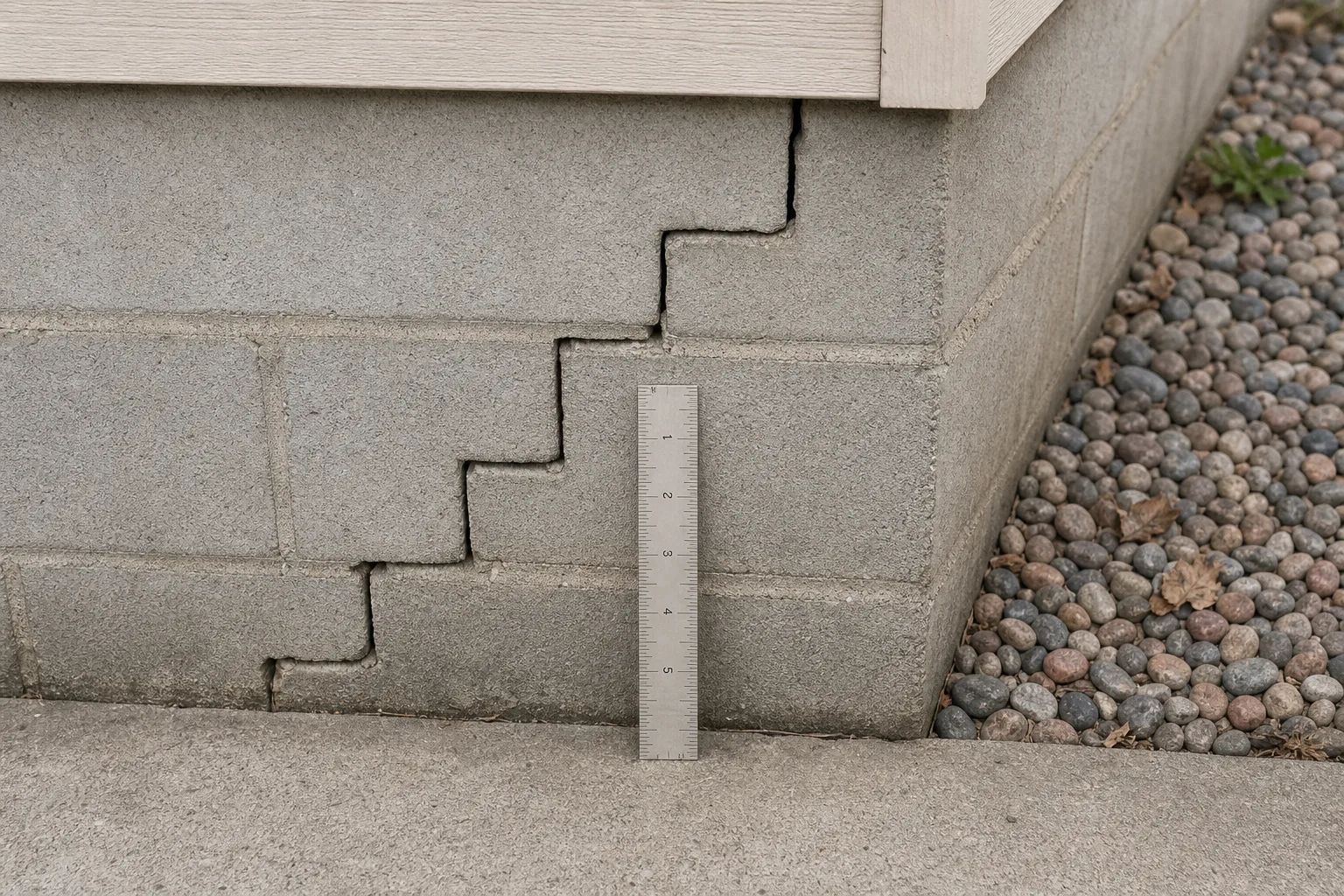
The sentence that costs you money is rarely dramatic. It reads something like this: Evidence of prior movement noted at the northeast corner of the foundation wall. Recommend evaluation by a qualified structural engineer prior to expiration of the inspection period.
Two lines. No opinion about severity, no estimate, no guess at cause. You are holding a report you paid for that has just told you to go pay someone else.
That is not laziness. It is the shape the document was designed to have. Understanding why explains which of your four options is actually appropriate, and why the cheapest one is sometimes the correct one.
Why the report hands the question back to you
Home inspection grew up as a consumer service in the 1970s, and it professionalized the way most trades do: by writing a standard of practice that said, in plain terms, what the job is and what it is not. The core limit in every version of that standard is the same. The inspection is visual and non-invasive. The inspector looks, and does not open, dig, or dismantle.
That limit is the whole business model. It is why an inspection can be done in a few hours for a fee a buyer will actually pay, and it is why errors-and-omissions coverage for inspectors is priced the way it is. An inspector who volunteers a cause and a repair scope for a foundation crack has stepped outside the visual standard and into engineering. Their insurer knows it. Many state licensing statutes know it too.
So the report developed a defensive vocabulary, and each word in it is load-bearing:
- "Evidence of" means observed, not diagnosed. The inspector saw a pattern consistent with movement. Nothing about when, or whether it is ongoing.
- "Qualified" means licensed in your state to do the thing being asked. A repair contractor is not qualified in this sense, no matter how good.
- "Recommend evaluation" means the question is open. It is not a statement that something is wrong.
- "Prior to expiration of the inspection period" is the only clause with a deadline in it, and it is the one people miss.
The exception proves the rule. Notice that the same report will state flatly that a water heater has no expansion tank, or that a receptacle near a sink lacks GFCI protection. Those are code-referenced, visible, and binary. No judgment call, no liability. The hedging appears exactly where the standard stops.
The four routes, side by side
Your goal is not a perfect answer. It is a defensible answer, in hand, before the contingency date. The Consumer Financial Protection Bureau is responsible for the federal mortgage disclosure rules that set much of the closing calendar, and that calendar does not move because your engineer is booked out two weeks.
| Route | What you get | What drives the price | Typical turnaround |
|---|---|---|---|
| Call the inspector back | A verbal read on how concerned they actually are, and often a clearer description of what they saw | Usually included in the original fee. A return site visit is billed separately | Same day |
| Written clarification from the inspector | A short letter narrowing the observation. Still will not diagnose cause | Time only. Some inspectors decline entirely on advice from their insurer | One to three days |
| Engineer site visit and letter | A licensed opinion on cause and whether the movement is active, in a form a lender and a seller will both accept | Minimum visit fee, travel, whether the letter is sealed, market demand in your area | Days to a few weeks |
| Engineer report with monitoring | Crack gauges installed, readings taken over months, a conclusion about whether anything is still moving | Repeat visits, elapsed time, sometimes destructive investigation | Months |
The fourth route does not fit inside a purchase contract. That is worth knowing early, because it is the route that actually answers the question, and it is the route you cannot have before closing.
What actually moves the number
The engineer's hourly rate is the part buyers ask about and the part that matters least. Four other things drive what you pay.
The minimum, not the hours
Structural engineers price residential visits against a minimum, because a two-hour job consumes half a day once travel is counted. A crack in a crawlspace forty minutes out of town costs more than an identical crack in town, for reasons that have nothing to do with the crack.
Whether the document is sealed
A verbal opinion at the site is one thing. A letter on letterhead is another. A stamped and sealed report is a third, and it is the expensive one, because the seal attaches personal professional liability to the conclusion for as long as your state's statute of repose runs. You are not buying paper. You are buying someone's willingness to be named later.
Whether anyone has to open something
If the engineer can see enough from grade and inside the basement, the visit is the visit. If the answer requires exposing a footing or cutting drywall to see a beam pocket, you have added a contractor, an excavation or demolition line, and a patch. That is where a single flagged item stops being a consultation and becomes a small project.
Who is paying for the opinion
The free option is almost always a foundation repair contractor, who will inspect at no charge and produce a proposal. That is not an evaluation. It is a bid, from the only party with a financial interest in the answer. Sometimes it is the right document to have alongside an engineer's letter. It is never a substitute for one.
The narrow case, worked through
Assume a stair-step crack in a block foundation wall at one corner, about a quarter inch at its widest, with no interior finishes to hide it and no water staining. Here is the sequence that gets you an answer without buying the expensive product first.
- Phone the inspector the day the report lands. Ask three questions: is the crack open at the top or the bottom, is there any offset between the two faces, and did you see anything at the grade or gutters above it. The answers are already in their notes, and they narrow the field fast.
- Photograph and measure it yourself. Date-stamped photos with a ruler in frame become the baseline reading for any monitoring later. This costs nothing and is worth real money if you buy the house.
- Book the engineer visit, unsealed letter. Ask on the phone whether a letter without a seal is acceptable to your lender. Frequently it is, and that single question changes the invoice.
- Ask the engineer one specific question in writing. Not "is this a problem" but "is there evidence this movement is active, and what would you monitor." A narrow question gets a narrow bill.
- Move monitoring into the negotiation. If the engineer says the movement is probably old but wants readings over a season, that is a post-closing task, and the cost of it belongs in the credit you ask for now.
Run that way, the flag on the report becomes what it was always meant to be: a signpost, not a verdict. The defensive language exists because the inspector's standard genuinely stops at the visible surface, and the sentence is telling you exactly where the boundary is. Read it as a boundary and you know precisely what to go buy, and what you can decline.