A Sentence Written Years Earlier Decided Who Owed the Accrued Vacation
An employee resigned with accrued vacation on the books, and whether it was payable came down to a line written by somebody who had long since left.
- Written by
- Roy Castellano
- Published
- Filed under
- Corporate
- Length
- 857 words, about 4 minutes
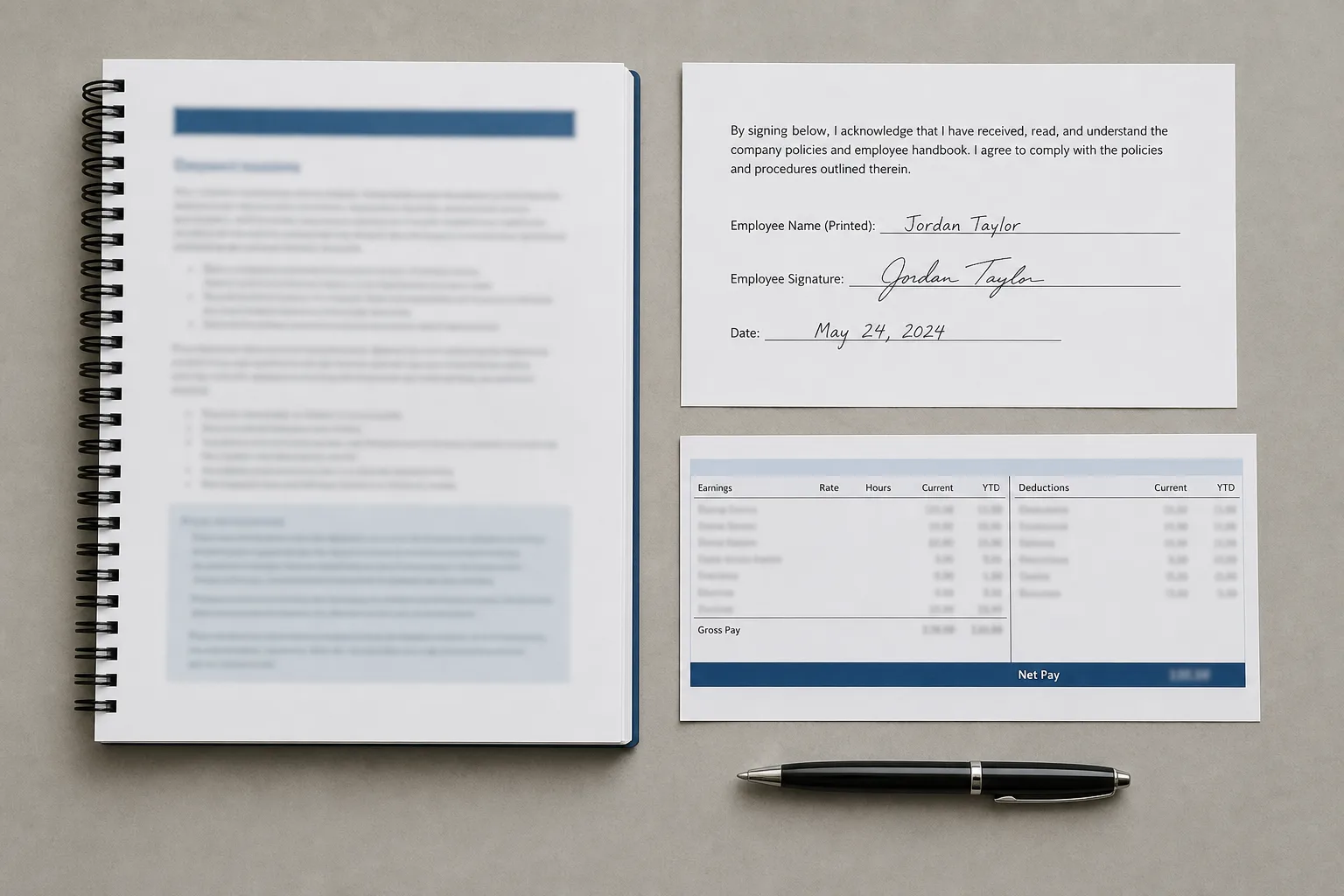
Most small employers believe that what happens to unused vacation on the last day is a matter of company policy, and that whatever the handbook says is what applies. An employee who gave two weeks' notice after four years asked on the final morning for the accrued but unused balance to be paid out. The owner had not budgeted for it and did not believe it was owed, and the employee was equally certain it was. Neither belief carried any weight whatsoever, because the answer sat in a document they had both signed for and neither had read since the day they signed.
The Two Sentences Pulling in Opposite Directions
The handbook's time off section stated that vacation accrues monthly and may be carried over into the following year, and that unused vacation is not paid on separation. Those are two provisions doing opposite work: the first creates a balance that grows, and the second says the balance evaporates at the end. Whether the second sentence is enforceable at all depends entirely on the state.
Some states treat accrued vacation as earned wages, which means it must be paid on separation regardless of what any policy says and a forfeiture clause has no effect. Others allow a clearly written forfeiture policy to stand, provided the employee was properly informed of it. A third group permits a cap on further accrual but not forfeiture of what has already accrued. This employer was in a state of the first kind, so the sentence did nothing at all and the balance was payable.
What Made It a Dispute Rather Than a Calculation
Three documentary problems turned a straightforward payment into weeks of correspondence, and all three are common. The accrual rate was described in two places and the two descriptions disagreed, with the handbook saying one thing and the offer letter another, and where two employer documents conflict the ambiguity is generally resolved against whoever drafted them. The handbook had been revised at some point with no record of the employee acknowledging the revision, so the signed acknowledgment on file covered an earlier version carrying a different policy. And the balance had never been tracked in any system, meaning it was reconstructed from a spreadsheet and from memory, which left the employer unable to state its own position with confidence. That third problem is what stretched a modest amount into a long argument, since neither side could produce an authoritative figure.
The Other Clauses That Were Doing Work
The same handbook carried three provisions that mattered in this case and are worth checking in any document. The at-will statement was present and correctly worded, which is what kept the resignation itself uncomplicated. The notice provision asked for two weeks and said employees failing to give it forfeit accrued time, which is a conditional forfeiture carrying the identical problem in this state, and which was irrelevant here anyway because notice was given. The reservation of the right to modify was also present, and that is the clause allowing a handbook to be updated at all, though it works only where changes are genuinely distributed and acknowledged, which is exactly where this employer had a gap.
How It Resolved, and the Deadline Nobody Watches
The accrued balance was paid at the higher of the two accrual figures, within the period the state sets for final pay. That deadline is a trap in its own right, since many states require final wages within a specified window after separation and the window is frequently shorter for a discharge than for a resignation. Missing it can trigger penalties that exceed the underlying amount by a wide margin, which turns a disagreement about a few days of vacation into something considerably more expensive.
The employer then made four changes, none of which took more than an afternoon. They checked the state's actual treatment of accrued vacation and rewrote the policy to match it. They removed the conflicting language from the offer letter template so that a single document governs the accrual rate. They moved balance tracking into the payroll system, so the figure is produced automatically and appears on every pay statement where both parties can see it. And they set a process for distributing handbook revisions with a dated acknowledgment collected for each version.
The Cheapest Audit Available to a Small Employer
A handbook is only useful to the extent that it is accurate, since a policy contradicting state law is unenforceable and a policy contradicting another company document creates an ambiguity that gets resolved against the employer who wrote both. The audit that prevents all of this costs an evening: read the handbook against three things, meaning what the state actually requires, what the offer letter says, and what genuinely happens in practice week to week. Where all three agree, the document does the job it was written for, and a final paycheck stops being a negotiation between two people with sincere and opposite beliefs. It becomes what it should have been on the first morning, which is a calculation somebody can run from a payroll screen while the employee is still standing there.