The Best Month of the Year Left the Account Lower Than It Was in June
Profit is measured when work is earned while cash moves when somebody pays, and in a busy month those two calendars can sit six weeks apart.
- Written by
- Ellen Marsh
- Published
- Filed under
- Corporate
- Length
- 1,163 words, about 5 minutes
August is the month this becomes unmissable in a seasonal business. The books show the strongest month of the year, every job was priced correctly and completed on time, and the bank balance is lower than it was in June with payroll due on Friday. Nothing is wrong with either figure and neither one is a mistake. They are measuring two different things against two different calendars, and the gap between those calendars is where a profitable business can run out of money without ever making a bad decision.
Two Calendars Measuring Two Different Things
Profit is recorded when work is performed and costs are incurred, entirely regardless of when any money actually moves. Cash is recorded when money arrives in or leaves the account. In a slow month with steady repeat customers the two look broadly similar and nobody thinks about the distinction at all.
In a fast-growing month they diverge sharply, and growth is the thing that causes the divergence rather than any inefficiency. That is the part owners find genuinely counterintuitive, because the instinct is that a busy month should feel comfortable and a quiet one should feel tight. The relationship runs the other way: the busier the month, the wider the gap, and a business doubling its work in a season is doubling the size of the hole it has to fund before the money comes back.
Walking a Busy Month Down Both Columns
Buying materials for four jobs affects profit not at all yet, since it sits as inventory or job cost, while it takes cash out of the account immediately. Paying the crew for the week is recorded against profit as the work is done and leaves the account the same week. Completing a job and invoicing it records the full revenue on the spot and brings in nothing whatsoever. The customer paying thirty days later affects profit not at all, because it was already recorded, and arrives as cash next month.
Three more rows finish the picture. Buying a second van touches profit only through depreciation while leaving a large hole in the account or a loan payment behind it. Remitting sales tax collected in July never touches profit, because it was never revenue, and removes cash. Paying quarterly estimated tax is a distribution of profit rather than an expense and does the same. Read down the two columns and the pattern is stark: profit is driven by one row, while cash is driven by every other row on the page.
The Five Things That Consume Cash in a Good Month
Receivables growth comes first, since every new customer on terms represents money earned and not received, and growing the customer base grows that balance continuously without it ever coming back until growth stops. Inventory and materials bought ahead is second, because buying at a seasonal discount is a perfectly reasonable decision that converts cash into shelves. Payroll timing is third, as wages go out on a fixed cycle regardless of when customers pay, and overtime worked in a peak month lands entirely inside that month.
The fourth is the one that actually damages businesses. Sales tax collected and payroll tax withheld are not revenue at any point in their existence, yet they sit in the account looking exactly like a balance while belonging to an agency with a due date. An account inflated by money held for somebody else reads as available cash, and spending it produces a shortfall at precisely the moment the filing falls due. Capital purchases are the fifth, since a vehicle or a machine leaves the account at once and enters the profit calculation across years.
Three Numbers to Watch Instead of the Bank Balance
Days to get paid, calculated by dividing the receivables balance by average daily sales, tells you how long your money is spending with customers, and the direction it moves matters far more than the absolute figure. The cash conversion gap is the number of days between paying for materials and labor and receiving payment for the finished job, and it is the number of days of operating cash a business genuinely needs on hand, widening as volume grows. Free cash after obligations is the bank balance minus taxes held, minus this month's payroll, minus committed supplier payments, and it is the only figure on any screen that represents money anybody can actually spend.
What Actually Closes the Gap
Invoice on completion, the same day, because slow invoicing is the most common single cause of slow payment and every day lost there is added directly to the gap at the other end. Take deposits, since a deposit covering materials converts the largest upfront cost from your cash into the customer's, which is standard practice in most trades and straightforward to introduce for new customers. Use progress billing on longer jobs so that cash arrives through the work rather than after all of it.
Separate the tax money into a second account funded on the day a sale is made or a payroll is run, which costs nothing and removes the largest single failure mode described above. And arrange a credit line before it is needed, because a facility applied for during a good month is offered on far better terms than one sought during a bad one, and it should be used for timing rather than for losses. Guidance on small business financial management, including planning tools and lending programs, is published by the Small Business Administration, and its planning templates are a reasonable place to build a first forecast from.
The Seasonal Shape, and What August Really Meant
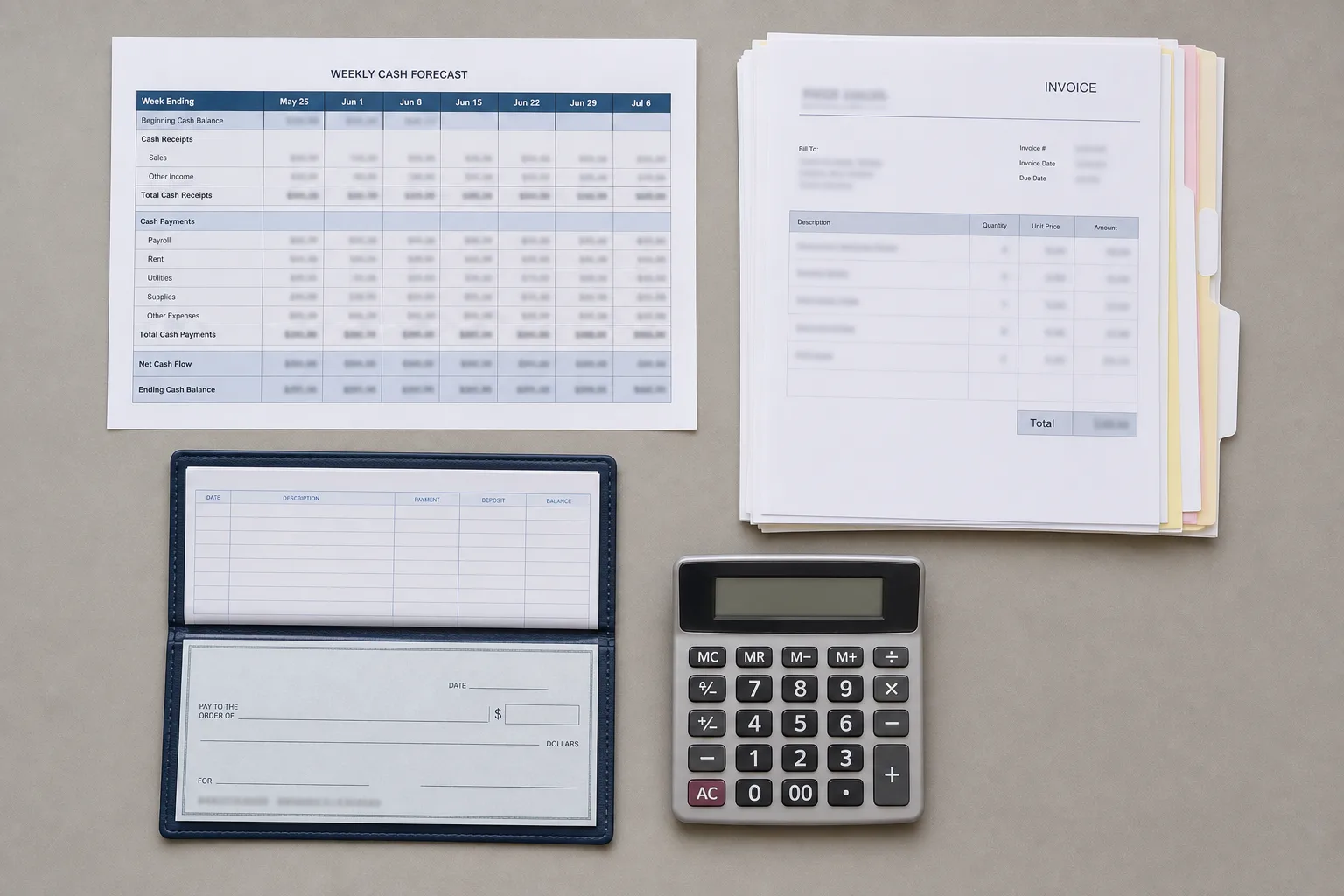
Businesses with a strong season follow a predictable curve: cash builds through the peak and then falls through the off season while the fixed costs carry on regardless. The failure, when it happens, happens in the trough and is caused almost entirely by decisions made at the top of the curve. Two habits hold it together. Forecast thirteen weeks ahead by week, listing expected receipts against known payments, and update it every Monday morning, which takes twenty minutes and is very likely the most useful management document a small business ever produces. And decide during the peak what share of the surplus is reserved for the off season, before that surplus is sitting in an account looking spendable.
What the profitable August actually meant is worth stating plainly, because owners in this position tend to conclude the opposite. It meant the work was priced correctly and performed profitably, which is the genuinely hard problem and the one that had already been solved. The cash position was a timing question with known causes and known fixes, and businesses that fail while profitable have almost always failed on timing rather than on pricing. A weekly forecast and a separate tax account remove most of that risk for the cost of an hour a month, which is a smaller intervention than the size of the problem suggests it should be.