Why Does a Floor Finish Applied in July Take So Much Longer to Harden?
Summer humidity slows the chemistry that hardens a floor finish, and the gap between dry to the touch and ready for furniture widens along with it.
- Written by
- Nadine Buckley
- Published
- Filed under
- Property
- Length
- 892 words, about 4 minutes
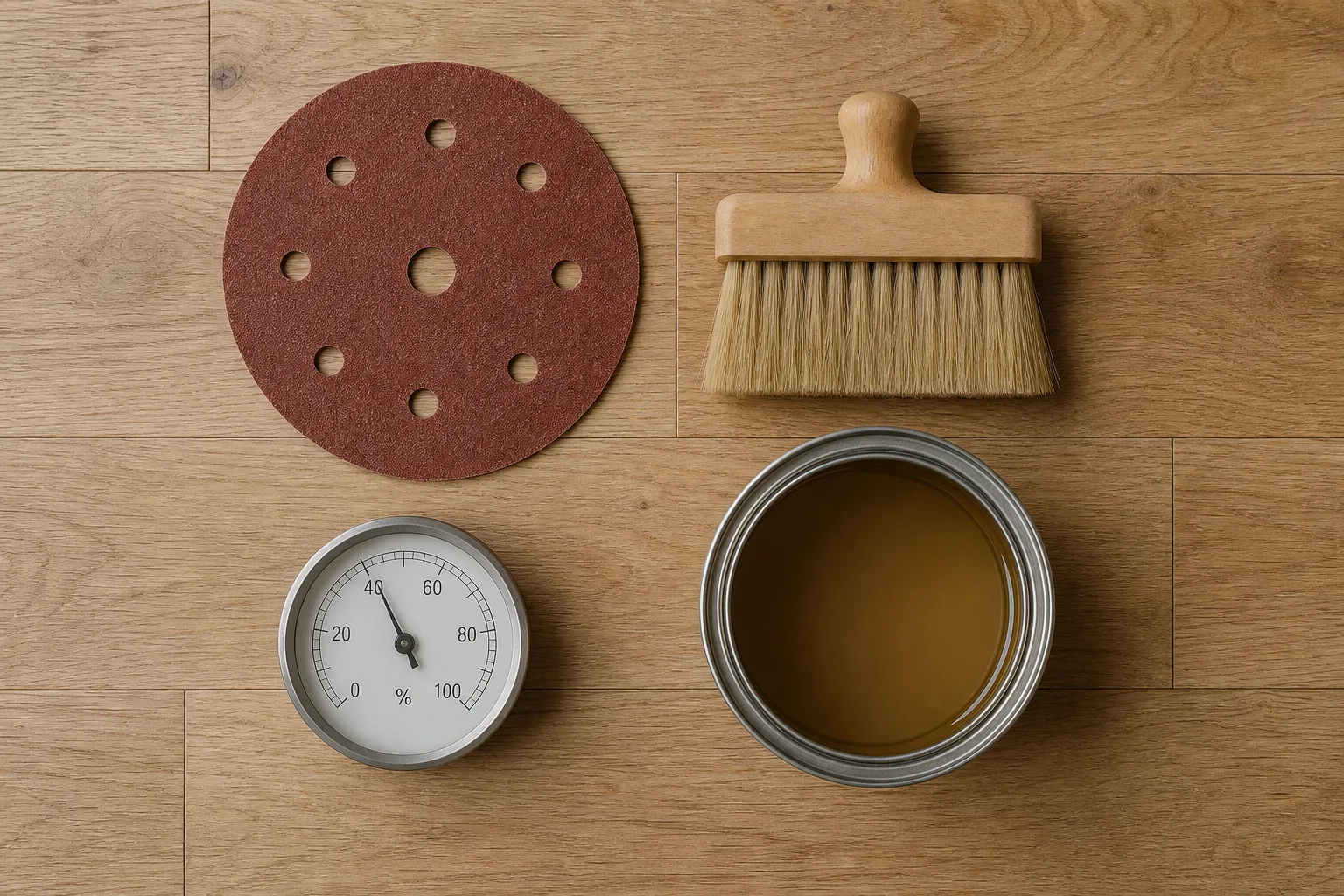
Almost everybody who has a floor refinished treats drying and curing as one event with one date attached, and that single assumption causes more ruined summer floors than any product defect ever has. They are two different processes. Drying is solvent or water leaving the film, which is what makes a surface stop feeling tacky. Curing is the film reaching its final hardness through a chemical reaction that continues for days or weeks after the surface feels perfectly dry. Summer affects each of them differently, and confusing the two is how furniture arrives on a floor a week before the floor can take it.
What Humidity Does to Drying
A waterborne finish dries by evaporation, and evaporation depends on how much additional water the surrounding air is able to absorb, so high relative humidity slows it directly and substantially. On a genuinely humid July day, a coat that would be recoatable in a few hours in October may need most of the day instead. Oil-modified finishes behave differently, drying partly by solvent evaporation and partly by reaction with oxygen, and warm air actually assists that second process. What hurts every product equally is the same July condition: still, saturated air with nowhere to go and no exchange happening.
What Heat Does to the Working Time
Heat cuts the time available to keep a wet edge, and a finish that skins over while it is still being applied produces lap marks where new material meets a partially set film. Those marks are permanent and no amount of buffing removes them. The adjustments professionals make in hot weather are simple and worth knowing about as a homeowner watching the job: working in smaller sections with the exit path planned before starting, beginning early in the day rather than after lunch, keeping material out of the sun and out of a hot vehicle before use, and closing blinds on windows carrying direct sun, since a hot strip of floor dries at a completely different rate from the rest of the room around it.
Dry, Recoatable, Walkable, Cured
Product data sheets give four different times for four different states, and reading only the first one is the source of most of the trouble. Dry to touch is measured in hours and means only that dust will no longer stick permanently. Recoatable is the window for the next coat, and applying inside it produces a chemical bond between coats while missing it means abrading the surface so the next coat has something to grip. Walkable in socks is usually a day or so and longer in humid conditions. Cured is days to weeks depending entirely on the product, and it is the state that governs furniture, rugs and pets.
What to Do While It Cures
No rugs, first and absolutely, because a curing finish needs air at its surface and covering it traps solvent or moisture underneath, producing a soft cloudy patch in precisely the shape of the rug. Felt pads go under everything before furniture returns and furniture gets lifted rather than slid. Pets stay off for the full cure period, since claws mark a partially cured film with very little effort. Run the air conditioning if the house has any, because conditioned air is dehumidified air and it is by a distance the most effective tool available for this problem. And clean with nothing but a dry method until the manufacturer's instructions say otherwise.
The Dust Problem Summer Creates
Open windows are the obvious way to move humid air out of a room, and they are also exactly how pollen, grass clippings and insects arrive on a wet floor that cannot be touched. The workable compromise is mechanical rather than architectural: exhaust through a fan in one window with a filter over the intake, instead of throwing everything open and hoping. Vacuum the room thoroughly and wipe down surfaces at height before the first coat goes on, because anything sitting on a window ledge or a door casing will eventually find its way down onto the finish while it is still open.
Scheduling It So the Cure Actually Happens
Summer is genuinely the right season in a house with central air conditioning, since interior conditions can be held steady at a moderate humidity for the whole job, which beats the swings a shoulder season produces, and the household can more easily arrange to be somewhere else. It is a harder season in a house without cooling, in a coastal area during a humid stretch, or anywhere the only ventilation available is opening windows onto wet air.
Either way, plan on the room being unusable for longer than the contractor's estimate suggests, and confirm what that estimate actually covers. Ask which product will be used and look up its cure time rather than its dry time. Ask what the plan is if humidity climbs partway through the job, where the honest answer is almost always to wait. Arrange for the household and the pets to be elsewhere on coating days. And schedule any furniture delivery against the cured date with a margin rather than against the walkable one. A floor coated patiently in July and then left alone ends up indistinguishable from one done in October, and the entire difference between those two outcomes is usually whether somebody put a rug down in the first week.