Roof Survey Written in November? The Sealing Note That Decides a January Claim
A cold-weather roof survey cannot confirm that asphalt shingles have sealed, and that one deferred line is what a wind warranty turns on later.
- Written by
- Nadine Buckley
- Published
- Filed under
- Property
- Length
- 1,078 words, about 5 minutes
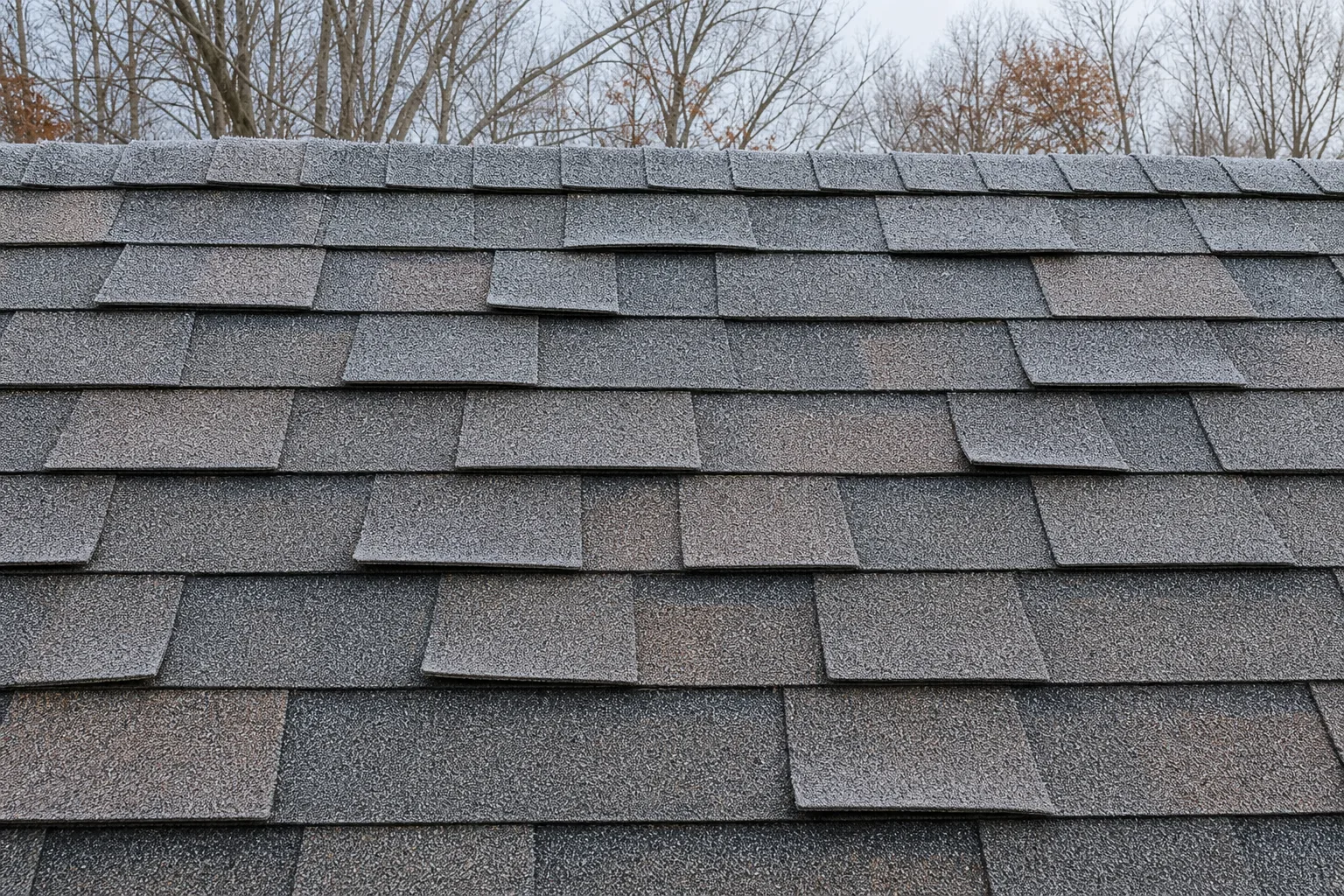
There is a line that shows up in roof surveys written between about late October and early March, and most homeowners read straight past it. It goes something like: shingles not fully adhered at seal strip at time of inspection; consistent with ambient temperature. No defect code. No cost estimate. Nothing in the summary page. It sits in the body of the report looking like weather commentary.
It is not weather commentary. It is the surveyor telling you, in writing, that the single condition your roof's wind rating depends on could not be verified on the day.
The wind rating is a laboratory number with a condition attached
Asphalt shingles are sold with a wind rating: a mile-per-hour figure on the bundle wrapper, tied to a test method. The test is run on specimens that have been conditioned and sealed. The sealant strip on the underside of each shingle has to soften, bond to the course below, and cure. That bond is what turns a stack of loose tabs into a continuous surface that wind cannot get under.
The strip is heat-activated. It needs sun on the deck and a run of warm days. In cold weather it does not bond, or it bonds partially at the south slope and not at all on the north.
So the rating promises something specific: this product, once sealed and installed to the manufacturer's instructions, resisted wind at that speed under test. It deliberately says nothing about an unsealed roof in February. The National Institute of Standards and Technology is responsible for the measurement standards that sit underneath test methods like these, and the value of a standard is that it states its own boundaries. The boundary here is sealing.
What a cold-weather survey can confirm, and what it defers
A competent winter survey still earns its fee. It can confirm most of what you are paying to learn. What changes is which items come back as observed and which come back as deferred.
Reliably observed in cold weather:
- Course alignment, exposure, and whether the nailing line was hit (visible where tabs lift)
- Flashing at chimneys, walls, and skylights, including counter-flashing that was surface-caulked instead of let into the mortar
- Ridge and hip detailing, ventilation openings, and whether the ridge vent is actually cut through the deck
- Gutter debris, granule accumulation, and drip edge presence at eaves and rakes
- Attic-side evidence: staining, rusted nail shanks, compressed or missing insulation at the eave
Commonly deferred:
- Seal strip adhesion, everywhere or on specific slopes
- Foot traffic inspection where frost or snow makes walking unsafe, which usually means the field of the roof is assessed from a ladder or from the ground with optics
- Anything under snow cover, including valley condition and the lower two or three courses
A summer survey inverts part of this. Hot shingles scuff under boots, so some surveyors limit walking in high heat, and evidence of ice damming has long since dried and faded. Every season buys you some certainty and postpones some.
The consequence people trace back to the wrong thing
Here is the narrow case worth following all the way through, because it happens quietly and often.
A roof is replaced in the second week of November. The crew is competent, the material is mid-grade architectural shingle with a respectable wind rating, and the invoice is paid. A survey is done a few weeks later for a refinance or a sale, and it carries the deferred sealing note. In late January a front comes through. Nine shingles lift off the northwest slope near the rake.
The homeowner concludes the shingles were cheap. The neighbor says the crew skimped on nails. Both explanations feel right and neither is the mechanism. The shingles never sealed, because they were installed into a cold stretch and the sun never got at that slope long enough to activate the strip. The material performed exactly as the standard describes for an unsealed assembly, which is to say the rating did not apply yet.
That distinction decides who pays. Manufacturer wind warranties are written around sealed shingles and typically exclude blow-off before sealing occurs. Workmanship coverage from the installer is a separate document with its own term. The homeowners policy has its own wind provisions. Three different papers, three different answers, and the deferred line in the survey is the piece of contemporaneous evidence that tells you which conversation you are actually in.
Reading it yourself, with nobody standing next to you
You do not need a builder present to get value out of this. You need to treat the deferred item as an open task with a date on it.
- Find the sealing language. Search the report for "seal," "adhere," "bond," and "tab." It is rarely in the summary.
- Note which slopes. A note that says north and west slopes is more useful than a general one. If it does not say, email the surveyor and ask them to specify in writing.
- Ask the installer for the cold-weather procedure they used. Manufacturers publish instructions for low-temperature installation, usually involving hand-sealing tabs with a specified dab of asphalt roof cement in a specified location. Ask whether it was done, on which slopes, and with what product.
- Put a spring recheck on the calendar. Late April or May, after a warm week. The check itself is simple: on a warm afternoon, tabs that have sealed will not lift by hand at the corners without tearing.
- Keep the pair of documents together. The winter survey noting the deferral and the spring confirmation that sealing occurred. Two pages, filed with the roof invoice and the warranty registration.
That file is what makes a later claim straightforward instead of contested. It shows the condition was identified, tracked, and closed.
The seasonal read, in one habit
Ask of any roof survey: what did the weather on this day prevent, and when does that item become checkable? In winter it is sealing and anything under snow. In deep summer it is walkable inspection of the field and faded evidence of winter water. In spring it is the season that shows you the most, which is why spring surveys tend to read longer and cost the same.
A survey is a snapshot with a timestamp, and the timestamp carries information. Once you read the deferred items as scheduled work rather than filler, a report written in the wrong month becomes just as useful as one written in the right one.