Ten Minutes a Month or a Lost Weekend: Setting Up Records That Hold Up
The cost of poor bookkeeping is not the bookkeeping. It is the deductions nothing supports and a preparer's hourly rate applied to sorting receipts.
- Written by
- Ellen Marsh
- Published
- Filed under
- Money
- Length
- 896 words, about 4 minutes
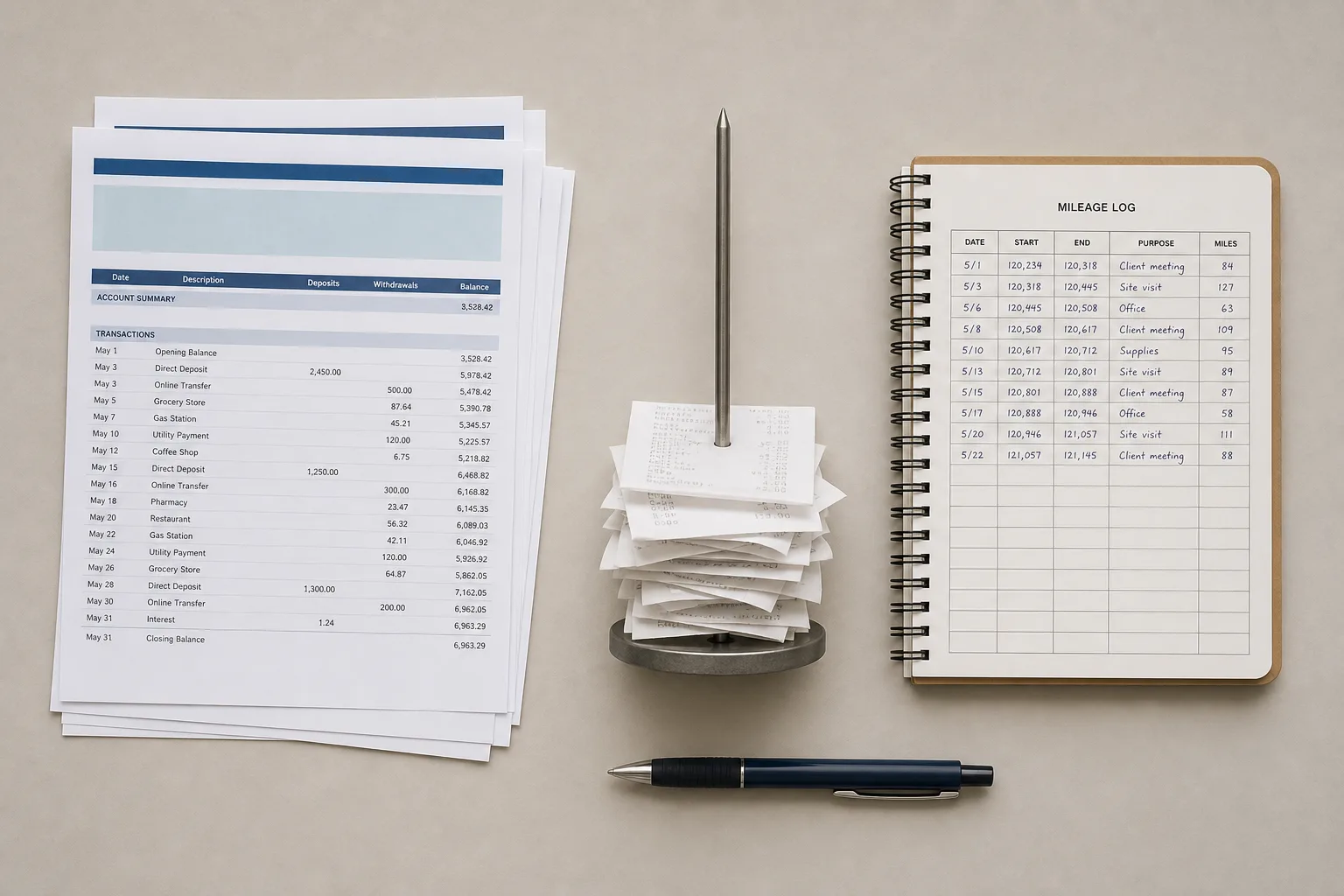
Picture the April version of this: a kitchen table covered in a year of paper, a laptop open to a bank site that only shows ninety days at a time, and somebody trying to remember what a payment in August was for. The work being done at that table is not accounting. It is archaeology, performed under a deadline, from incomplete evidence, and its most expensive feature is the deductions that get abandoned because nothing in the pile supports them. The same work, spread across the year, takes about ten minutes at the end of each month and produces a better answer.
Separate the Accounts Before Anything Else
One bank account and one card used only for the business, which takes an afternoon to arrange and is by a wide margin the highest-value step on this list. What it buys is not tidiness. It is that the account statement becomes an independent record of the business, so every categorization has a source document sitting behind it and a mixed transaction becomes the rare exception rather than the default condition of every line. Where money genuinely has to move between personal and business, move it as a labeled transfer rather than as an ad hoc payment, so that next year the entry explains itself.
Copy the Categories Off the Form You Will File
Do not invent a chart of accounts. Open the schedule you will actually file, copy its expense lines, add the two or three categories specific to your own work, and stop there. Categories that map directly onto the return convert the year-end task from interpretation into transcription, which is most of what makes an April afternoon short instead of long. The IRS publishes those forms alongside their instructions, and the instructions for the expense lines settle the overwhelming majority of categorization questions in a paragraph apiece, at no cost and without a phone call.
The Monthly Ten Minutes, in Order
Pick a recurring date, whether the first Saturday or the last day of the month, and treat it as fixed. Open the month's statements for both accounts. Assign every line a category, flagging rather than guessing anything you cannot place in ten seconds. Attach receipts for anything unusual or above whatever threshold you set for yourself, photographed and filed by date. Note the month's mileage total from wherever trips get recorded. Then reconcile, confirming the ending balance on the statement matches your own record.
That last step is the one people skip and the one that earns its place, because a discrepancy caught in May is this month's small problem while the same discrepancy found in April is a mystery nobody can now reconstruct. Ten minutes is a realistic figure once the accounts are separated and an unrealistic one if the same session also involves untangling personal spending, which is the practical argument for doing the first step before any of this.
The Records Worth More Than They Look
Mileage logged as it happens, with the date, the purpose and either odometer readings or the distance, is the standout, since reconstructed mileage is the most commonly disallowed deduction there is and the reconstruction takes longer than the logging would have. Asset purchases need dates and amounts, because equipment expected to last past this year follows different rules from a box of envelopes, and which rules apply turns on the purchase date. Home office square footage should be measured once and written down alongside the total square footage of the home. Contractor payments need the payee's tax identification information collected at the first payment rather than in January, which is the annual scramble every small business recognizes. And loan statements belong in the file so that interest and principal stay separated rather than collapsing into one expense.
What Gets Left on the Table and What Gets Invented
The commonly missed deductions are ordinary and supportable and get overlooked because nothing prompts for them: health insurance premiums paid by a self-employed person, the deductible portion of self-employment tax, retirement contributions still available after the year has closed, bank and payment processing fees that are trivial monthly and meaningful annually, professional subscriptions and licenses, and the share of a phone or internet bill genuinely used for the business. The invented ones run in the opposite direction and are just as consistent: personal costs recategorized because they happened during a working day, and mixed-use items claimed at full business use when a vehicle driven for errands and for work is a proportion needing a basis.
How Long the Paper Has to Survive
Three things stay: the return itself, the records supporting every number on it, and anything establishing what an asset cost. Records backing income and deductions are generally kept for several years after filing, while records fixing the cost basis of property stay in the file for the entire time the property is owned and then for that same stretch again afterward. Digital copies filed by year and month are sufficient for nearly everything, named so they sort themselves, with a second copy somewhere other than the machine that produced them. Set up that way, the April task becomes opening twelve folders and adding columns that were already correct, and a preparer's fee, if one is used at all, lands at the low end of the quoted range, because the money is buying judgment rather than sorting.