Three Years, Seven Years, Forever? Sort Your Paperwork by What It Can Actually Prove
Retention schedules tell you how long to keep things. A better test is what each document would prove if someone disputed you, and to whom.
- Written by
- Ellen Marsh
- Published
- Filed under
- Health
- Length
- 1,047 words, about 4 minutes
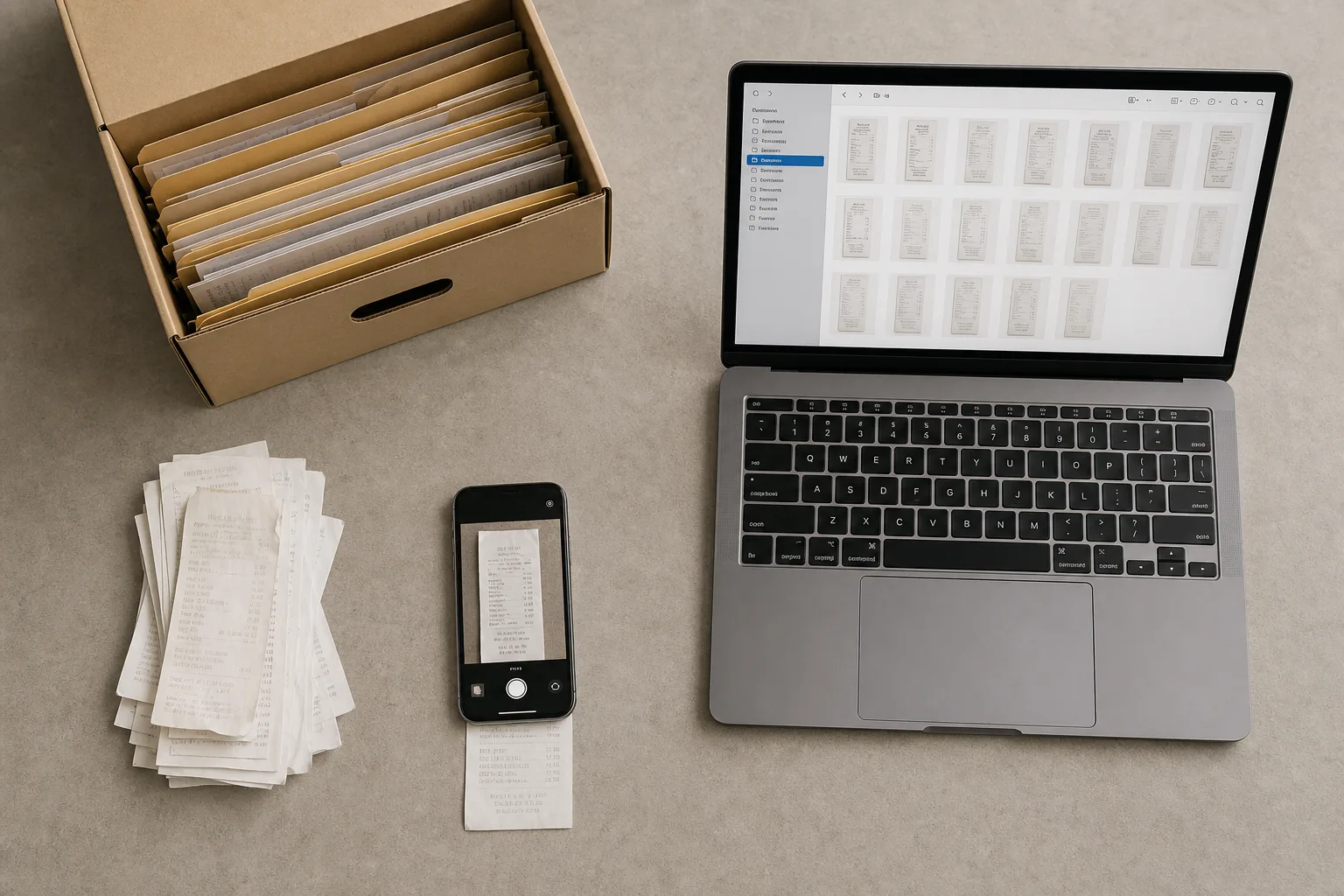
Most retention advice arrives as a list of durations. Keep this three years, that seven, this one forever. It is easy to follow and nearly useless, because it tells you nothing about the week you actually spend with paper: the receipt in the coat pocket, the emailed invoice that never got printed, the warranty card for a dishwasher you have already forgotten the model number of.
The useful question is not how long. It is what would this prove, and to whom, if somebody disagreed with me. Answer that and the duration usually falls out on its own.
Sort by the dispute, not by the calendar
Every document you keep is a bet on a future argument. There are only a handful of counterparties who ever show up.
- A tax authority. The Internal Revenue Service is responsible for administering federal tax law and for examining returns, and the window in which it can do so is what sets the floor for anything supporting a deduction, a basis calculation, or reported income. Check the current guidance for your situation rather than a number you half-remember, because the window lengthens in specific circumstances.
- An insurer. Proof of ownership, condition, and value, at a moment before the loss.
- A contractor, retailer, or manufacturer. Proof of what was agreed, what was paid, and when.
- A buyer, lender, or title company. Proof of what you own, what you improved, and what was paid off.
- Yourself, next year. The largest category by volume and the one nobody plans for.
A document with no plausible counterparty is not a record. It is paper. That single filter empties about half of most people's drawers.
Four categories, compared
The categories below are the ones that behave differently. Within each, the retention logic is consistent, which is what makes the sorting fast.
| Category | Examples | What it proves | How long it stays useful |
|---|---|---|---|
| Transaction records | Receipts, invoices, canceled checks, card statements | That money moved, for what, on what date | Until the return that used it is closed to examination, or the return period is well past; short for anything you did not deduct |
| Ownership and basis | Closing documents, deeds, titles, records of capital improvements | What you own and what it cost you, including work done years ago | For as long as you own the asset, plus the tax period after you sell it |
| Contracts and obligations | Leases, service agreements, loan notes, warranties, permits | What each side promised and what remedy exists | The life of the agreement, plus the period in which a claim could still be brought |
| Condition and identity | Photographs, serial numbers, inspection reports, appraisals | The state of something before a loss or a dispute | Until superseded by a newer record of the same thing |
Notice what the table does not include: monthly statements you never reconcile, utility bills for a service you no longer use, and manuals for appliances whose manufacturer publishes the same PDF for free. Those are the bulk of a typical file box and they carry almost no evidentiary weight.
Where the standard advice is thin
Two gaps recur. First, retention lists treat a bank statement and a receipt as interchangeable. They are not. A statement proves a payment was made to a merchant. A receipt proves what was bought. In a warranty argument, a deduction question, or an insurance claim, only the second one does the work. Keep both for anything that matters, and stop keeping either for anything that does not.
Second, the lists rarely mention capital improvements, which is where the money is. Work that adds to what a property cost you can matter years later when you sell. The invoice for a new roof or a finished basement is worth more, over a long enough horizon, than an entire year of grocery receipts. It also tends to be the record people throw away first, because the job ended and the folder felt closed.
The week-to-week version
A system that requires a monthly session will not survive March. The version that survives is one that takes under a minute per item, at the moment the item appears.
- Capture at the point of arrival. Photograph the paper receipt in the parking lot. Forward the emailed invoice to one address you control. The failure point is almost always the gap between receiving something and filing it, not the filing itself.
- Name the file so a stranger could find it. Date first, then vendor, then what it was. "2024-09-14 Harrow Plumbing water heater install." You are the stranger in four years.
- Use four folders, not forty. The categories above map to four. Subfolders by year inside each. Anything that does not fit in four folders probably does not belong in the system.
- Keep one running list of major purchases. Item, date, price, serial number, where the receipt lives. This is the document an insurance adjuster asks for and almost nobody has.
- Purge on a fixed date, not on impulse. Once a year, delete or shred the oldest year in the transaction folder only. Leave the other three alone. Ownership records do not get purged.
Digital, paper, or both
Digital wins on retrieval and loses on durability if it lives in exactly one place. Paper wins on durability for a small number of documents and loses on everything else. The split that works: everything scanned or photographed, with original paper kept only where an original matters. Deeds, titles, signed contracts, and certain legal instruments go in a fireproof box or a safe deposit box. The rest can be pixels.
Whatever the storage, have a second copy somewhere that a house fire or a stolen laptop cannot reach. A backup that shares a roof with the original is not a backup.
How to tell your judgement is working
You will know the system is right when three things are true. You can produce any document from the last several years in under five minutes. You are not keeping anything you cannot name a counterparty for. And the annual purge takes an hour, because the sorting already happened on the day each item arrived.
Build it around the arguments you might actually have. The durations become obvious, the volume drops sharply, and the folder you need on a bad day is the one you can find.