Two Firms Both Said One Third. The Same Case Paid Out $40,000 Apart
A contingency percentage means nothing until you know what it multiplies. A worked example showing how identical quotes produce very different checks.
- Written by
- Ellen Marsh
- Published
- Filed under
- Legal
- Length
- 1,216 words, about 5 minutes
The number people remember from a consultation is the percentage. One third. Forty percent. Whatever it is, it gets written on the back of an envelope and carried home, and it becomes the basis for comparing one firm against another. It is close to useless on its own.
The percentage is a multiplier. What matters is the thing it multiplies, and firms differ on that in ways that never come up unless you ask. Below is a composite drawn from how these agreements are typically structured. The dollar figures are illustrative, chosen to make the arithmetic legible, not reported from any particular case.
Two quotes, one number, different math
A woman we will call the client is pursuing a civil claim after an assault at a workplace. She meets two firms. Both handle this work. Both say one third.
Firm A's engagement letter says the fee is one third of the gross recovery, with case costs reimbursed to the firm from the client's share afterward.
Firm B's letter says the fee is one third of the recovery after case costs are deducted.
Same case. Assume it settles for $300,000 and the firm has advanced $45,000 in costs: filing fees, deposition transcripts, an expert witness, investigator time, records retrieval, travel.
| Firm A (fee on gross) | Firm B (fee on net) | |
|---|---|---|
| Settlement | $300,000 | $300,000 |
| Case costs off the top | $0 | $45,000 |
| Fee base | $300,000 | $255,000 |
| Fee at one third | $100,000 | $85,000 |
| Costs deducted after fee | $45,000 | $0 |
| To the client | $155,000 | $170,000 |
Fifteen thousand dollars, from one preposition. Nobody misquoted anything. Both firms said one third and both meant it.
Now add the second variable. Firm A's agreement steps the fee to forty percent if a lawsuit is filed. Firm B's steps at the same point. Neither mentioned it out loud, because the trigger felt remote in a first meeting. Most of these cases are filed. On a $300,000 recovery at forty percent on gross, the fee is $120,000 and the client nets $135,000. That is the $40,000 spread against Firm B's net-basis, pre-escalation figure. It came from two lines of boilerplate.
What else comes out before you see a dollar
Costs and the fee are not the only claims on a settlement. In a case involving physical or psychological injury, there is usually a third layer, and clients almost never see it coming.
- Medical and counseling liens. If health insurance paid for treatment connected to the injury, the plan may have a right to be repaid out of the recovery. Same for Medicaid, Medicare, or a workers' compensation carrier.
- Provider balances. Treatment obtained on a letter of protection is billed against the settlement, not against you month to month.
- Case advances. Some firms front living expenses or refer clients to third-party funding companies. Those get paid back with interest, and the interest is not the firm's problem.
- Costs from a prior attorney. If you switched firms, the first one may assert a claim for time or expenses.
None of that is improper. All of it is normal. The question is whether the person quoting you a percentage walked you through the full stack or stopped at their own line item. A firm that shows you a mock disbursement sheet at the first meeting is telling you something about how it operates.
Ask this directly: on a hypothetical recovery of X, walk me down the sheet to the number I deposit. Any experienced sexual assault attorney has done that arithmetic hundreds of times and can do it on a legal pad while you watch. Hesitation there is data.
The costs question is really a risk question
Read the cost provision twice. There are two distinct issues buried in it and they get conflated.
Who advances the costs? Most contingency firms front them. Some ask the client to fund depositions or experts as they arise. A household that cannot write a $9,000 check mid-case needs to know that before signing, not in month fourteen.
Who eats them if the case loses? This is the one that matters. "No fee unless we win" is a statement about the fee. It says nothing about costs. Some agreements make the client responsible for advanced costs regardless of outcome. Others waive them on a loss. The distinction is worth more than several points of percentage, and it is the single question most likely to go unasked in a first meeting because the client is not thinking about losing.
Get the answer in the document. Not in an email, not in a reassuring sentence across a conference table. The document controls.
Where the escalators sit
Tiered fees are standard and defensible. More work at a later stage justifies a higher share. What varies is where the firm sets the trip wires, and clients rarely think to compare them.
- Pre-suit settlement. The lowest tier. A demand package, negotiation, resolution without filing.
- Suit filed. The most common step-up. Worth knowing how often this firm files in cases like yours. If the honest answer is "nearly always," the pre-suit rate is decoration.
- Discovery or a set number of days before trial. Some agreements escalate at a calendar date rather than an event, which means a defendant's delay can raise your fee.
- Trial. Another step.
- Appeal. Often a separate rate, sometimes a separate agreement entirely.
Ask which tier the firm's last several comparable cases actually resolved at. That is the rate you should be comparing, not the number on the first line.
The Federal Trade Commission oversees how services are advertised to consumers, and the general principle it applies is a useful lens here: the headline claim has to hold up once the qualifications are read. A percentage quoted without its base, its escalators, and its cost treatment is not a price. It is a starting point.
What a good agreement looks like from the client's side
The firms worth hiring tend to volunteer this material rather than wait to be asked. Signs you are in that conversation:
- The engagement letter defines "recovery" explicitly, in a sentence you can read once and understand.
- Costs are listed by category with a rough expected range for a case of this type, and the loss scenario is stated in plain terms.
- Lien resolution is addressed: who negotiates the health plan's repayment claim, and whether that work is included in the fee or billed on top.
- You are told how you will be updated and how often, and settlement authority is described as yours.
- You are given the agreement to take home. Nobody asks for a signature the same afternoon.
For an individual, as opposed to a company with a general counsel, this is likely the largest financial document you will sign outside of a mortgage, and unlike a mortgage nobody hands you a standardized disclosure sheet that puts the real cost in a box on page one. You have to build that box yourself.
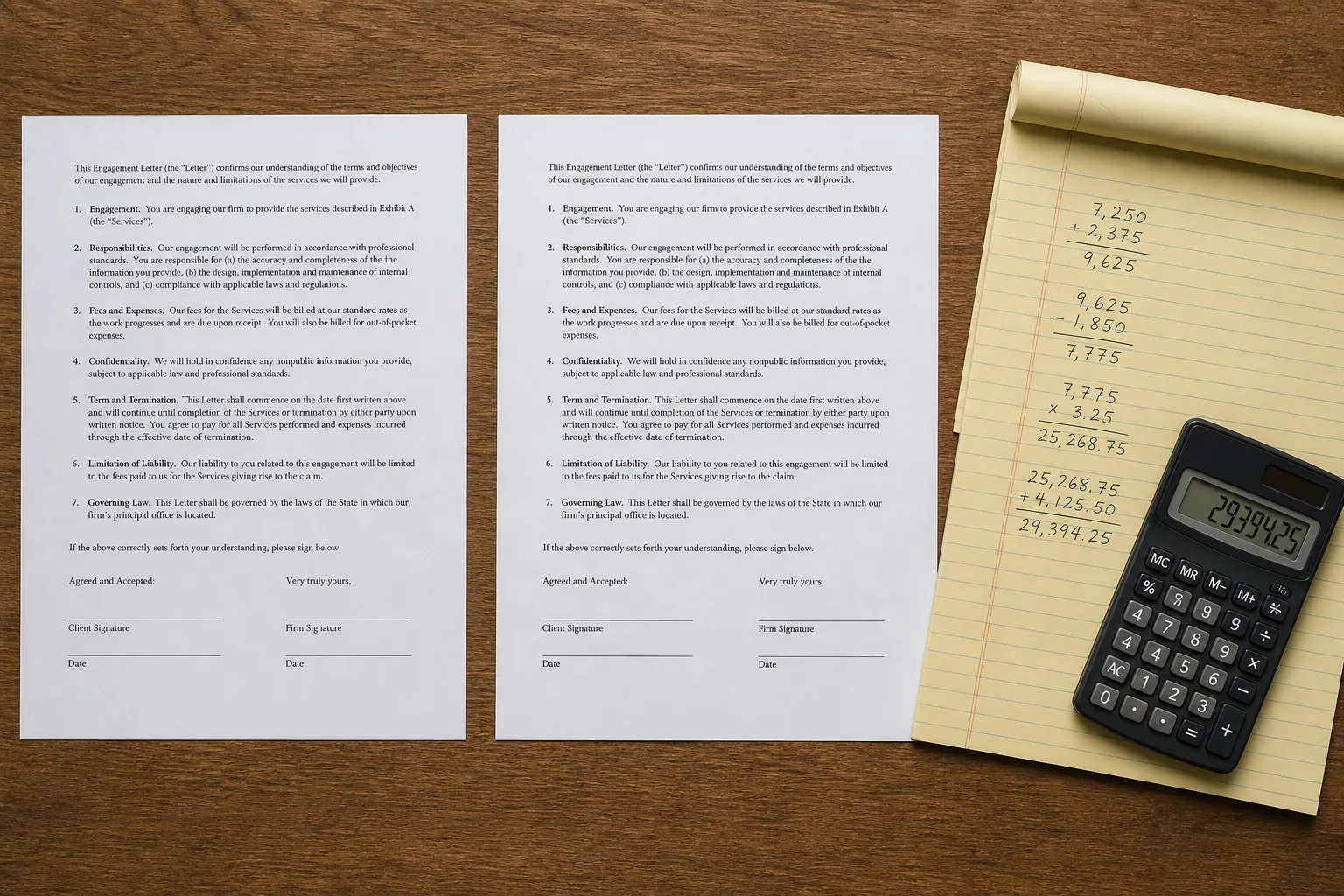
Take the two or three agreements you have collected, put them side by side, and run the same hypothetical recovery through each one, all the way down to the deposit. Fifteen minutes with a calculator does what an hour of conversation will not. The firm that comes out best on that page is usually also the firm that explained itself most clearly in the room.