Two Hours in the ER for Six Stitches. What a Line-by-Line Read Actually Finds
A single emergency room visit produces two bills, one EOB and a dozen coded lines. Here is the difference between skimming them and actually reading them.
- Written by
- Ellen Marsh
- Published
- Filed under
- Health
- Length
- 1,281 words, about 5 minutes
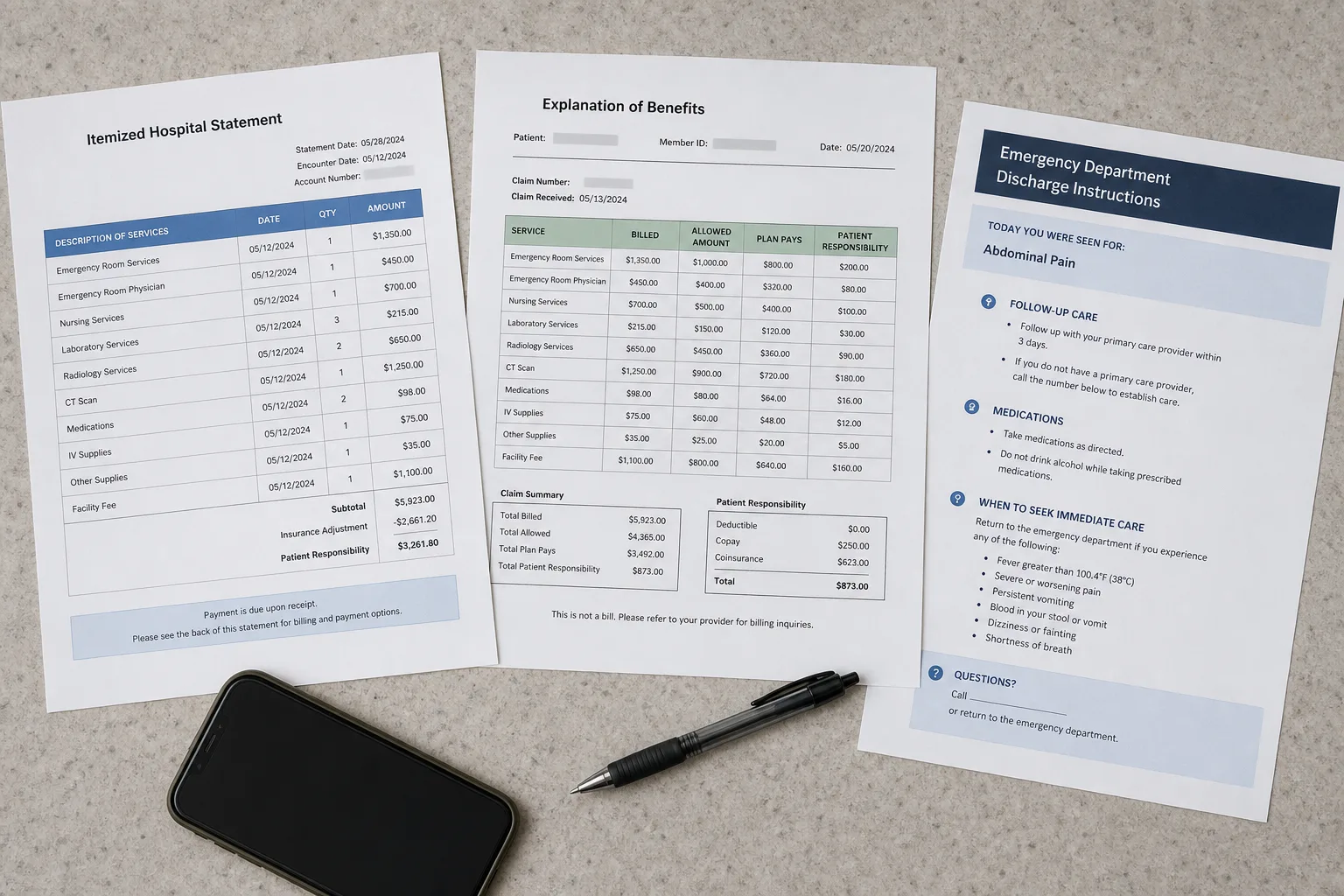
A kitchen knife slips. The cut is deep enough that urgent care declines it and points to the emergency department. Two hours later there are six stitches, a tetanus booster and a discharge sheet. Three weeks after that, an envelope arrives with one line on it: Emergency services, $2,318.00. Amount due after insurance, $604.12.
That is not a bill. That is a total wearing a bill's clothing. The document that can actually be checked has not been sent yet, and most people never ask for it.
What follows is one narrow case, deliberately: a single uncomplicated ER visit for a laceration. It is small enough to read all the way through in one sitting, and it contains almost every structural feature that shows up on larger hospital bills.
The summary statement and the itemized statement are different documents
A barely adequate review compares the summary total to the insurance statement, sees roughly matching numbers, and pays. A good one starts by asking for the itemized statement, sometimes called a detailed bill or a UB-04 detail, and waiting for it before paying anything.
The itemized statement carries what the summary strips out:
- A revenue code for each department that touched the visit (emergency room, pharmacy, supplies, laboratory).
- A CPT or HCPCS code for each billable service.
- A units column.
- A date of service on every line.
- A charge per line, which should sum to the number on the summary.
Ask for it in writing, by the patient account number printed on the summary, and ask for the professional charges separately if the hospital bills them separately. Most billing offices will send it without argument. It is a routine request, not an accusation, and the people on the phone handle it daily.
The other half of the pair is the explanation of benefits from the insurer. It is not a bill and says so, usually in small type. It is the only document that shows what the plan considered allowable, what it paid, and what it assigned to the patient. Reading the hospital bill without the EOB next to it is reading one side of a conversation.
What the lines on a laceration repair actually are
Here is the shape of the itemized statement for this visit, in the order it usually prints:
The facility fee
One line, revenue code 450, with an emergency department visit code attached. These codes run from the lowest acuity to the highest, and the level assigned drives most of the charge. The hospital sets its levels by its own internal criteria based on resources used, not by how long the visit felt. A six-stitch repair with no imaging and no labs sits toward the lower end of the range. If the line shows a high-acuity level, that is the single most consequential thing on the page and the first item to question.
The repair itself
Simple repair codes are grouped by body site and by total length in centimeters. A cut on the hand is in a different family from a cut on the scalp, and the length band matters. The discharge paperwork usually states the size of the wound. If the code billed is for a longer band than the wound the chart describes, that is a clean, checkable discrepancy.
The tetanus booster
Two lines, not one. There is a code for the vaccine product and a separate code for administering it. Both are legitimate. People see two lines and assume a duplicate, and it usually is not.
Supplies and pharmacy
Revenue codes in the 250 and 270 ranges. Sutures, dressing, local anesthetic. These lines are frequently small and occasionally absurd, and they are also where a wrong units entry hides most comfortably.
The doctor's bill, which arrives separately
The emergency physician usually works for a contracted group with its own tax ID, and bills on its own schedule, often weeks after the hospital does. A patient who pays the hospital and closes the file gets a second envelope and assumes it is a duplicate. It is not. Two bills for one visit is the normal architecture, and the professional bill carries its own visit level code, which can differ from the facility level.
The checks that separate a real read from a skim
Once both documents are on the table, the work is mechanical. Go line by line on the itemized statement and mark each one against the EOB.
- Do the dates match? Every line should carry the date of the visit. A line dated the following day on a two-hour visit is worth a question.
- Does the units column say 1? Units of 2 on the visit code, or 10 on a supply that was used once, are entry errors, and entry errors get corrected without a fight.
- Does the itemized total equal the summary total? If not, something was added or reversed between the two printings. Ask which.
- Is the visit level defensible against what happened? No imaging, no bloodwork, no cardiac monitoring, discharged in two hours. Ask the billing office what criteria supported the level assigned.
- Was the claim actually filed with insurance? A statement showing the full charge and no adjustment usually means the account is sitting as self-pay because the coverage was never keyed in. This is common and entirely fixable by giving them the member ID.
- Does the patient responsibility on the bill match the EOB? The hospital may bill more than the EOB assigns. The EOB governs for an in-network provider. A gap between the two is the most valuable thing a line-by-line read produces.
- Did anyone bill you for the difference between their charge and the allowed amount? For emergency care, federal protections limit what out-of-network clinicians at an emergency visit can collect from you beyond in-network cost sharing. If the physician group's bill is far larger than the EOB's patient share, say the words "balance billing" on the phone and ask for it to be reviewed.
- Was the deductible applied correctly? Check the EOB's running deductible against what has already been met this plan year. Deductible math errors survive because nobody checks them.
Deadlines, and the discount nobody offers you
Two clocks run at once. The insurer's appeal window is printed on the EOB, and it is shorter than most people expect. The hospital's collection timeline is separate and usually more forgiving, particularly while an account is flagged as in dispute. Call and ask for the account to be held while the itemized statement is reviewed, and get the name of the person who agreed.
Then ask the question the billing office is not required to raise first: what financial assistance is available. Nonprofit hospitals operate under federal requirements tied to their tax-exempt status, and the IRS is responsible for that framework, including the obligation to maintain a written financial assistance policy and to make it available. Many policies extend well above the income level people assume, and some hospitals apply a straight uninsured or prompt-pay discount independent of income. Neither is volunteered on the summary statement. Both are granted routinely to people who ask.
If a genuine error turns up, ask for a corrected claim to be submitted to the insurer rather than a courtesy adjustment to the balance. A corrected claim fixes the record and re-runs the plan's payment. A courtesy adjustment shaves the number and leaves the wrong code sitting in the file.
Six stitches and a tetanus shot generate perhaps a dozen coded lines across two bills and one EOB. That is an afternoon's work with a pen, and it is the smallest version of a job that gets harder with every additional day of stay. Learn it on the cut hand.