What Does Your Town Already Have Planned for the Block You Live On?
By the time a hearing notice reaches a mailbox, the proposal has usually sat in a public file for a year. Four documents show what is coming.
- Written by
- Roy Castellano
- Published
- Filed under
- Policy
- Length
- 1,131 words, about 5 minutes
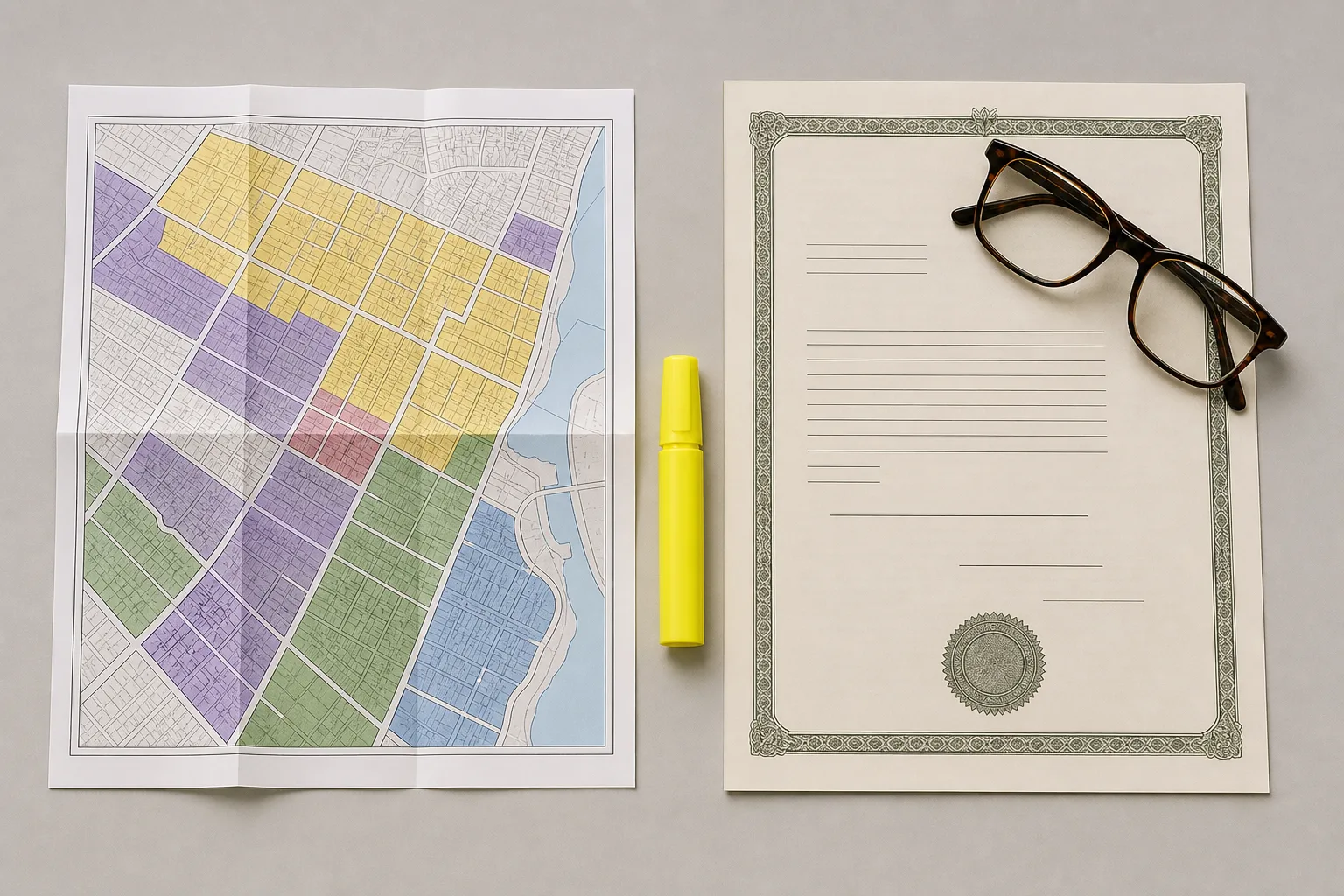
A postcard arrives naming a parcel two doors down, a case number, and a hearing date eleven days away. That notice is the last step of a long process rather than the first, because by the time it is mailed the application has been filed, staff have reviewed it, comments have been written and a date has been set on a calendar that fills months in advance. Everything that happened before the postcard was public the entire time, sitting in files anybody could have opened without asking permission or explaining why. Four documents cover almost everything a household would want to know about what is planned nearby, and none of them require a lawyer to read.
The Comprehensive Plan Says What the Town Wants Before It Has to Defend It
Every municipality of any size keeps one, updated on a cycle measured in years and titled a master plan or a general plan depending on the state. It is the long document with maps in it that nobody reads, and the single most useful page in it is the future land use map, which shows what the town intends each area to become rather than what the zoning currently allows. A parcel drawn as mixed use on that map while zoned single family today is a rezoning waiting for somebody to file an application.
Two chapters repay the time after that. The transportation chapter names road widenings, new connections and corridors identified for study, and road projects appear there years before anybody funds them. The housing chapter carries targets and, more usefully, language about where additional units are intended to go. The plan is advisory rather than binding, which is exactly what makes it worth reading, because a town writing an advisory document says plainly what it wants at a stage when it does not yet have to defend the position in front of anybody.
The Zoning Ordinance Says What Can Be Built Without Asking You
The ordinance is the binding half of the pair. The map states which district a parcel sits in and the ordinance text states what that district permits, and both are needed to answer any real question. Read three parts of the text for your own district and for every district touching your block. Permitted uses happen over the counter with no hearing at all, while special permit uses require a board and a public process, which is the only way anybody ever gets notice. Dimensional standards for height, setbacks, lot coverage and minimum lot size describe the largest thing that can legally appear next door without a single person consulting you.
The third part is the one most often missed. Overlay districts sit on top of the base district and change its rules, and historic, flood, corridor and transit overlays are all common enough to catch somebody who read only the base zoning and stopped. The practical question worth putting to the planning office in writing is whether a proposal on a given parcel would be by right or discretionary, because that one answer tells you whether you will ever have a vote or merely an opinion.
The Capital Improvement Plan Is the Leading Indicator Nobody Reads
This is the least known document of the four and frequently the most immediately useful. It is the multi-year schedule of what the municipality intends to build and repair, with a year attached to each line and usually a funding source beside it. It is where a household finds out that the water main under their street is scheduled for replacement in two years, which is worth knowing before repaving a driveway or planting a tree in the strip beside the curb. It also works as a leading indicator on development, because utility capacity upgrades in an area reliably precede building in that area, for the simple reason that the building cannot proceed without them.
Agendas, Minutes and the Staff Report
The fourth source is not one document but a continuously updated stream, and it is where the current activity lives. Planning board and zoning board agendas are posted in advance, usually on the municipal website, listing every application by address so a scan takes under a minute. Minutes record what was said and how members voted, and reading three months of them teaches more about how a particular board actually decides than any amount of ordinance text.
The application file itself is public record and contains plans, staff comments, traffic studies and correspondence. Within it, the staff report is the single most informative document in the whole process, because it is a professional planner's written assessment of whether the proposal complies with the rules, which is very nearly the question the board is being asked to decide. Nobody has to attend a meeting to read any of this, since most municipalities post it and, where they do not, a records request produces it.
Why the Mailed Notice Arrives So Late
State statutes generally require notice to abutters within a set distance and a set number of days before a hearing, and both of those numbers are minimums written to give a fair opportunity to object rather than time to organize a response. Two consequences follow that are worth knowing before they apply to you. A household one parcel beyond the notice radius receives nothing at all, even where the effect on them is identical to the effect on the neighbor who was notified. And a notice period measured in days is not long enough to retain anybody or commission anything, which means the response has to have been prepared beforehand or it will not exist.
What to Do With What You Find
Write down the district your parcel sits in, the districts adjoining it, and any overlay that applies, and keep the note with the deed rather than in a browser tab. Mark anything on the future land use map near you that differs from the current zoning, since that difference is where the next application will appear. Check the capital improvement plan for your street and the two nearest intersections. Then set a monthly reminder to scan the planning board agenda for addresses on your block, which is genuinely a four-minute task, and if something appears, request the staff report before doing anything else at all.
Households that work this way find out about a project while it is still a sketch, at the stage where comments still shape the drawings and staff are still asking the applicant for changes. That is a completely different position from learning about it eleven days before a vote with a postcard in hand, and the difference costs nothing beyond a monthly look at a web page and one afternoon spent reading a plan that was written to be read.