Who Actually Reads Your Complaint File? Build the Evidence for That Stranger
Most disputes are decided by a third party who never met you, never saw the job, and reads your file cold. Build the evidence for that reader, not for the argument you are having.
- Written by
- Nadine Buckley
- Published
- Filed under
- Legal
- Length
- 1,103 words, about 5 minutes
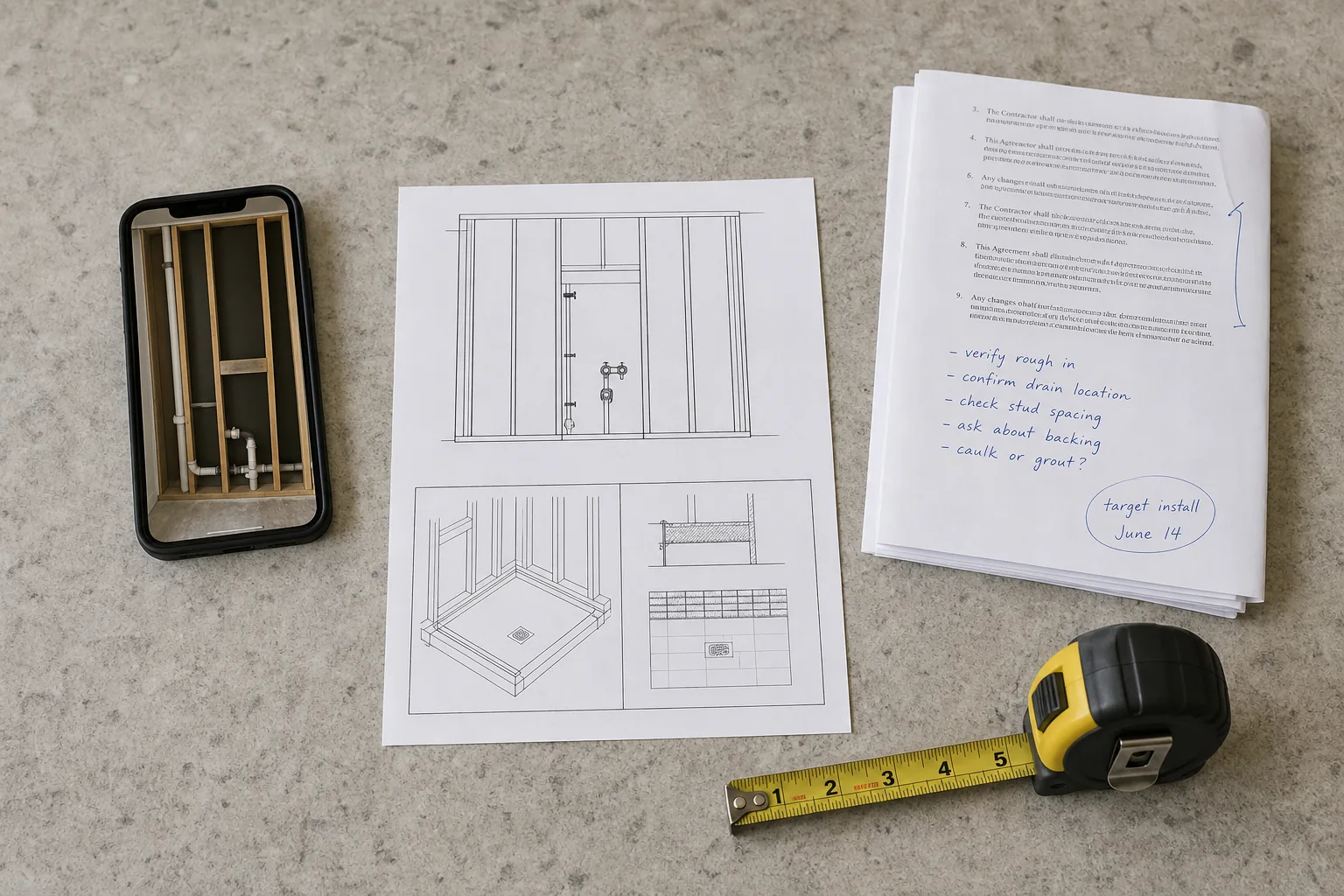
Almost nobody assembles evidence for the person who will actually decide the matter. They assemble it for the contractor they are angry at, or the manager on the phone, or themselves at two in the morning. That is the wrong audience. The party who settles most disputes is a stranger with a file, a queue, and a checklist, and they will never stand in your kitchen.
Once you know who that stranger is, the question of what counts as evidence gets much simpler.
The party in the transaction most people overlook
You think of a dispute as two-sided: you and the firm that took your money. It rarely resolves that way. Depending on how you paid and who is licensed, the decision lands with one of these:
- An insurance adjuster, working from photographs and a policy schedule.
- A card issuer's dispute analyst, working from a written record and a merchant's rebuttal.
- A state licensing board investigator, working from a complaint form and whatever you attached to it.
- A manufacturer's warranty administrator, who cares about installation compliance and almost nothing else.
- A small claims judge, working from documents and about fifteen minutes.
None of them saw the job. None of them will call you to clarify. Each is applying a written standard to a stack of paper. The Federal Trade Commission oversees consumer warranty and advertising practices at the federal level, and much of what happens in a dispute is a downstream consequence of rules written for that decider, not for you.
So the operative test for any piece of evidence is: does this mean something to someone who was not there?
What a certification promises, and what it deliberately leaves out
People submit certificates as evidence constantly. A logo from a trade association, a manufacturer's "certified installer" card, a state license number in an email signature. These are worth having. They are worth almost nothing as proof that your particular job was done correctly, and understanding why changes what you collect.
A certification is a statement about a firm at a point in time. It says the company met a set of criteria on a given date: hours logged, an exam passed, insurance in force, a fee paid. Most schemes say so plainly in their own terms. What a certification does not promise is that the work at your address followed the method. That is deliberate. No credentialing body can inspect every job, and none claims to.
The evidence that does the work sits one layer down:
- The manufacturer's published installation instructions for the exact product model.
- The specification page from your contract or proposal.
- A photograph showing what was actually built.
Two of those three are free and public. Put them side by side and you have a comparison a stranger can make in thirty seconds. That is a finding. "They were certified and they did a bad job" is an opinion.
Evidence that holds up, evidence that does not
| Holds up | Falls apart |
|---|---|
| A photo with a fixed reference in frame (a doorway, a tape measure, a labeled panel) | A tight close-up of damage with nothing around it to locate or scale it |
| A text or email confirming a phone call: "Confirming what you said at 2pm today, you'll replace the two cracked units at no charge" | Your memory of the phone call |
| A signed change order, even a photographed handwritten one | "They said the extra work was included" |
| The original written estimate showing line items and quantities | A final invoice with one lump sum |
| Payment by credit card or check, with the statement line | Cash, or a payment app transfer to someone's personal handle |
| A dated maintenance record, even three lines in a notebook | "We serviced it regularly" |
The pattern is not complexity. It is whether a third party can verify the thing without trusting you. A blurry photo taken on the day beats a clear one taken three months later, because the date is the evidence.
The consequences people never trace back to this
Weak evidence rarely announces itself. It shows up later as an outcome that seems to have another cause entirely.
- A warranty claim denied for "improper installation." The unit failed for its own reasons, but with no photographs of the install and no commissioning paperwork, the administrator applies the default. The exclusion did the work, quietly.
- A chargeback refused as out of time. Card networks and issuers run on fixed windows measured from the transaction or the expected delivery date. Months spent trying to work it out directly with the merchant are months spent burning the only leverage that had a deadline.
- A licensing complaint closed with no action. Boards act on their own statute. If the complaint does not describe conduct the board actually regulates, and does not attach the contract, it closes as unsubstantiated. Nothing about the work is decided either way.
- A deposit written off. Not because it was unrecoverable, but because there was no written scope showing what the deposit bought.
Each of those reads, to the person it happens to, as bad luck or a rigged system. It is usually a records problem that was fixable for free on the day.
How to build the file while the job is going well
The whole point is that this happens before there is a dispute, when it costs nothing.
- Photograph the start. The existing condition, the empty room, the meter, the model plate on whatever is being removed. Wide shots first, then detail.
- Photograph what gets covered. Anything about to disappear behind drywall, backfill, or flashing. Once it is hidden, the argument becomes verbal.
- Confirm every verbal agreement in writing the same day. One short message. No accusation, just the facts as you heard them. Silence in response is itself useful later.
- Keep the estimate, not just the invoice. Save the version you agreed to, and every revision, as separate files with dates in the filenames.
- Download the manufacturer's install instructions when the product is chosen. Documents get revised and pages disappear. Keep the copy that applied on your date.
- Pay in a way that leaves a trail with recourse. Method of payment is evidence, and it also decides which decider you get.
Twenty minutes across a whole project. Less than the first phone call of a dispute you cannot prove.
The file you build this way tends to end arguments early rather than win them late. A firm that receives a dated photograph and the relevant page of its own manufacturer's instructions usually stops disputing and starts scheduling. That is the ordinary outcome, and it is the one worth aiming at.