A Slab Is Never Finished Drying: What That Decides About Wood, Engineered and Vinyl
Concrete on grade releases moisture upward for as long as the building stands. That single fact eliminates one popular option and constrains another.
- Written by
- Nadine Buckley
- Published
- Filed under
- Property
- Length
- 1,156 words, about 5 minutes
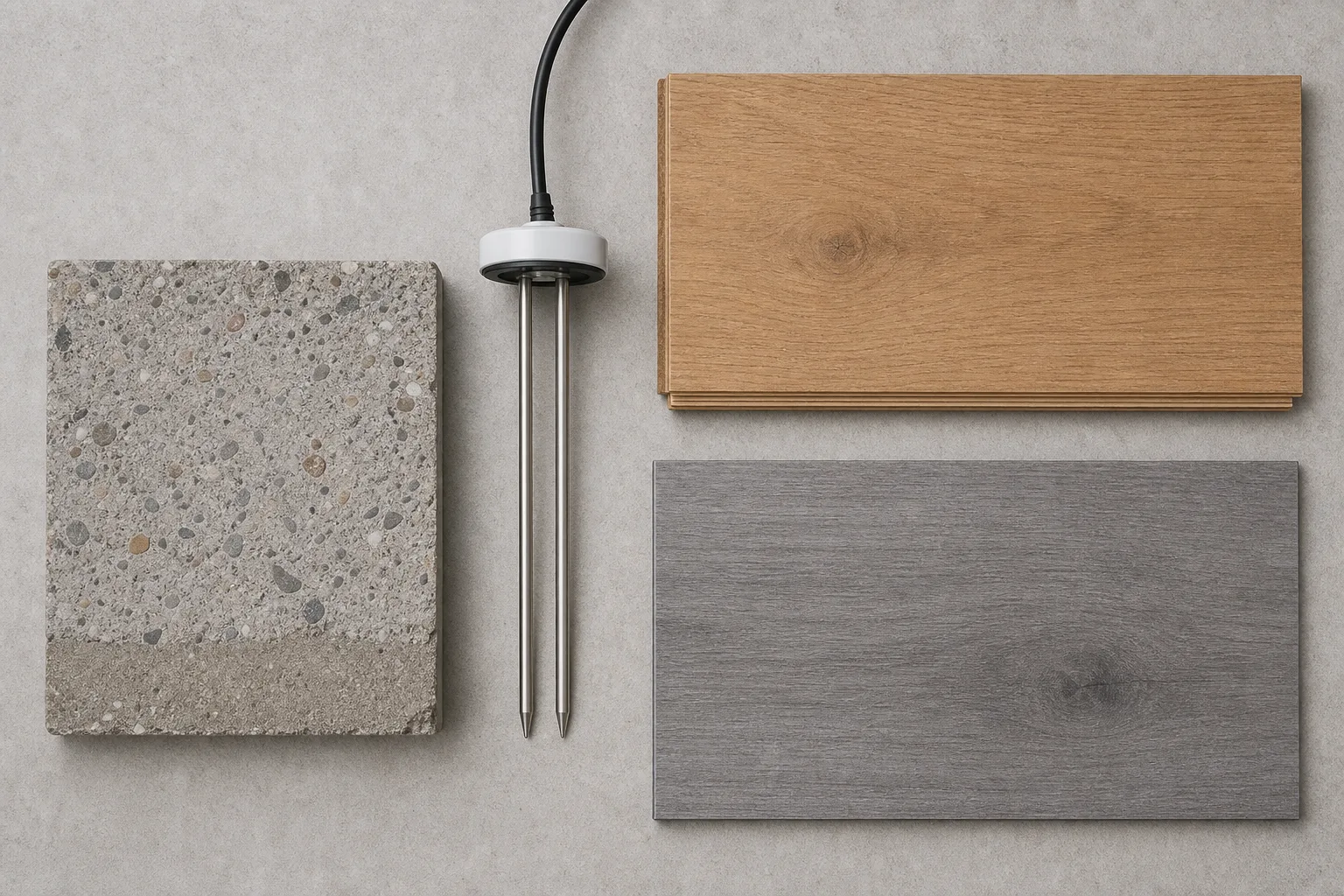
Concrete reads as the most inert material in a house, which is the assumption behind most of the flooring that fails over it. A slab on grade sits in permanent contact with soil, soil holds water, and water moves upward through the slab as vapor continuously for as long as the building stands, whether the surface feels dry to a hand or not. Understand that one mechanism and a great many flooring decisions over a slab stop being matters of taste and start being matters of arithmetic, because the moisture sets the boundary and everything else gets chosen inside it.
What Is Actually Happening Inside the Slab
Two separate sources of moisture matter and they behave quite differently. The first is residual water left from the original pour, since concrete gains strength through a chemical reaction that does not consume all of the mixing water and the excess leaves slowly through the surface. A new slab keeps doing that for months, at a rate depending on thickness, mix design, temperature and whether both faces are open to the air.
The second source never stops at all, and it is vapor driven up out of the ground. A slab with an intact vapor retarder beneath it drives far less of it. A slab poured before that was standard practice, or one where the sheeting was punctured by rebar chairs during construction, drives considerably more. Putting any covering on top changes the equilibrium that had been holding, because vapor that was leaving freely through the surface now collects underneath the covering instead, and anything sensitive to moisture is suddenly sitting in it rather than above it.
How the Moisture Gets Measured, and by Whom
Not by touch, and not by taping a square of plastic down overnight, which is a rough indicator and nothing more. Two standard methods exist and a flooring contractor should be using one of them by name. In-slab relative humidity probes involve drilling to a specified depth, inserting sleeves, and leaving the assembly to equilibrate before taking a reading, which measures the condition inside the slab rather than at its face and is the method most manufacturers now specify. Calcium chloride testing seals a measured dish of desiccant to the surface for a set period and weighs it before and after to produce a vapor emission rate, which is surface-focused, older, and still referenced in plenty of specifications.
Both carry published limits inside their own standards, and more to the point, the flooring manufacturer's warranty states which method it accepts and what result it requires before the product may be installed. That document rather than the contractor's confidence is the operative one, and a homeowner who has read it is holding the only number that will matter if the floor is ever argued about.
Solid Wood, and Why It Is Usually the Wrong Answer Here
Solid hardwood is a single piece of wood that moves across its width as its moisture content changes, and over a slab it meets two problems simultaneously. The fastening problem comes first, since solid wood is normally nailed to a wood subfloor, and over concrete that means building a plywood subfloor or a sleeper system beforehand, which raises the finished floor height, complicates every doorway, threshold and stair in the house, and adds real cost before a single board is opened.
The movement problem is the more serious one. Even installed correctly, solid wood over a slab sits above a continuous moisture source with dry indoor air above it, and that gradient produces cupping, where board edges rise above their centers and no amount of refinishing fixes the cause. It can be done well, with a full vapor barrier, a properly built subfloor assembly and acceptance of the height change, and in most houses where it is done the reason is that the rest of the floor is already solid wood and matching genuinely matters more than the alternative would save.
Engineered Wood and the Layer That Solves the Problem
Engineered flooring is a wood wear layer bonded to a core of plies laid at alternating grain directions, or in some products to a composite core. The cross-lamination is the entire point, because layers that would each expand in one direction restrain one another, so the finished assembly moves far less than a solid board of the same species would. That dimensional stability is what makes it the default answer over concrete, since it can be glued directly down with a moisture-control adhesive or floated over an underlayment carrying a vapor retarder, and neither route requires building a second floor first.
The specification worth checking before ordering is the thickness of the wear layer, because that alone decides whether the floor can ever be sanded and refinished. A thin veneer can be cleaned and recoated but not sanded, while a thick sawn wear layer will take a full refinish and sometimes more than one, which over twenty years is the difference between a floor that gets renewed and a floor that gets replaced.
Vinyl Plank, and What Waterproof Does Not Mean
Vinyl plank is not damaged by water, which leads to a reasonable and incorrect conclusion that slab moisture is therefore irrelevant to it. The plank itself survives. What can fail is everything around it, starting with the adhesive on a glue-down installation, which carries its own moisture limit and can release, producing movement and lifting along the edges. Then there is whatever gets trapped underneath, because a vapor-impermeable covering laid over a wet slab holds moisture at the interface, and that interface can grow mold while the plank above it stays perfectly intact, a distinction the Environmental Protection Agency's guidance on indoor moisture makes central, since controlling the water is the only durable remedy and cleaning the surface is not.
Click-together floating vinyl over a slab with a suitable underlayment tolerates more moisture than any other option discussed here, which is exactly why it has come to dominate basements. Tolerates is not the same word as ignores, though, and every manufacturer still publishes a limit that the installation is expected to respect.
The Sequence That Avoids the Failure
Test the slab using a standard method before selecting a product rather than after the boxes arrive. Read the chosen manufacturer's moisture limit and the method it requires, since that is the number the warranty actually depends on. Where the reading exceeds the limit, the honest options are a moisture mitigation coating applied to the slab, a different product entirely, or simply waiting where the slab is new. Then confirm in writing which adhesive and which underlayment the estimate includes, because substitutions at that line are where warranties quietly disappear. Slab floors that fail almost always failed at the first of those steps, and slab floors that last were chosen against a number that cost less to obtain than a single box of the flooring sitting on top of it.