The Gaps That Were Obvious in February Have Closed and the Floor Is Fine
Boards that feel tight and seams that have disappeared are a wood floor doing precisely what wood does in humid weather. Four other summer symptoms are not.
- Written by
- Ellen Marsh
- Published
- Filed under
- Property
- Length
- 879 words, about 4 minutes
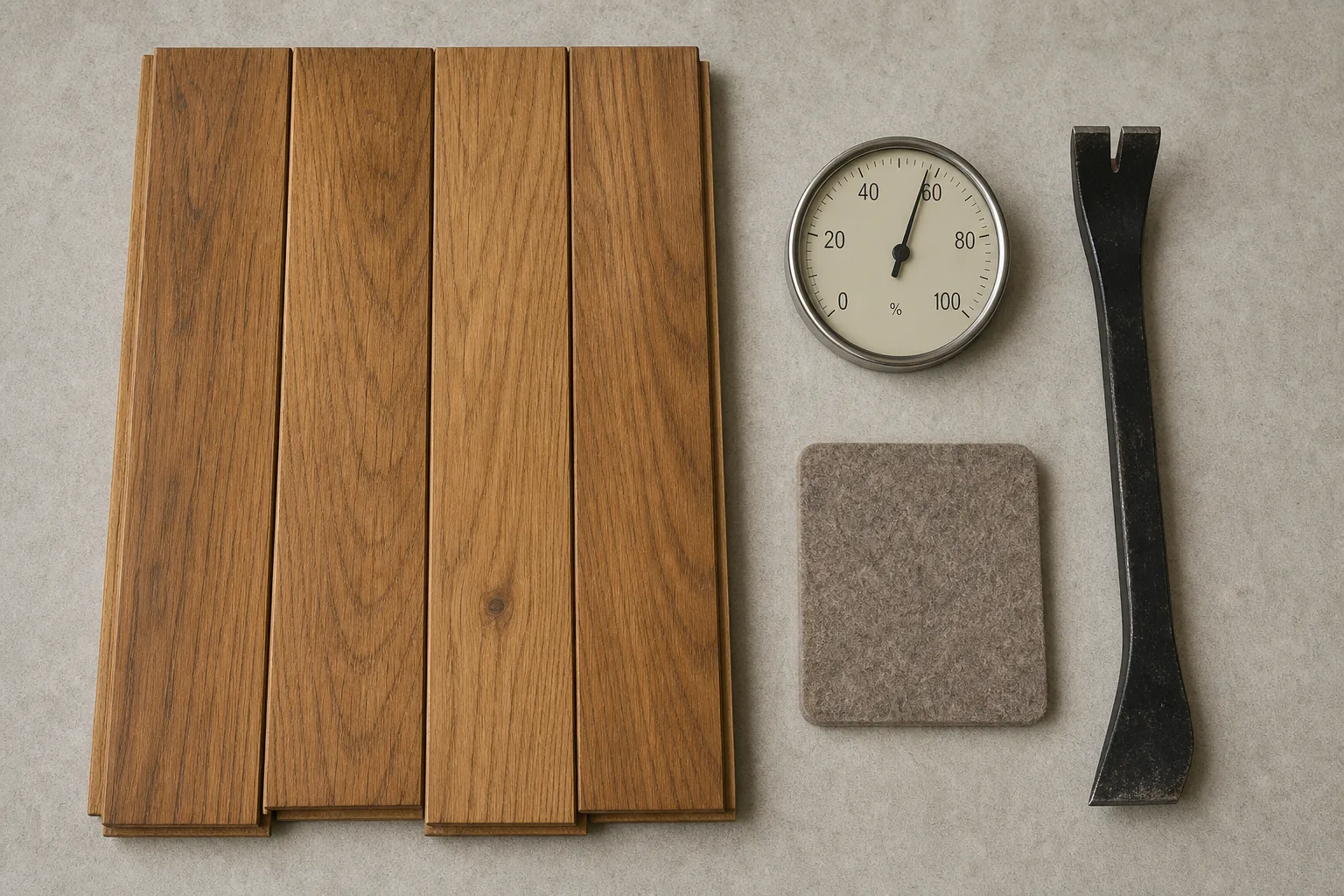
Look down at a wood floor in the middle of June and compare it against the memory of the same floor in February. The thin lines between boards that were obvious enough to catch dust have closed up completely, a few boards feel tight underfoot, and a threshold in one doorway has started to bind against the door above it. Every one of those observations describes a floor behaving exactly as designed. Wood is hygroscopic, meaning it takes up moisture from the air and gives it back again, and it changes dimension as it does so, mostly across the width of a board rather than along its length.
What Normal Seasonal Movement Looks Like
Indoor humidity across most of the country swings substantially between winter heating and summer weather, and a wood floor follows that swing rather than resisting it. Winter gaps that close in summer are the clearest expression of it, and the expansion space left at the walls during installation exists for precisely that reason. Slight height differences at board edges that appear and disappear with the season belong in the same category, as does a door that swung freely in January and rubs in August, which is more often the door than the floor. Even the sound changes, since a floor is quieter when the boards are tight against one another and squeakier when they have shrunk apart.
How much movement is normal depends on what was installed. Wider boards move more than narrow ones, solid moves more than engineered, and a floor laid at an unusual moisture content moves more than one that was properly acclimated to the house before installation. None of that is a defect and none of it is worth acting on, which is the useful thing to establish before spending money looking for a problem that is actually a calendar.
The Four Symptoms That Are Not the Season
Cupping is the first, where board edges sit visibly higher than their centers, and it means the underside of the floor is wetter than the top, which points at a crawlspace, a slab or a leak below rather than at humid air above. Buckling or tenting is the second, where a board lifts off the subfloor entirely, and it is expansion with nowhere to go, usually because the perimeter gap was omitted at installation or has since been blocked by trim, cabinets or something added later.
A localized problem is the third, because seasonal movement affects a whole floor evenly while a patch of cupping in front of a dishwasher, beneath a window or along one exterior wall is a leak with an address. The fourth is movement that does not reverse: a floor that gapped last winter, closed this summer and then gapped wider the following winter is losing ground rather than cycling, and the cause is almost always a persistent moisture source that nobody has found yet.
Why Summer Is When the Failures Announce Themselves
The mechanism is compression and it is easy to picture. A floor with adequate expansion space absorbs the summer growth into that space and nothing happens. A floor without that space has nowhere to put the growth, so boards press against one another, the pressure builds through the humid weeks, and eventually it has to go somewhere. It goes upward. Two things commonly remove space that was there originally: cabinets or a kitchen island set on top of the floor after the fact, which pins it in the middle, and baseboards or shoe molding nailed through the flooring rather than into the wall, which pins it at the edges.
What Actually Helps, Starting With the Air
Keeping indoor humidity inside a reasonable band year round is by a wide margin the most effective thing a household can do, and flooring manufacturers publish a target range in their care instructions that is worth finding rather than guessing at. In practice that means air conditioning or a dehumidifier through the summer and often a humidifier through the winter. Below the floor, a ground vapor barrier and a dry crawlspace remove the single most common source of cupping, and outside the house, gutters discharging at the foundation and grade sloping the wrong way put water exactly where it eventually becomes floor movement. One thing not to do: never sand a cupped floor while it is still cupped, because correcting the moisture and letting it flatten over weeks takes patience while sanding it flat produces a crowned floor the moment it dries.
The Summer Jobs Worth Doing
Refinishing suits summer in a house with air conditioning, since indoor conditions can be held steady through the cure, while a house without cooling faces humidity swings during that window and is usually better served waiting for fall. Two smaller tasks fit the season neatly: replacing the felt pads under furniture, which are the main defense against a year's accumulated scratches, and resetting any shoe molding that was nailed through the floor instead of into the baseboard. A floor that moves with the season and then comes back is a floor doing its job, and the ones worth acting on are the ones that move in a single direction only. June is simply the month they announce themselves clearly enough to be found.