Quoted a Flat Fee to Fight a Ticket? What That Number Is Actually Priced Against
A flat fee for traffic defense is priced against a defined scope of work, not an outcome, and the engagement letter is where that scope is either written down or left vague.
- Written by
- Nadine Buckley
- Published
- Filed under
- Legal
- Length
- 1,117 words, about 5 minutes
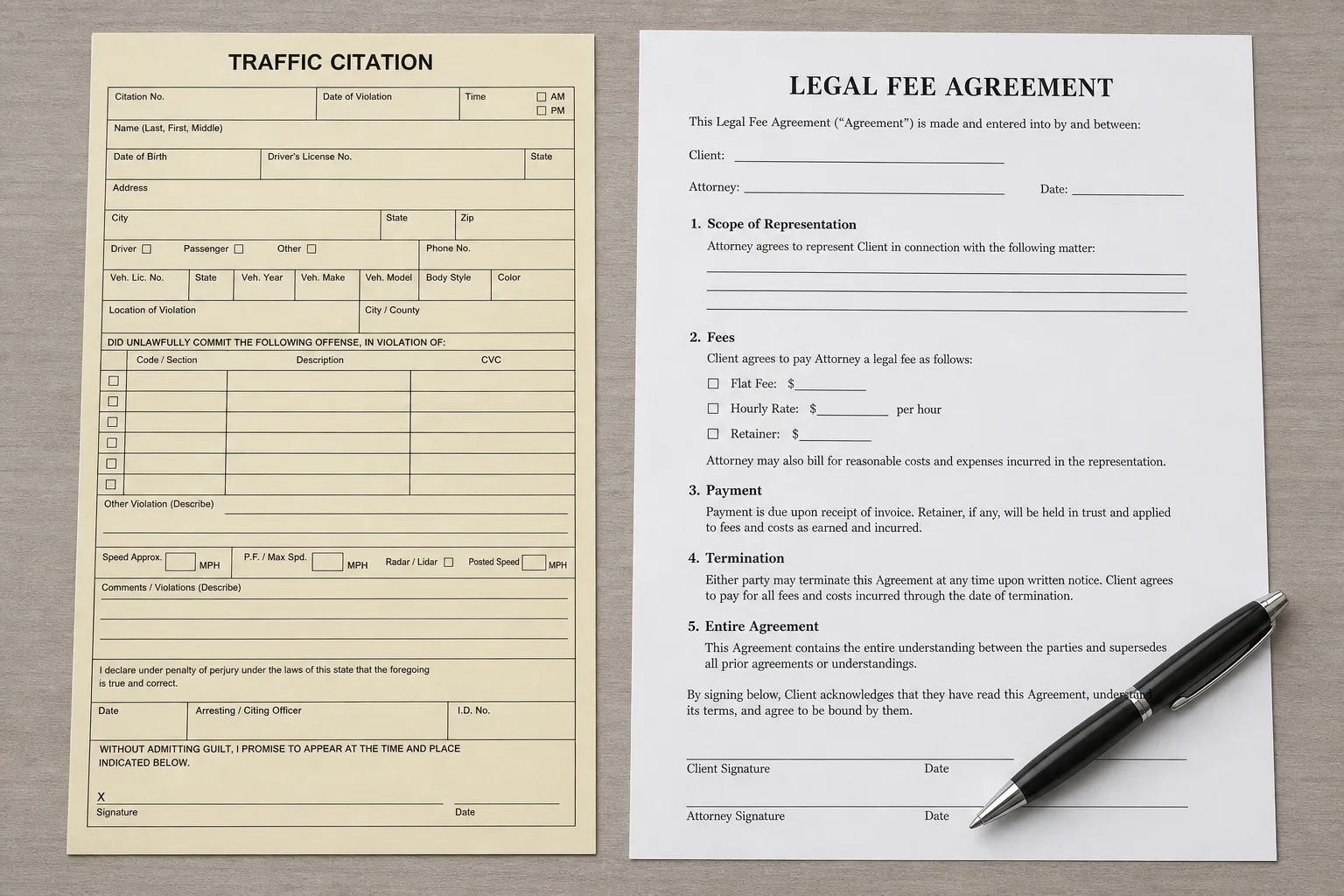
Two firms quote you for the same citation. One says $350. One says $750. Neither number tells you anything on its own, because a legal fee is not priced against a result. It is priced against a defined block of work, and the definition lives in the fee agreement, not in the phone call.
That distinction is where most disappointment starts. People believe they bought an outcome. What they bought was appearances, filings, and a certain number of hours of attention, with the boundary drawn somewhere they did not read closely.
The fee is quoted against scope, and the rules make outcome pricing off limits
Every state's professional conduct rules require that a fee be reasonable and, in most jurisdictions, that the basis of the fee be communicated to the client, usually in writing, early in the relationship. Those same rules prohibit contingency fees in criminal matters. Traffic violations that carry criminal exposure fall under that bar; even where an infraction is technically civil, most firms will not take a percentage of anything because there is nothing to take a percentage of.
So the pricing has to attach to something else. In practice that something is a list of steps:
- Reviewing the citation, the officer's notes, and any calibration or certification records the prosecution has to produce
- Filing an appearance and a written not-guilty response by the deadline on the ticket
- Requesting discovery and, where available, subpoenaing the officer
- Appearing at the first setting and negotiating with the prosecutor or city attorney
- Appearing at a contested hearing if the case gets that far
A $350 quote and a $750 quote often differ because the cheaper one stops at step four. That is a legitimate way to sell legal work. It is only a problem if nobody told you where the line was.
Where a flat fee usually ends
Ask any firm to name the events that trigger a second invoice. The honest answer is a short, predictable list, and it does not vary much across providers:
- Trial or contested hearing, if the base fee covered only pre-hearing work
- A second or third continuance caused by the court or the officer's schedule, where the agreement caps included appearances
- Depositions or subpoenaed witnesses, which are rare in traffic work but not unheard of when a commercial license or a serious speed allegation is involved
- Appeal, which is almost always a separate engagement with its own agreement
- Related matters: a license suspension hearing, a failure-to-appear warrant, an insurance surcharge dispute
The last one catches people. A ticket and a license action are two proceedings in front of two different bodies. One fee rarely covers both, and it should not be assumed to.
What changes when the provider is a larger firm
Volume changes the shape of the quote in ways worth understanding before you compare prices.
A firm that handles hundreds of citations a year across several courts has standardized its fee agreement. That is usually good for you. The scope language has been tested, the trigger events are enumerated because the firm got tired of arguing about them, and the trust accounting is set up properly: your advance sits in a client trust account and is earned as work is performed, which is what the rules require of any advance fee. A solo practitioner may run this just as cleanly, but a larger operation has more reason to have written it down.
Volume also changes who appears. At a multi-attorney firm, the person who quotes you may not be the person standing at the podium. That is normal and often efficient, since the attorney assigned may be the one who is in that particular courthouse every Tuesday. It is still worth asking, in writing, whether the fee assumes coverage by any attorney at the firm or by a named one. Both answers are fine. Only the unstated version is a problem.
The other difference is geographic. A statewide or metro-wide practice prices against courts it already knows, and a firm that regularly appears before a specific municipal court has a working sense of how that prosecutor handles deferrals, mitigation, and dismissals for defective paperwork. If you are comparing a local speeding ticket attorney against a firm three counties away, ask each how many appearances they made in your court last year. The answer tells you more about value than the fee does.
The costs that are never inside the fee
A fee is what the lawyer charges. Costs are what third parties charge, and they pass through to you at whatever they actually are. A clear agreement lists them and says who pays them and when:
- Court filing costs, where the court imposes them
- The fine or penalty itself if the case resolves against you, plus any statutory assessments
- Certified copies of driving records
- Interpreter fees, in the rare case the court does not provide one
- An expert on radar or lidar calibration, if the defense turns on the device
- Deferral or diversion program fees paid directly to the court
None of these are the firm's revenue and none of them should be quietly bundled. If a quote says "all-inclusive," get a sentence confirming whether the fine is included. Almost always it is not.
Reading the engagement letter for the three things that matter
Advertising claims about legal services fall under the Federal Trade Commission's remit on unfair and deceptive practices, and state bars separately police what a lawyer may promise in an ad. Neither one reads your engagement letter for you. Do these three checks yourself before you sign.
1. Find the scope paragraph and the exclusions paragraph
They are usually adjacent. If there is a scope clause and no exclusions clause, the scope is broader than the firm intends, and you will find that out later. Ask for the exclusions in writing.
2. Confirm what "flat fee" means if you withdraw
Flat fees are still subject to the reasonableness standard. If you plead out at the first setting or decide to just pay the ticket, most rules entitle you to a refund of the unearned portion. Look for a clause that says how that is calculated.
3. Check the deadline against the ticket
The response deadline printed on the citation is yours, not the firm's. Confirm in writing who is filing the response and by what date. That single email prevents the most expensive failure mode in traffic work.
A quote you can compare is a quote with a boundary drawn around it. Once you can see where one firm's work stops and another's continues, the price difference usually explains itself, and you are choosing between two known things rather than two numbers.