Selling Soon? What a Survey Actually Certifies, and What the Inspection Report Deliberately Leaves Out
A boundary survey, a home inspection and an appraisal answer three different questions. Knowing which one your buyer needs is what keeps a sale on schedule.
- Written by
- Nadine Buckley
- Published
- Filed under
- Property
- Length
- 1,341 words, about 6 minutes
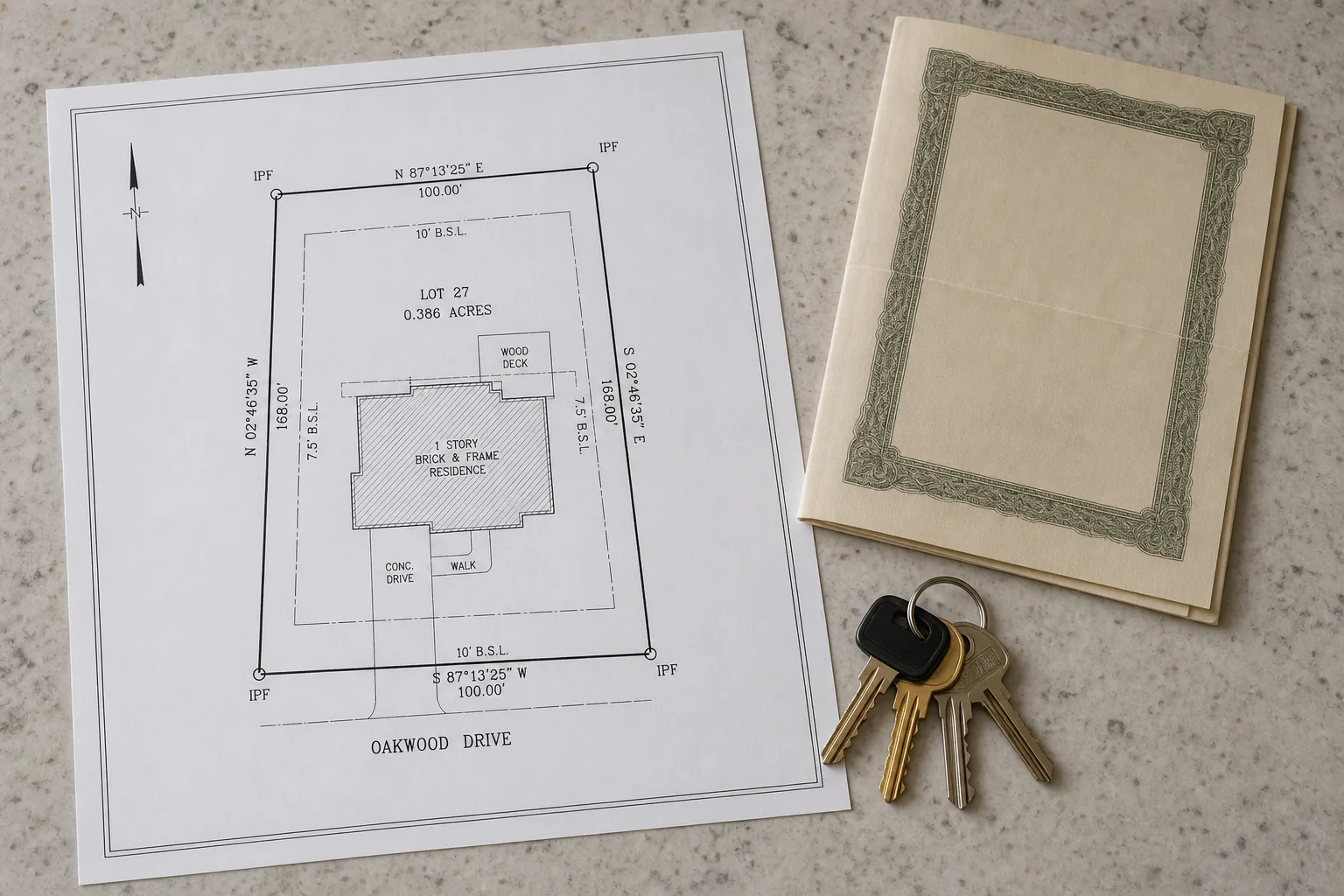
Three documents get called "the survey" in the course of one house sale, and they are not interchangeable. One shows where your land ends. One describes the condition of what sits on it. One states a number a lender will rely on. Sellers who treat them as a single errand tend to buy the wrong one first, then buy the right one later under time pressure, at a rush rate.
The useful skill is not memorizing which is which. It is learning to read what each document promises on its face, and what its own scope section quietly carves out.
Three documents, three questions
Start by separating them by the question each is engineered to answer.
- Boundary or land survey. Where are the property lines, easements, encroachments and recorded rights of way? Performed by a surveyor licensed by the state, signed and sealed, and tied to the legal description in your deed. It says nothing about the house.
- Home inspection. What is the observable condition of the systems and components, on the day of the visit, from the accessible areas? Usually performed to a written standards of practice document adopted by the inspector's state board or trade association. It says nothing about where your fence sits.
- Appraisal. What is the opinion of market value, supported by comparable sales, for the purpose of a specific lender's loan file? Performed by a state-licensed or certified appraiser. It is not a condition report, and the appraiser is not looking under the sink.
A fourth document shows up in some transactions: the survey affidavit, sometimes called a residential real property affidavit, in which a seller swears nothing has changed since the last survey so the title company can insure over the old one. That is a legal statement by you, not a measurement by anyone.
What each one excludes on purpose
Exclusions are the most honest part of any professional report, and the part most sellers skip. They are not fine print hedges. They are the boundary of the promise.
The boundary survey
A standard residential survey locates improvements relative to the record lines. It typically does not evaluate soil, does not determine ownership disputes (that is a title and legal question), and does not certify that a structure complies with zoning or with a subdivision's private restrictions unless that certification was ordered. If a neighbor's shed crosses the line, a survey shows the geometry. It does not resolve who now owns that strip.
The inspection
Standards of practice for home inspection are written around the word accessible. Inspectors are generally not required to move stored items, enter crawl spaces they judge unsafe, dismantle equipment, operate shutoff valves, or evaluate anything concealed behind finished surfaces. They are usually excluded from estimating remaining service life and from pricing repairs. The report tells you what was seen. Its silence about a component is not a clean bill of health for that component.
The appraisal
An appraisal for a mortgage is prepared for the lender, not for you, even though you may pay for it. Federal mortgage rules require that applicants receive copies of appraisals and other written valuations in most closed-end first-lien transactions, and the Consumer Financial Protection Bureau is the agency responsible for those disclosure requirements. Receiving the copy is not the same as the report being written to serve your interests.
The large-provider version of the same work
Regional and national providers now sell all three products, often bundled. A title company with an in-house survey desk. An inspection franchise with a hundred licensees under one brand. An appraisal management company standing between the lender and the appraiser. The comparison worth making is not big versus small. It is what standardization buys you and what it costs.
What a larger organization tends to deliver well:
- Turnaround certainty. Capacity to absorb a rush. If your closing is in eleven days, a firm with twelve field crews is a different proposition from a sole practitioner with a three-week backlog.
- Consistent deliverables. The same report template every time, which matters when an underwriter or a lender's review desk has to accept it without a phone call.
- Acceptance by counterparties. Title underwriters keep lists of surveyors whose work they will insure over. Being on that list is a practical asset.
- Errors and omissions coverage that survives. A firm with a claims department is still reachable in three years. That matters more than it sounds.
- Scheduling infrastructure. Confirmations, lockbox coordination, tenant notice. Boring, and the reason deals close.
What standardization tends to cost:
- Scope compression. The template covers what the template covers. Unusual conditions (an old dry-stacked retaining wall, a well, a shared driveway with a handshake agreement) get a sentence and a recommendation to consult a specialist.
- Distance from the individual. You are buying the brand's process. Ask who is actually walking the property and what their license number is.
- Bundling opacity. When one invoice covers survey, inspection and a courier fee, it is harder to see whether the survey was a full boundary survey or a mortgage inspection sketch, which is a much thinner product.
The judgment call: use a large provider when speed, format acceptance and coordination are what is at risk. Use a specialist when the property has a feature the template will not handle well.
Deciding which one you need as the seller
Most residential sellers do not need to commission an inspection. The buyer will order one, on their own schedule, and a seller-ordered report has a habit of becoming a disclosure item without buying much goodwill. The survey is the opposite. If your title company cannot insure over an existing survey, someone is paying for a new one, and the timing of that order is often what determines whether you close on the date in the contract.
Run these in order:
- Find the last survey. Check your closing packet from when you bought. If there is a sealed survey with a date, photograph it and send it to the title company early.
- List what changed. Pool, deck, fence, driveway extension, detached garage, storage building. Any of these can defeat an affidavit and force a new survey.
- Ask the title company one question. "Will you accept this survey with a T-47 style affidavit, or do you need a new one?" Get the answer in writing before you accept an offer with a tight close.
- Match the product to the buyer. A financed buyer brings a lender, an appraisal and probably a survey requirement. A cash buyer may waive all three.
- Price the delay, not just the fee. A survey costs what it costs. Two weeks of carrying costs and a rate lock expiring cost more.
When the buyer's own process replaces the paperwork
Companies that purchase directly change which documents matter. They generally carry no lender, so no appraisal is ordered. They inspect for their own account, which means the report is theirs and is not negotiated line by line with you. What they still need is clean title, and that is where the survey question survives even the fastest transaction.
Owners who want to sell my house fast in floresville tx are usually comparing a direct purchase against a listed sale, and the honest difference is not just price: it is how many third-party reports have to be produced, accepted and reconciled before funds move.
Two things to confirm with any direct buyer:
- Who pays for a new survey if the title company requires one, and is that stated in the contract or assumed?
- Is their condition walkthrough a basis for a later price reduction, and if so, what triggers it?
Both answers should be in writing. A buyer who answers plainly on those two points is generally a buyer who will close plainly.
The through line across all three documents is the same discipline: read the scope section before the findings section. A report is a promise with edges, and knowing where the edges are is what lets you order the right one, once, at the right moment in the deal.